Ebola: Best and worst case scenarios for Kenya
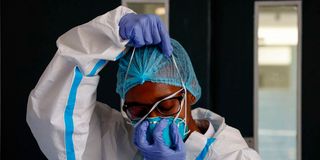
A nurse wears a protective mask at Nairobi Hospital where an Ebola patient was isolated immediately upon arrival and treated at the hospital's East Wing Isolation Facility, but later died, in Nairobi, on October 7, 2026.

What you need to know:
- Health authorities have identified more than 100 people who came into contact with Kenya’s first confirmed Ebola patient.
- The best-case scenario is straightforward: the infected man came into the country, died and did not transmit the virus to anyone else.
In the coming days and for up to three weeks, Kenya will wait to learn if one Ebola death of a patient who travelled from the Democratic Republic of Congo to Nairobi will end the story or be the beginning of something bigger.
Several things will determine which way the country is heading: whether quarantined contacts remain symptom-free and test negative, a new case emerges that cannot be linked to the first patient or a healthcare worker is infected.
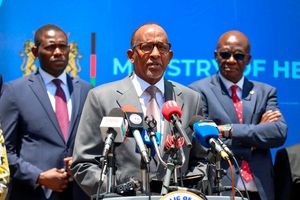
Health authorities have identified more than 100 people who came into contact with Kenya’s first confirmed Ebola patient, with 66 so far placed in quarantine. Health Cabinet Secretary Aden Duale insists the country is not facing an outbreak.
“I will emphasise that there is no Ebola outbreak in Kenya. What we have is an imported Ebola incident in Kenya,” he said.
Whether this remains an isolated incident will become clearer as contacts are monitored through the 21-day incubation window following their last possible exposure. Ebola’s incubation period ranges from two to 21 days.
The best-case scenario is straightforward: the infected man came into the country, died and did not transmit the virus to anyone else.
Independent consultant pathologist Dr Ahmed Kalebi says this is the outcome Kenya is hoping for.
“The person who was infected came into the country, the person died and he did not infect anybody in the country or there was no trace of virus left,” he said.
For Prof Shem Otoi, an infectious disease modelling expert at Daystar University, the key question is no longer whether the patient was in Kenya.
“The most important question now is not simply whether the patient was in Kenya. He was. The important question is whether the infection was transmitted to anyone else while he was here,” Prof Otoi said.
Dr Kalebi said the coming days would provide an early indication of whether the chain had been broken.
“By next week, if none of the primary contacts have any symptoms and the ones who have symptoms get tested and they are negative, then this will be best for the country and we will have to wait for 21 days to be sure,” he said.
Experts say there are reasons for hope at this stage.
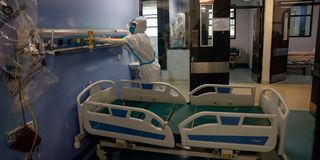
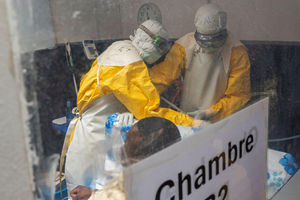
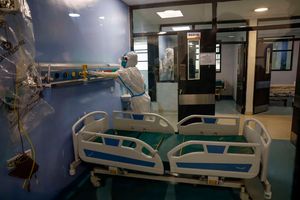
A nurse in protective gear in a ward at Nairobi Hospital where an Ebola patient from the Democratic Republic of Congo was isolated and treated shortly after arrival. The patient later died.
Dr Kalebi considers people who travelled with the patient to be at relatively low risk, with family members facing higher risk because of closer contact.
“Being in the same room with an Ebola patient, the chance of infection is below one per cent, not unless someone hugged him on the flight,” he said.
Prof Otoi said simply sharing an enclosed space does not mean a person will contract Ebola. The virus spreads mainly through direct contact with the blood or other body fluids of an infected person or contaminated materials.
What matters, he said, is what actually happened during the journey: whether the patient was already showing symptoms, whether he needed assistance, whether anyone came into contact with his body fluids and who had close physical contact with him.
Dr Kalebi said the highest-risk group would be people who had direct physical contact with the patient, including relatives who may have hugged him and healthcare workers who attended to him before he was moved to isolation.
He puts the risk among such contacts at between 12 and 30 per cent and says they are the people who must be quarantined.
He credited the Ministry of Health for moving quickly to quarantine the patient’s family.
According to Ministry data, 12 family members have been quarantined.
“Family members were quarantined within two days which could stop the spread if any of them were infected,” Dr Kalebi said.
But Prof Otoi warned against ending monitoring simply because people remain well.
“Ebola can take up to 21 days to show. A person can look completely well for days after being exposed. Contact monitoring cannot end simply because someone feels healthy today,” he said.
The second possibility lies between the best and worst outcomes, where a small number of people may have been infected before the patient was isolated.
Prof Otoi says that would not necessarily mean Kenya had lost control.
“These cases would not necessarily mean that the country had lost control of the situation. If they are found early, isolated promptly and their contacts traced, the chains can still be broken. This is why the next several days and weeks are so important,” he said.
The contact list is also likely to grow, with CS Duale warning that the tracing exercise is not over, noting that the aircraft involved made other flights and that cleaners, immigration officials and customs staff who came into contact with the patient would also have to be traced.
The most worrying scenario would be the emergence of cases that cannot be traced back to the first patient.
According to Prof Otoi, such a case would raise the possibility that a contact had been missed or that another chain of transmission was already under way.
“The greatest concern would be a different development of a case that cannot be linked to the known patient. That would suggest that a contact was missed, or that another chain of transmission already exists. This is why experts watch more than the number of cases. We look at the shape of the transmission network,” he said.
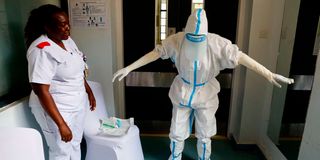
A nurse in protective gear at Nairobi Hospital where an Ebola patient from the Democratic Republic of Congo was isolated and treated shortly after arrival. The patient later died.
He said an uncontrolled outbreak could grow rapidly if several chains of transmission escaped detection.
Starting with one imported case, he said, there could be two or three secondary cases, followed by five to 10, then 10 to 20 and potentially 20 to 40 over successive generations.
“If several chains escaped detection, Kenya could reach hundreds of cases and a prolonged, uncontrolled outbreak could reach thousands. This is a contingency scenario, not a prediction,” Prof Otoi said.
Dr Kalebi described widespread community transmission as a “real nightmare”.
“We are not prepared for that; we don’t have the public and civic education,” he said.
The danger points are also known: hospitals can become sites of amplification if infection-prevention measures fail, while families caring for sick relatives before Ebola is suspected can become infected through ordinary acts of care. People who die from Ebola remain infectious, making safe and carefully managed burials critical.
“Protecting healthcare workers is not only about protecting them individually. It protects the entire health system from becoming a transmission network,” Prof Otoi said.
Prof Omu Anzala, a virologist and member of the National Task Force for Ebola, says Kenya’s focus should extend beyond the current case.
“We have now noted that Uganda is not a buffer. This case told us that we have no buffer,” he said.
His message is that Kenya must prepare for the next case now even as it works to ensure there is no next case, adding that border staff need to be in place and surveillance maintained at a high level.
“One case is bad enough,” he said, pointing to the 66 contacts already identified and the facilities required to monitor them.
“Once you start managing by crisis it becomes very expensive and that’s where we get to the worst-case scenarios. If Kenya can find every link, monitor every meaningful contact and break every emerging chain, an imported case can remain just that: an imported case,” he said.
Follow our WhatsApp channel for breaking news updates and more stories like this.