How skin-to-skin contact saved my son after four newborn deaths

Davis Omollo during the interview at Nation Center in Nairobi on July 2, 2026.

What you need to know:
- According to the World Health Organization, the global neonatal mortality rate as of 2024 was 17.2 per 1000 live births, with premature births, neonatal infections, and birth complications among the leading causes.
At their Nairobi home, David Omollo, 54, eagerly awaits September when his son, Emmanuel Odhiambo, 18, will join college to pursue Building and Construction. For Emmanuel, this marks an academic transition that will equip him with skills to build a future like his peers. But for his father, it represents something far deeper, a testimony to the power of Kangaroo Mother Care (KMC), a skin-to-skin contact practice between a parent and a preterm or low birth weight infant.
David's journey of testimony began on a December night in 2007, just hours before Christmas Day celebrations. His wife was in the labour ward, having been admitted for over a week with complications during her sixth pregnancy. That night, nurses informed him that his wife had developed false labour pains and that both mother and baby needed saving. They presented two options: a Caesarean Section or normal delivery.
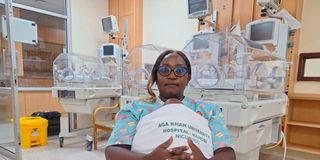
Joyce Wanjohi, a supervisor at Aga Khan University Hospital’s Neonatal ICU demonstrating how Kangaroo Mother Care is done.
"This is not her first delivery," David whispered reassuringly to the nurses. "My wife can push through normal delivery."
Moments later, as David anxiously awaited news, he recalls how his baby's birth coincided with Christians' annual celebration of Jesus Christ's birth.
"When I heard the sound of a newborn baby crying, I went straight into the labour ward. Even the placenta was still intact. He was a bouncing baby boy. I told my wife that God is with us, and that is how we named our son, Emmanuel," recalls an elated David.
But while the couple celebrated their new arrival, a challenge quickly emerged. "My wife had a normal delivery but preterm at seven months. The hospital matron said the baby should be placed in an incubator, but I refused. I was ready to care for my baby at all costs, but outside the hospital. I also wanted to take my son to his older sister at home," he tells Healthy Nation.
The hospital administration agreed and advised the couple to practise Kangaroo Mother Care.
"I was shown how to do it. I took leave from work and was always with the baby against my chest while my wife healed. At night we would alternate. I was a very happy dad."
David took two weeks' leave from work to support his wife. As a couple, they practised KMC for six consecutive months, by which time they had weaned Emmanuel and saw he was a very active baby. "At five months, we started introducing him to other foods besides milk. The good thing is that our baby was good at feeding. He was also sleeping very well," he says.
According to Joyce Wanjohi, supervisor at the Neonatal Intensive Care Unit at Aga Khan University Hospital, when practising KMC, one needs a comfortable seat or bed where they can sit as much as possible, leaving only for washroom breaks or when tired. The baby is unwrapped, remaining only in a diaper, hat, and socks if necessary, then placed vertically between the breasts and covered with warm clothing.
"Kangaroo Mother Care is recommended immediately after birth following initial resuscitation. The baby should be placed on the mother's bare chest. It should be 20-24 hours continuously, but sometimes due to various reasons, some mothers cannot achieve that. So, anything above 60-90 minutes per day is still beneficial.”
What is the magic behind this technique?
"We have what we call transferring of protective microbiota from the mother. Anything not harmful from the mother's skin is transferred to the baby and acts as a protective agent. Most babies who are Kangarooed don't suffer from severe infections compared to those who haven't been," Joyce explains.
The technique offers numerous neurodevelopmental and physiological stability benefits to the baby. "It stabilises the baby's wellbeing. The heart rate stabilises, blood pressure stabilises, oxygen saturation stabilises, giving the baby a better opportunity to thrive. Sometimes it works magic when you have a baby who is actually relatable; the heart rates are high, the baby has been crying, then when you put it onto the mother's chest, you observe those heart rates calming down. When the heart calms to normal for that age, it helps the baby thrive," she explains.
Joyce also notes that the technique promotes better long-term cognitive development and reduced stress levels.
"There is improved growth in terms of weight, height, and head circumference, which is actually the most important thing for preterm and low birth weight babies. There is also better immunity. We know it lowers severe infection," says Joyce.
The technique also benefits mothers by boosting breastfeeding. "Once the baby is put on the breast, it works magic because there is production of oxytocin which helps the letdown of milk. Most of the time, when the mother is holding the baby, the milk just pours because there is also a connection between mother and baby," says the nurse.
Although KMC is primarily done by mothers, Joyce says fathers can also participate as it promotes the psychological wellbeing of parents.
"Holding your baby is very beneficial. You feel that the baby is not as sick. There is also strong attachment, and the parent feels confidence because they are part of the team caring for the baby. They can notice certain changes and report them to healthcare workers," observes Joyce.
Kangaroo Mother Care is primarily practiced in hospital settings as mothers are considered to have no other responsibilities than caring for their babies. However, Joyce says that for underweight infants discharged, especially in public hospitals at a weight of 1.8 kilogrammes, mothers are still encouraged to continue KMC as much as possible at home.
"In various levels of government hospitals, they have a Kangaroo Mother Care room where mothers stay, eat, and their babies are there 24 hours. It is also encouraged that the other partner comes and holds the baby. It is not necessarily the mother because even fathers can do Kangaroo Mother Care," she says.
The technique is widely practised in Kenya, mostly in government hospitals.
"In private institutions, it is practised intermittently. A mother will come and Kangaroo around 9-10am when all rounds are done, continue until lunchtime, and come back in the evening to hold the baby. That brings in approximately eight hours per day where possible, but it is very dependent on the baby's and mother's conditions," she says.
According to UNICEF, this technique was developed in Colombia to help premature babies survive when incubators are unavailable or in short supply. The skin-to-skin contact with either mother or father helps normalise the baby's temperature, preventing some leading causes of death in premature infants such as hypothermia, infections, sepsis, and breathing problems.
"Many research points out that KMC is better than a baby being put in an incubator where possible. Although it was first introduced as a strategy to curb incubator scarcity, it has proved to be very important and beneficial to the baby," Joyce says.
Additionally, Joyce says KMC is a highly evident and high-impact intervention recommended globally.
"If you look at the cost implication, an incubator is quite expensive compared to the presence of the parent, which costs nothing. At the end of the day, especially in low-resource areas, Kangaroo Mother Care is very good and very important," says Joyce.
According to the World Health Organization, the global neonatal mortality rate as of 2024 was 17.2 per 1000 live births, with premature births, neonatal infections, and birth complications among the leading causes.
"The neonatal mortality rate in Kenya stands at 21 deaths per 1000 births, and mostly these deaths occur within 0-28 days, the neonatal period. It is very important for us to embrace Kangaroo Mother Care because it has shown a lot of benefits," Joyce tells Healthy Nation.
A 2016 study reviewing 3,042 infants across medical databases to determine whether KMC reduces morbidity and mortality in low birthweight infants concluded that the technique is "an effective and safe alternative to conventional neonatal care for low birthweight infants, mainly in resource-limited countries."
For David, KMC marked an end to a dark period the couple had lived through for almost seven years. He vividly recalls what led to complications that caused his wife to deliver their preterm son.
"At around four months during the third pregnancy, doctors told me my wife had developed a fibroid-like growth inside her fallopian tube which was interfering with the baby's growth. But we took it as a simple thing because it was linked with traditional beliefs. In my culture, people call fibroid 'segete' or 'rariwo.' Some people told me there was nothing like fibroid and that it was a normal disease for women," David recalls.
Such unscientific comments, David says, delayed their uptake of conventional fibroid treatments.
"Doctors advised surgery, but we had a lot of problems from my in-laws. They believed that fibroids couldn't cause someone to undergo surgery. So we tried other avenues like using herbal medicines."
That pregnancy, David says, became another statistic. After the joy of holding a bouncing baby girl, the baby only survived a few hours before the couple found themselves mourning again.
"My wife delivered in the morning, and at 4pm the same day, while still at the hospital, I was told we had lost our baby. We were again expecting our 5th baby, and sadly, the baby was born and a few hours later developed breathing problems. My wife called the nurses who then said the baby had aspirated amniotic fluid. She died right in the maternity bed. We lost my fourth child in a row within a period of seven years. It was my dark moment," he says.
Beyond delaying conventional treatment after diagnosis, David, who had their firstborn daughter without complications during their second year of marriage, says it wasn't easy at first to recognise that his wife had a condition that led to their newborns' deaths in subsequent years.
"During the first three pregnancies, the knowledge that a pregnant woman should attend antenatal clinic was not a priority to us. Sometimes my wife would go to local government dispensaries where birth attendants would only check the developing baby by touching without doing ultrasound, then we would go to Kenyatta National Hospital when my wife was in labour pain to deliver there," David recalls.
By the time their son Emmanuel was born, David's wife was pursuing both traditional and conventional treatments for fibroids. Her condition continued to worsen, and just when Emmanuel turned nine months old, his mother died from fibroid complications at Kenyatta National Hospital.
"The ancient proverb, 'time and tide wait for no man,' hit me very hard when my wife died. I was left with a nine-month-old baby. Imagine losing my four children and then my wife," David recalls, struggling to hold back tears.
"The death of my four children gave me so much pain. I only buried one of them who died in the house, while the other three, I filled disposal forms confirming that I agreed my children died in the wards and gave the hospital authority to dispose of their bodies," he adds.
David, whose mother had passed on earlier, found strength in his mother-in-law, who came to his aid and cared for baby Emmanuel.
"She was taking care of the baby while I worked to support them financially. I used to be in a very embarrassing situation because now I was always alone inside the house after work. My Emmanuel started crawling, walking, and talking without me knowing. He knew his grandfather was his dad, and at some point, he refused to accept that I am the
dad."
That dark period ended, and David now lives in Nairobi with his firstborn daughter Ann, his son Emmanuel, and his new wife.
"Kangaroo saved my Emmanuel. Despite being preterm, he is a very strong boy who likes masculine jobs. Sometimes I say to myself that had we taken my wife for early ultrasound checkups during pregnancy, we would not have lost our other babies," says the father of four.
Understanding fibroids
Signs and symptoms of fibroids include abdominal bleeding, heavy and painful periods, and abdominal swelling, among others. However, fibroids may also grow without showing any symptoms, which is why gynaecologists emphasise the importance of annual check-ups for all women.
"If somebody has fibroids and gets pregnant, the fibroids can increase in size and cause more pain during pregnancy," says Dr Ong'ech Odero, chief medical specialist in Obstetrics and Gynaecology at Nairobi Reproductive Health Services.
Depending on the location of the fibroid, Dr Ong'ech explains that it can cause miscarriage or preterm delivery. In some instances, the baby may develop deformities due to lack of space inside the uterus. Other complications include severe postpartum haemorrhage immediately after delivery.
"Fibroids can also result in what we call the risk of developing pulmonary embolism. Even outside pregnancy, one of the biggest risks of fibroids is the formation of blood clots that can travel to the lungs, which can be life-threatening," he warns.