Kenya joins 24 nations in landmark pledge to protect wildlife from climate change shocks
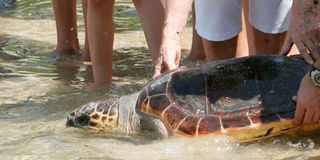
A loggerhead sea turtle is set free on the Mediterranean island of Cabrera August 7, 2008. A turtle was among the most photographed figures at COP31 in Antalya, Türkiye.

What you need to know:
- Kenya has joined 24 other countries in a landmark COP31 declaration recognising wildlife protection as an essential part of climate action and ecosystem resilience.
- Scientists are warning that climate solutions risk falling short unless governments recognise the role wild animals play in carbon storage, ecosystem regeneration and biodiversity conservation.
IN ANTALYA, TURKIYE
A turtle was among the most photographed figures at COP31 in Antalya, Türkiye. Delegates stopped for pictures with the giant loggerhead sea turtle, while children made a beeline for it whenever it appeared.
It was an unusual choice of mascot for a global climate summit. The host country, Turkiye, said it is a symbol of the growing threats facing wildlife in different parts of the world. On the Mediterranean coast, the loggerhead sea turtles are facing many challenges from rising nesting-site temperatures, plastic pollution, and boat traffic to capture by the fishing nets.
“A lot is happening in the sea. Sea turtles have more tumours than before and their reproduction is decreasing year by year,” Teresa Jangir, a scientist and project manager at the Lamu Marine Conservation Trust, tells Healthy Nation.
But beyond the declining numbers, conservationists are concerned about another possible consequence of rising temperatures. There are fears that climate change is upsetting the balance between males and females needed for future reproduction.
“Warmer nest temperatures tend to produce more female hatchlings, while excessively high temperatures can also affect the survival of embryos, but we do not have sufficient data here to establish the extent of the problem,” she offers.
“Monitoring these changes requires significant resources. However, studies have been conducted elsewhere, and we know that this is happening. We are concerned that the same could be happening along our coast.”
Also read: Take urgent action for nature
In a controlled environment, she explains, scientists can put eggs in an incubator, control its temperature for hatching, then cut to see if their gonads are female or male. The threats, however, extend beyond sea turtles. On land, climate change is also putting pressure on wildlife, sometimes bringing animals into closer contact with human communities as they compete for increasingly scarce food, water and grazing land.
Dry conditions experienced in some parts of the country can leave wildlife with little vegetation to feed on and fewer water sources to rely on. Elephants may venture into farms in search of food and water, destroying crops in the process, while predators such as lions may prey on livestock when their natural food sources become harder to find.
The consequences can be deadly for both people and animals. In January 2026, preliminary investigations indicated that six lions had been poisoned after preying on bulls in a village neighbouring the Amboseli ecosystem. More than 30 vultures also died after feeding on the poisoned carcasses.
The growing recognition of wildlife's role in climate action is beginning to find its way into international climate policy.
At COP 31, experts say that protecting animals and their habitats must be interconnected to climate adaptation. It is also a message that Turkiye is also passing to the delegates. In one of the presentations, its official said, “ Forests, wetlands, grasslands and marine ecosystems support biodiversity while helping regulate water, store carbon and reduce climate-related risks. Their degradation can weaken these natural defenses leaving both wildlife and human communities more exposed.”
In June 2026, scientists launched the Scientific Consensus on Wildlife and Climate during the UN climate talks in Bonn, Germany. The statement brought together research showing how wild animals contribute to the functioning of ecosystems, including carbon storage, nutrient cycling, seed dispersal and ecosystem regeneration. It called on governments to recognise these roles when developing climate policies.
The scientific call has since attracted the support of more than 350 scientists from 47 countries, strengthening calls for wildlife conservation to be considered alongside other nature-based climate solutions. They argue that climate solutions centred on nature risk overlooking a critical piece of the puzzle if they fail to account for the role wild animals play in keeping ecosystems functioning
That scientific backing has now been followed by a political commitment. On November 16, 25 countries launched the Wildlife for Climate Declaration at COP31 in Antalya, Türkiye, under the leadership of Zimbabwe. The declaration seeks to put wildlife more firmly into national climate and biodiversity plans, while encouraging countries to protect animal populations and their habitats, invest in research and mobilise financing for conservation.
It also recognises the need to address human-wildlife conflict and promote coexistence, particularly for communities living alongside wildlife. Kenya is among the countries that signed the declaration. It is the first time that governments have come together at a UN climate conference, to include protection of wild animals as part of climate action.
“This Declaration is the beginning of a shared commitment to see climate action more clearly. To understand that healthy wildlife and healthy ecosystems belong together, and that both are essential to a resilient future,” Evelyn Ndlovu, the Minister of the Environment, Climate and Wildlife, Government of Zimbabwe said on the sidelines of COP31 on the significance of this Declaration.
“When we lose wildlife, it is not only a loss of species. It is a loss of the living processes that keep natural systems working as they should. That is why protecting and restoring wildlife is climate action. It must be recognised and prioritised as such.”