Kenyan students win US-Kenya AI challenge with maternal health platform
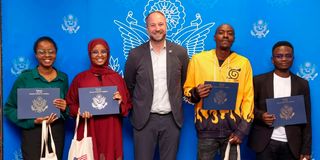
Medibora team members (from left) Jael Wainaina, Fardosa Mohammed, Cedric Mwanebetu and Washington Odiado with Mark Burrel (centre), Regional Public Engagement Specialist at the US Embassy in Nairobi.

What you need to know:
- The winners were selected by judges from among 70 other students and young professionals.
- The judges evaluated projects on feasibility, economic relevance, and market readiness.
In September last year, five students from different universities met at an event organised by the Embassy of the United States in Nairobi.
They were total strangers, but each was inspired to become one of Kenya's next big innovators, in keeping with the event's title: Stars of Innovation.
The students had big ideas, but when they came together, they realised they shared a common goal: finding a solution to maternal health emergencies in the country.
Read: From teen mum to crusader of hope: The woman returning thousands of vulnerable youth to school
After four months of developing their prototype, they created Medibora, an AI-powered platform that enables continuous monitoring, early risk alerts, and real-time communication between expectant mothers and healthcare providers.
On Thursday, the quintet was announced as winners of the Stars of Innovation: US-Kenya AI Challenge, selected by judges from among 70 other students and young professionals.
Their passion for maternal health stems from personal experiences with loved ones.
Nation spoke to Fardosa Mohamed, a business analyst and student at Strathmore University, who said her interest in maternal health was sparked by her sister's experience.
"During my sister's first pregnancy, she had no way to predict or monitor pregnancy-related complications, even though she had regular gynaecological visits. At the last minute, as she was going about her usual day with no labour pains or contractions, a routine visit to a clinic turned into an emergency caesarean section," she told Nation.
"It was not predicted through scans, and she had seemed fine. At the time, I wondered whether there was a way to detect such issues before complications arose," she added.
Prototype wearable device
In Kenya, data from the United Nations Population Fund shows that approximately 355 women die from preventable pregnancy-related causes per 100,000 live births annually.
This is why the students developed a platform that works across mobile applications, SMS, USSD, and voice channels, making it accessible even in low-connectivity and low-literacy settings.
The team is also developing a wearable device—akin to a wristband—that women can use to alert clinicians in emergencies.
Winning required the students to go beyond theoretical ideas and show how their solutions could be realistically implemented, sustained, and scaled. Judges evaluated projects on feasibility, economic relevance, and market readiness.
Jael Wainaina, a data science student at Jomo Kenyatta University of Agriculture and Technology (JKUAT), explained that the prototype wearable device monitors a woman's vital signs and transmits the data to a dashboard, enabling clinicians to respond quickly in emergencies.
The device also uses GPS tracking, enabling emergency response teams to locate mothers quickly.
"Other features on the application include a multilingual voice agent in English or Swahili, allowing mothers to ask questions about pregnancy and get the help they need," she said.
The application also features a chatbot that offers guidance on non-emergency pregnancy-related queries, such as nutrition.
Jael emphasised the importance of data in creating solutions that address real problems.
"It's not something far-fetched. We need to know the numbers—how many mothers are dying from preventable conditions. With that information, we can create solutions that can be used by everyday people," she said.
Fardosa explained that her role as business analyst is to ensure the end product is economically viable and that vulnerable women can access it and receive assistance in good time.
"We are trying to make it locally available at a low cost, and the mobile application is free," she said.
With their product still in the initial phases, they plan to partner with hospitals that will onboard doctors to handle emergency cases and help prevent maternal deaths.
Although there is no monetary reward yet, the team says the win has given them the encouragement they need to scale up the idea and bring it to life.
"We are working on protecting our idea and building a real prototype—a device we can actually take to market," said Jael. "We hope to go global," she added.