Nairobi tops list of counties starving Kemsa of cash
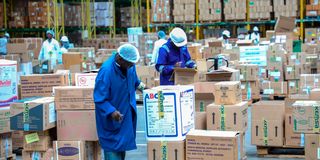
Employees at the Kenya Medical Supplies Authority (Kemsa) Embakasi Depot in Nairobi on May 18, 2023.

What you need to know:
- For the last five years, Kemsa has never managed to fill even half the orders placed by public hospitals.
- Behind that number is a Sh7.6 billion debt that counties and the Ministry of Health owe Kemsa.
For every ten medicines a hospital orders from the Kenya Medical Supplies Authority (Kemsa), the agency can only supply fewer than five, according to data from the recently released Economic Survey 2026.
The shortage is not for lack of orders from hospitals. It is missing because Kemsa, the national warehouse responsible for stocking every public health facility in the country, can fill fewer than half the orders placed by the hospitals that serve you.
For the last five years, as documented in the survey, the authority has never managed to fill even half the orders placed by public hospitals. Behind that number is a Sh7.6 billion debt that counties and the Ministry of Health owe Kemsa and have not paid, year after year.
And at the end of the chain is the patient, who walks away empty-handed, told only that the medicine is out of stock.
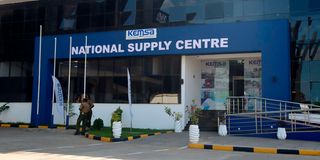
Kenya Medical Supplies Authority (Kemsa) offices in Embakasi Nairobi on December 10, 2024.
In 2020/21, the order fill rate sat at 54 per cent. In 2024/25, it fell to 49.2 per cent. In between, it barely moved: it dipped, recovered slightly, dipped again, and finally slipped below the halfway mark for the first time. In the five years of tracking, it has never come close to the 90 per cent order fill rate that the agency says it needs to function.
For medicines supplied under donor and programme funding, such as family planning commodities, oncology drugs and HIV supplies supported by partners like UNFPA and the Max Foundation, the picture is different. In 2020/21, the rate sat at 94 per cent. It has declined since then, dropping to 79 per cent in 2024/25, but it remains relatively high because donor-funded supply chains operate outside Kemsa's liquidity constraints.
The Ministry of Health signed agreements with Kemsa to handle these donated supplies and pay the associated fees. In some cases, the authority has not been paid for ten years.
Its inability to stock more drugs is tied to the Sh7.6 billion debt that counties and the Ministry of Health owe and have not paid.
County governments carry the largest share at Sh3.66 billion. Eleven counties owe more than Sh100 million each. Nairobi leads at Sh254 million, followed by Kilifi at Sh234 million, Turkana at Sh229 million and Tharaka Nithi at Sh186 million. Marsabit owes Sh138 million, Wajir Sh131 million, Kakamega Sh124 million, Homa Bay Sh122 million, Meru Sh108 million, Bomet Sh103 million and Samburu Sh101 million. Only two counties, Kajiado and West Pokot, owe nothing.
The Ministry of Health's debt is Sh1.9 billion, and it carries a particular character. Of this, Sh1.5 billion represents outstanding arrears, while Sh452 million covers products that have already been delivered and distributed under ministry programmes but never paid for.
"These are not products sitting in a warehouse. They have already reached patients. Kemsa simply has not been paid for them," chief executive officer Dr Waqo Ejersa said when he appeared before the National Assembly's Health Committee last month to present the agency's supplementary budget estimates.
"Without the payment, patients will keep arriving at clinics across the country only to be told that the medicine they need is not there, yet they blame Kemsa for this. Behind every empty shelf is a debt that someone decided not to pay. And behind every unpaid debt is a patient who goes home without treatment," he added.
The situation with development partner fees is worse in terms of duration. When UNFPA donates family planning supplies or the Max Foundation provides oncology drugs, Kemsa handles the warehousing and distribution, and the ministry signs an agreement to reimburse those costs. In some cases, that reimbursement has not come for a decade.
"We have been warehousing family planning commodities supported by UNFPA and oncology products supported by the Max Foundation. We have incurred distribution and handling costs for over ten years without reimbursement, forcing the authority to utilise its appropriations-in-aid, further eroding liquidity and weakening its capacity to maintain adequate stock reserves," Kemsa's report to the committee stated.
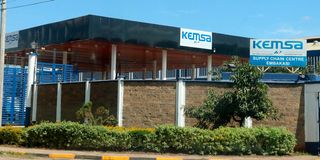
Kenya Medical Supplies Authority (Kemsa) offices in Embakasi Nairobi on December 10, 2024.
The World Bank's Covid-19 warehouse fees alone have gone unpaid for six years, amounting to Sh17.6 million. UNFPA's family planning warehousing bill stands at Sh654 million, while the Max Foundation's oncology products account for Sh403 million.
Before the Health Committee, Dr Ejersa tabled a request for Sh3.7 billion in supplementary budget funding for 2025/26. The committee approved Sh135 million, leaving a funding gap of Sh3.1 billion.
Of the debt owed to Kemsa, more than Sh5.6 billion has been outstanding for over 90 days, tipping the agency into a liquidity crisis tipping the agency into a liquidity crisis, with a direct operational consequence: Kemsa cannot meet its Sh2.5 billion supplier commitments, so it cannot restock, the order fill rate stays below 50 per cent, and hospitals stay short.
"This persistent gap compels Kemsa to divert internally generated revenues from key operational priorities such as restocking and logistics to meet payroll obligations," Dr Ejersa said.
An agency that cannot fill orders cannot keep shelves stocked. And when it is forced to choose between paying staff and buying medicine, it has already lost the ability to do its core job.
The debt crisis has a compounding dimension that the numbers alone do not capture. Counties that owe Kemsa money are not simply slow to pay; many have quietly moved their procurement elsewhere. Health devolution gave counties the authority to procure medicines through their own systems, and in recent years, a growing number have done exactly that, bypassing Kemsa entirely in favour of direct tenders with private suppliers.
In 2020, at the height of the Covid-19 pandemic, the agency became the centre of a multi-billion-shilling procurement scandal. Investigations revealed that Sh7.8 billion worth of emergency supplies had been procured under questionable circumstances. Personal protective equipment was purchased at massively inflated prices, and suppliers with no prior experience in medical supplies were awarded large contracts. Senior officials were suspended, and investigations were launched.
Reforms followed. Procurement processes were tightened, and new leadership was brought in. The agency has spent the years since trying to rebuild both its systems and its credibility.
The authority has been trying to recover from a procurement scandal while simultaneously being owed Sh7.6 billion by the very institutions it serves, an agency being asked to run with both feet tied.
Dr Ejersa asked the committee to compel the debtors to pay and to approve the budget he had tabled. It was approved by less than four percent.
Follow our WhatsApp channel for breaking news updates and more stories like this.