Patients held hostage as KNH's new digital system collapses
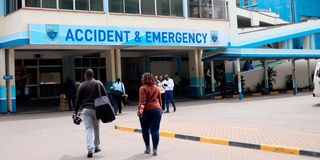
The Kenyatta National Hospital in Nairobi, where 15 teachers received treatment under SHA.

What you need to know:
- On April 15, Kenyatta National Hospital announced the official launch of its Hospital Management Information System.
- The new system is reportedly offline more often than it is functional, effectively halting services across the hospital.
A botched transition to a new digital management system at Kenyatta National Hospital (KNH) has thrown Kenya's largest referral facility into an operational crisis, leaving patients stranded, medical staff demoralised, and critical services paralysed.
On April 15, the hospital announced the official launch of its Hospital Management Information System (HMIS), declaring it would usher in "a new era where patient care is anchored on seamless, end-to-end digital processes." In its announcement, the hospital said patients would now "be digitally registered, tracked, and managed throughout their care journey, from admission and diagnosis to treatment and discharge, significantly reducing reliance on paper-based records."
It promised that "clinicians can now access patient information in real time, improving decision-making and reducing delays, while patients benefit from shorter waiting times and more coordinated care. The system also enhances accountability and data integrity, offering a clearer, more transparent view of service delivery across departments."
What has unfolded instead is a high-stakes bottleneck. The new system is reportedly offline more often than it is functional, effectively halting services across the hospital, from admissions and laboratory processing to pharmacy requests and discharge clearances. The situation is compounded by insufficient training, with frontline health workers struggling to navigate the new interface even during the rare moments the servers are running.
Hours of waiting, life on the line
The human cost is measured in hours of agonising waiting.
Edith Sabaki arrived at the hospital late one night with her nephew, a chronically ill diabetic patient whose condition was deteriorating rapidly. His blood sugar had dropped below three, a life-threatening level.
"At midnight, we were sent to the lab for tests. But when we got there, they told us the systems are down," she recounts.
"I asked them: 'What does a system have to do with patients being treated?' They told me that without the digital system, the pharmacy could not process prescriptions, the lab could not release results, and the billing department could not clear patients for admission. We watched as medical staff, reportedly under strict orders not to use the 'old system', stood by helplessly."
It was only through personal connections that her nephew eventually received help. "I had to make calls to a nurse I knew, who came to persuade the pharmacist to give us drugs to stabilise the child before the system picks up. Only then did he use the old system, saying he was doing it against the rules because he wanted to help," Sabaki said.
Two days in emergency, Sh30,000 out of pocket
Edwin*, whose brother was recently admitted for care, experienced a different dimension of the crisis. System failures at the emergency department delayed his brother's admission for nearly two days, forcing the family to spend nights at the hospital. Despite being registered under the Social Health Authority (SHA), the technical breakdown meant they could not be processed through the insurance system. They ended up paying approximately Sh30,000 in cash for registration, laboratory tests, and blood work, costs ordinarily covered under the health scheme.
The ordeal continued at discharge. Although doctors had cleared his brother to go home, prescriptions entered in the ward were not reflecting in the pharmacy system.
"After walking between the ward and the pharmacy multiple times, I was eventually told we would have to purchase the medication from an external pharmacy using our own funds. The next step is to process the discharge, which has remained impossible because the system is unable to finalise the release," Edwin said.
"Many families are stranded at the hospital, exhausted by the back and forth between medical orders and the digital infrastructure meant to support them."
Cleared to go, but going nowhere
Joseph*, who asked not to be named for fear of victimisation, underwent a routine appendectomy after being admitted on April 27. His surgery was performed on April 28, and by the morning of April 30, doctors had cleared him for discharge. Yet on May 1, he was still in the ward.
"I am still here, not because I need care, but because the hospital cannot process my discharge," he said.
The HMIS, he explained, has integrated hospital billing with SHA, creating a single processing point.
"If you're under SHA, you only go through their billing office. But for about a week, the system has been down. The only options we're given are to pay cash or wait indefinitely, and not everyone can afford to pay out-of-pocket."
For some, the situation has become desperate. "You'll find patients considering wearing civilian clothes, blending in with visitors, and leaving quietly.
That's how bad it is. It feels like being held hostage," Joseph said.
He also spoke of the psychological toll of remaining in a ward unnecessarily. "Imagine staying in a trauma ward when you don't need to be there.
You're surrounded by suffering, yet you're well enough to leave. It takes a toll."
Joseph was scathing about the administration's silence.
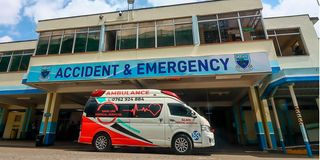
The entrance of the Accident and Emergency unit at Kenyatta National Hospital in Nairobi.
"They're not giving timelines. They're not offering backup solutions. There's no clear communication. Patients are paying with their dignity, time, and emotional well-being."
But the hospital's Chief Executive Officer, Richard Lesiyampe, however, stated that all patients who were supposed to be discharged by April 30 had been discharged.
“There were some challenges initially. The system cannot allow you to be discharged if there was some requirement for you in radiology or the labs or maybe the pharmacy. If there was anybody who skipped that process and decided to go for manual or decided to use any other method, the system will not allow it," Mr Lesiyampe explained.
“Let us also agree that sometimes the system fails. The issue is the issue of change and transformation. We are creating a superhighway of efficiency in KNH. And there is no way we are not going to get resistance. But we are determined to make sure that it's going to be efficient to a point whereby there's no patient who will ever even wait for more than an hour to be discharged at KNH. We are also going to make sure there's no patient who will ever carry a single piece of paper while getting services at KNH. It's just a matter of time and all things will be fully streamlined,” he added.
Five days chasing a discharge
Susan Gathoni's child was admitted on April 25, with a head injury following a fall, and was discharged on April 27. By May 1, she was still trying to complete the discharge process.
"Because the system is down, we cannot make any payments or complete any procedures. Everything has stalled. I have been following up on the discharge since Monday, and up to now, nothing has moved," she said.
"Whenever we ask the management, they simply tell us that the system is down. There is no clear communication on what can be done or how long it will take. We are just told to wait and be patient."
Her patience, she said, has run out. "It has now been five days. Every day, I come early in the morning because we are required to be here, moving from one office to another, hoping the system will be restored. Meanwhile, we have to leave our sick loved ones behind in the wards after they have eaten, as we continue chasing the discharge process. It is exhausting, frustrating, and uncertain. We are simply stuck, waiting for a system that is not working, with no clear solution being offered."
Rose Njeri's experience is perhaps the starkest illustration of the gridlock. Admitted for a stomach problem and discharged on Friday, April 24, she was still at the hospital a week later on May 1, unable to leave.
"I was discharged on Friday last week, but up to now, on May 1, a week later, I am still here because the discharge process has not been completed. Since my discharge, I have been moving up and down the hospital, trying to follow up, but nothing has changed. The system is not working, and everything seems to have stalled," she said.
Staff secretly breaking the rules to help
A doctor who spoke to Nation on condition of anonymity confirmed that the system drops periodically, that health workers are still learning it, and that it "was not quite embraced" by hospital staff. Another medic revealed that staff are also grappling with billing and clearance of patients who have died, because of the same system challenges.

Kenyatta National Hospital.
There is now a quiet act of defiance playing out inside the wards. A directive has reportedly been issued prohibiting health workers from reverting to the old system. But internal sources say compassionate nurses and pharmacists are secretly using the legacy system in defiance of official orders to provide emergency care.
"What we are witnessing here is not just a technical failure, it feels like a failure of duty," said Joseph*
Billing jail deepens bed crisis
The gridlock at the exit points is worsening the facility's chronic bed shortage. Recovering patients who no longer need care are occupying beds required by emergency cases, who are themselves stuck in the admission bottleneck, a cycle that feeds on itself.
Adding to the burden, KNH has implemented steep price hikes for specialised procedures, particularly in the endoscopy unit. Investigations confirm that costs have nearly tripled. A colonoscopy that previously cost Sh9,800 has risen to Sh25,000. An endoscopy has been hiked from Sh6,000 to Sh20,000, with other theatre procedures similarly affected.
Names* changed to protect identity
Follow our WhatsApp channel for breaking news updates and more stories like this.