Public hospitals empty, KNH overflowing as clinical officers' strike drags on
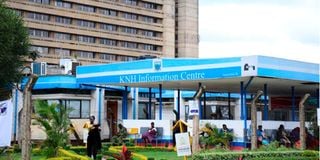
Kenyatta National Hospital in Nairobi.

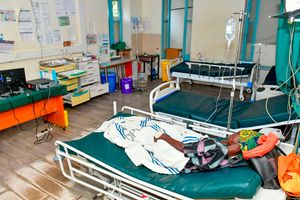
Forty-three days into the Kenya Union of Clinical Officers (Kuco) strike, the country's public health system has split into two realities: abandoned county wards on one side, and a handful of overwhelmed referral hospitals absorbing the overflow on the other.
At Kenyatta National Hospital's (KNH) outpatient wing, the benches are packed with patients who have travelled from counties where the nearest clinic has gone dark. They are not there because KNH is where they would ordinarily seek care, but because it is the only place left with staff to see them.
Elsewhere in the country, the opposite scene plays out: locked consultation rooms, silent maternity wings, and diagnostic machines gathering dust in county facilities with no one left to run them.
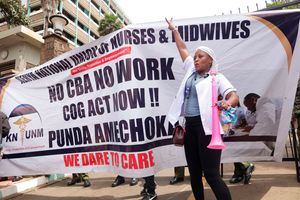
The strike began at midnight on July 20, 2026, and has paralysed outpatient clinics, maternity units and diagnostic services in all 47 counties. Its impact has been compounded by a simultaneous nationwide nurses' strike, leaving public hospital wards across the country largely deserted. Patients who cannot afford private care, or who cannot find a bed in private facilities already buckling under the overflow, have been left to fend for themselves.
"Clinical officers cover most of the outpatients all the way from level 2 to level 6 facilities. We cover most of the specialised services. If you are to go to surgery and have anaesthesia before the surgery is performed, you have a 98 per cent chance that the person administering it is a clinical officer. If you have a problem with your eyes, around 96 per cent of people you are going to see are clinical officers," Peterson Wachira, chairperson of Kuco, told Nation.
" When we started the strike, the nurses were still there, so patients could find nurses and services. Now, only the doctors are there. So, Kenyans are suffering. What is bothering us is that the CoG seems unbothered. There doesn't seem to be urgency anywhere," said Wachira.
Union leaders are demanding that officials honour agreements the government has already signed off on. Chief among the sticking points is that the Health Cabinet Secretary, the Public Service Board CEO and the Chief Officer of Health Services have yet to formally sign and deposit the negotiated 2025–2029 Collective Bargaining Agreement (CBA) with the Salaries and Remuneration Commission, the final procedural step needed to make it enforceable.

Kenya Union of Clinical Officers Chairman Peterson Wachira at a past event.
Kuco says it will not return to work until the CBA is formally signed and registered, clear career progression guidelines are put in place to unlock stalled promotions, Universal Health Coverage (UHC) contract workers are absorbed onto permanent and pensionable terms, and unpaid risk allowances and delayed statutory deductions are released.
Wachira has been unequivocal that clinical officers will not be talked back to work on the strength of fresh assurances alone. That stance, he said, is rooted in a pattern that has repeated itself for years, where return-to-work formulas signed in good faith are followed by little or no follow-through once the crisis passes and workers return to the wards.
He noted that the picture is not uniformly bleak. Some counties, he said, have begun signing their own return-to-work formulas in a bid to get local health services moving again, though those agreements remain incomplete and still lack the sign-offs needed to take full effect. The unevenness underscores a broader complaint from the union: implementation of past agreements has been left to limp along county by county, rather than being resolved decisively at the national level.
"Around 35 counties have signed the CBA, including Kajiado, Mombasa, Kericho, Nandi, Nyeri, Laikipia and Nyamira. Migori is now joining the strike because the county government never honoured their agreement or paid the money they promised. Also, I just finished touring healthcare facilities in Nakuru, including Milimani, Bondeni, and Molo. Nothing is operational. They are using clinical officers and medical interns who were posted just seven weeks ago to treat patients. It is unethical and extremely unsafe, especially after the president asked for a week to resolve these issues," said Wachira.
The strain has been most visible at KNH, the country's largest referral and teaching facility. In a signed notice dated August 20, 2026, KNH Chief Executive Officer Dr Richard Lesiyampe confirmed that the hospital was experiencing increased patient volumes and congestion directly linked to the industrial action affecting health services in various counties.
As a national referral facility, he said, the hospital was absorbing patients who would ordinarily have sought treatment at county-level facilities, and the resulting strain had produced longer waiting times and delays, particularly for non-emergency cases
"Clients seeking non-emergency care are encouraged to consider other hospitals closer to them, where appropriate, to ease pressure on KNH and facilitate timely access to care," said Dr Lesiyampe.
For now, the impasse leaves patients across the country caught in the middle, shuttled toward private clinics they often cannot afford, or left to wait out a crisis with no clear end in sight.
Follow our WhatsApp channel for breaking news updates and more stories like this.