The faulty malaria diagnosis fuelling drug resistance — and how to fix it
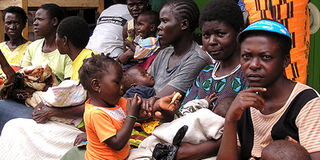
Mothers and their children wait to be tested for malaria in Bumala, Busia, during the World Malaria Day celebrations.

What you need to know:
- According to the Global Fund, Kenya ranks as the 20th highest contributor to global malaria cases, accounting for about 1.4 per cent of the total global burden.
- Approximately six million cases are reported annually, with 70 per cent of the population at risk of the disease.
Stakeholders in Kenya’s malaria control programme have warned that gaps in laboratory diagnosis are undermining case management and fuelling the risk of drug resistance in endemic counties.
In many health facilities, weak microscopy skills, poor reporting, and delays in detection mean patients either miss timely treatment or are prescribed anti-malarials unnecessarily, severely escalating the risk of drug resistance.
To address this, 20 laboratory technologists from Busia and Siaya counties have completed an intensive, five-day malaria microscopy training supported by the Ministry of Health’s Health’s National Malaria Control Programme (NMCP) and AMRE’s Primary Health Care for Malaria Elimination Project.
Also read: Back to the drawing board: Treated nets fail as resistant mosquitoes fuel malaria resurgence
The course focused on parasite detection, speciation (biological evolution), parasite counting, and accurate reporting to improve treatment outcomes.
NMCP’s Diagnostic Head Regina Kandie noted that the two counties were selected due to identified gaps in reporting and general diagnostic competency, despite major progress in malaria interventions.
“Accurate results are key to effective case management. When diagnosis is delayed, patients may go untreated, and inaccurate results can lead to missed cases. By the time some patients return, the infection may have progressed to severe malaria, which can be fatal,” noted Ms Kandie.
The training targeted laboratory officers from lower-level health facilities (levels 2-4) to strengthen diagnostic capacity. It focused on practical skills like parasite detection and blood staining to improve diagnostic accuracy, ensuring clinicians receive precise results for effective treatment decisions.
Ms Kandie added that Busia and Siaya remain high-burden areas. According to the 2020 Kenya Malaria Indicator Survey, Busia’s prevalence is 39 per cent and Siaya County’s is 28.5 per cent. Overall, malaria prevalence in lake-endemic counties stands at 27 per cent.
Reduce infections
Ms Kandie warned that changing weather patterns, particularly increased rainfall, could drive cases higher.
“Indoor Residual Spraying, which previously helped to reduce infections, is no longer optimally implemented, and this may lead to a resurgence in malaria cases. Case management, diagnosis, and treatment, through accurate diagnosis, remains our priority.”
Malaria remains a major public health concern in Africa, with the WHO estimating 246 million cases in 2023. At least.3 billion people on the continent are at risk of contracting the disease.
According to the Global Fund, Kenya ranks as the 20th highest contributor to global malaria cases, accounting for about 1.4 per cent of the total global burden.
Approximately six million cases are reported annually, with 70 per cent of the population at risk of the disease.
AMREF’s Regional Laboratory Programme Manager David Isaboke expounded on the diagnostic challenges facing malaria-endemic regions and ongoing efforts to strengthen laboratory systems.
He explained that in many health facilities, laboratory services are not yet contributing effectively to patient treatment due to limited staff competency, outdated procedures, and inadequate infrastructure.
He observed that this gap has affected confidence between clinicians and laboratory professionals. “When the clinician cannot trust the results, they often resort to syndromic treatment. This means that if a patient presents with a headache or fever in an endemic region, they are often prescribed antimalarials without proper confirmation.”
Mr Isaboke noted that this pattern has contributed to misdiagnosis and drug misuse, fuelling resistance to antimalarial medicines. He added that some patients also self-medicate, buying over-the-counter drugs without testing.
“Not every fever or headache is malaria. When people take antimalarials unnecessarily, it worsens the problem of drug resistance, which is already a growing concern,” he said. The official further noted that Kenya has already moved to combination therapy because parasites developed resistance to single-drug treatments, and resistance is now emerging to the combined regimen.
He stressed that improving diagnostic quality through skilled microscopy remains the first line of defence against drug resistance.
He pointed out emerging challenges with Rapid Diagnostic Test kits (RDTs), noting that parasite gene deletions can cause some RDTs to return false negatives.
“We’ve seen cases where parasites mutate, deleting the gene that RDTs detect. This means the test reads negative when the patient is actually infected. Such gaps underline why skilled microscopy remains essential,” he explained.
The official said AMREF in partnership with the National Malaria Programme has thus intensified efforts to strengthen the competence of microscopists through training, supervision, and mentorship.
Laboratory officers who attended the training confirmed the immediate value of the course. Gloria Auma, a lab officer at Port Victoria Sub-County Hospital in Busia, admitted they previously struggled with speciation and parasite counting. “We could diagnose malaria, but struggled with speciation and counting. Now we have the skills to ensure accurate reporting.”
Dennis Aluku, a lab officer at Sifuyo Health Centre in Siaya, shared similar sentiments, noting he previously struggled with species differentiation and parasite counts. “I used to confuse harmless artefacts (something that resembles a parasite but doesn’t have a nucleus) with parasites. Now I can confidently tell them apart after the
training.”
However, both highlighted persistent systemic challenges: understaffing and a need for better supplies, like Giemsa stain. Despite this, they committed to sharing their new knowledge with colleagues to improve quality even
when resources are stretched.
Dennis Kinyua, programme manager for the Primary Health Care for Malaria Elimination Project, said the microscopy training aligns with the project’s goal of strengthening malaria diagnosis, treatment, and surveillance at the primary healthcare level.
He added that strengthening microscopy is key to achieving Kenya’s malaria elimination targets and ensuring better patient care.
The training was a joint effort by NMCP, the National Reference Laboratory, and AMREF Health Africa, funded by GlaxoSmithKline Plc.