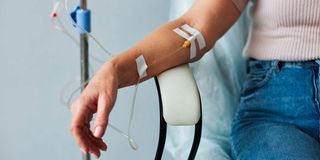
A chemotherapy patient does not need their own set of cutlery or their own bathroom.

When a family member starts chemotherapy, a type of cancer treatment, the questions come fast, and even faster for the family members who rush online to seek answers.
Caregivers are nowadays turning to ChatGPT, typing in the name of the drug and getting back warnings of what not to touch, share, or go near. “Can we share a bathroom? Does a chemo patient need their own plates? Should I sleep in a different room if my wife is doing chemo?”
The answers that come back make a chemotherapy patient sound like a biohazard in the home.

Dr Andrew Odhiambo, a consultant medical oncologist based at the Nairobi Hospital Cancer Centre.
Dr Andrew Odhiambo, a consultant medical oncologist based at the Nairobi Hospital Cancer Centre, says the alarm is outpacing the evidence, as patients are arriving at consultations having already frightened themselves and their families. In some cases, the fear is becoming a reason to avoid treatment altogether.
“People are going to ChatGPT and asking, ‘my wife is on chemo, what can and can’t I share or do? ChatGPT will give you a whole list of don'ts,” he says. “It will increase the fear and the stigma.”
What chemotherapy does inside the body
To understand what the actual risk is, it helps to start with how these chemo drugs work. There are many treatments for cancer: chemotherapy, hormone therapy, targeted cancer drugs, immunotherapy, or a combination.
Depending on the type of cancer and the treatment plan, the drugs can be delivered into a vein, swallowed as tablets, or injected under the skin. Once inside the body, they travel through the bloodstream and are processed by the liver and kidneys before being eliminated.
For most chemotherapy drugs, this happens within 24 to 72 hours of treatment. While that is happening, the by-products leave the body through urine, stool, vomit, sweat and blood.
“That is the window caregivers need to know about. The drugs are leaving through fluids, and those fluids carry traces of the medication. The question is not whether those traces exist because they do. The question is how much exposure is actually harmful and under what circumstances,” says Dr Odhiambo.
Not all chemotherapy carries the same risk
Dr Odhiambo says part of what makes the online guidance so difficult to navigate is that it treats all chemotherapy as the same. It is not.
“Not every drug behaves the same way once it leaves the body. Some are excreted in higher concentrations than others. Some clear the body faster. Because caregivers have no way of knowing which specific drug is in use, oncologists issue the same precautionary advice to everyone,” he says.
“We give them blanket recommendations for everyone. But it's not all chemotherapy drugs that have that exposure.”
What is consistent across drugs, however, is the timing. The concentration of drugs in bodily fluids is highest on the day of treatment and drops over the following 24 to 48 hours.
“In the cancer units, patients have a dedicated toilet on the day of treatment for exactly this reason. The urine will have a higher concentration on that day,” Dr Odhiambo says. “It may be for the first one or two days at most.”
The toilet question, and when gloves are needed and when they are not
What does the shared toilet actually require? “A caregiver can use the same toilet as a patient on chemotherapy. The patient should flush after use, twice if following the standard recommendation closely.”
Dr Odhiambo adds that for a properly working toilet, the number of flushes matters less than what comes after. “Hand hygiene is also very important,” he says. Once the waste is flushed, the risk is effectively gone. If the person has flushed, it has gone.”
Protective equipment
What about protective equipment at home? He says this applies if someone is coming into direct contact with the bodily waste of a patient, for instance, while changing a diaper, handling soiled bedding, and cleaning up vomit. These situations, Dr Odhiambo says, require gloves.
“This is not a chemotherapy rule. It is the standard for handling any human waste, from any person. You cannot be touching somebody's diaper with your bare hands”, says Dr Odhiambo.
Sweat has no risk, saliva low risk
Beyond gloves, nothing more is needed. A mask is not required. The protective equipment people associate with infectious diseases has no place here.
“It's not like they have Ebola,” he says. Sweat carries a negligible risk—the concentration of drugs in perspiration is too low to cause harm through skin contact. "I don't think there's enough chemo in the sweat that can penetrate your skin to harm you," he says.
Of the bodily fluids, saliva carries the lowest risk. Vomit carries more, particularly in patients on oral chemotherapy, and should be handled with gloves.
What can be shared normally?
Utensils, plates, showers, bathrooms and beds can all be shared provided normal hygiene is maintained. A chemotherapy patient does not need their own set of cutlery or their own bathroom.
“Where families do keep utensils separate, it is usually to protect the patient from infection, not to protect the household from the patient.”
Condom use
Clothing and bedding, he says, do not need to be washed separately unless soiled with waste. For sexual partners, a condom is recommended within the 72-hour window after treatment.
Some of the fear also stems from confusion between chemotherapy and radioactive iodine therapy, used in certain thyroid cancer cases. Patients receiving radioactive iodine are isolated in the hospital for several days because they are, in a clinical sense, radioactive.
Dr Odhiambo notes that chemotherapy carries no such risk, and a patient who has received it is not radioactive, not contagious, and not emitting anything harmful into the surrounding environment.
“The message should not be that a chemo patient is toxic,” he notes.
Follow our WhatsApp channel for breaking news updates and more stories like this.