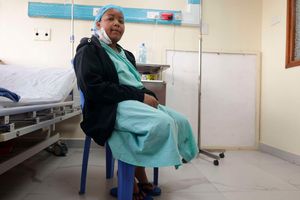
A chat with retired metal worker David Wambua brings up the theory that cancer sometimes builds up slowly and painlessly inside someone’s body until something triggers it.
He has heard of a woman who thought she was all fine until one day she accidentally squeezed her breast between wooden frames while closing a door. What began as the “it will end soon” kind of pain ended up in the woman being diagnosed with breast cancer.
For Mr Wambua, 60, a simple barbed wire scratch on his left wrist in 2019 ended up becoming a wound that could simply not go away. This eventually led to his being diagnosed with skin cancer in 2022 and an amputation the following year.
“I was at home, and a barbed wire scratched my hand. It caused a small wound that bled a bit. I didn’t take it seriously because I was working with metals, and it was usual for metals to scratch me. So, I presumed that it would recover. But it wasn’t to be,” he says of the occurrence that started a chain of events.
“Because I didn’t consider it serious, I did nothing about it. But after a week, I realised that it wasn’t recovering. I put salt in warm water and rubbed the wound, but still it didn’t improve. It stayed so for almost a month,” he adds. “I got a tetanus jab but there was no change.”
The wound festered on for the rest of 2019. He continued working at a steel firm, where his initial designation was welder before he later moved to metal-cutting using a computerised machine.
“Then 2020 came. I continued medicating it, applying medicine to no avail. It wasn’t recovering, it wasn’t hurting, it wasn’t drying up. It would show signs of drying up, but it would fester again - 2020 passed and the wound was still there. 2021 came. I continued washing it and applying medicine, but there was little success. In 2021, it started to hurt bit by bit. The year also ended,” said Mr Wambua.
In 2022, his co-workers grew uncomfortable with his never-healing arm. The sentiment, he recalls, was: “With his hand that doesn’t recover, won’t he infect us?”
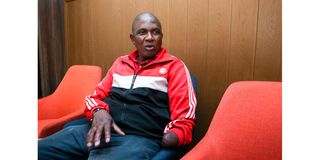
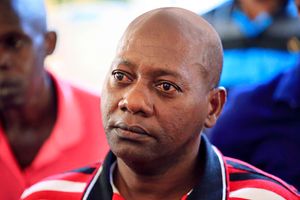
David Wambua a skin cancer survivor.
Photo credit: Billy Ogada | Nation
Says Mr Wambua: “The boss then called me and asked, ‘Why is your hand not recovering? How can we know you won’t infect others?’ I told him, ‘I don’t feel pain, and it doesn’t bother me.’ He said, ‘No. We want you to go to your doctor and get a letter saying this wound isn’t infectious.’ I went and came back with a letter. They read it, and I continued with my work. Later, they called me and said, ‘No, this wound doesn’t look safe because it is not even covered.’ I went and dressed it. I didn’t know that dressing it would trigger it.”
The wound kept spreading, and by June 2022, it had to be dressed daily.
“If I dressed it in the evening, by the evening the next day it would smell. Colleagues at work would say, ‘This person is rotting.’ So, I was depressed, and my colleagues weren’t comfortable with me. They wanted me to be sacked, but what would my children eat? That stressed me a lot. I had very many thoughts. My body deteriorated due to worries, but I persevered,” says Mr Wambua.
When he was on his December break in 2022 at his rural home in Machakos County, he went to the hospital.
“I was hoping they would do skin grafting. They said they’d first do a biopsy. They admitted me for almost a week. They did a biopsy, discharged me, then told me to return after two weeks,” he recalls. “I was praying that they wouldn’t say it’s cancer.”
After numerous tests, some that took days for the results to come out, skin cancer was confirmed.
He was advised that amputating the arm slightly under the elbow would be the best solution. He was reluctant at first because he wanted to remain employable.
The question in his mind was: “‘If I lose my arm, and yet I work with metals and I have children in secondary school, what will I do?”
A Magnetic Resonance Imaging machine at the Mombasa Cancer Treatment Centre, located within the Coast General Teaching and Referral Hospital. It is an advanced, non-invasive imaging test that uses strong magnetic fields and radio waves to produce detailed images of the cervix, uterus, and surrounding pelvic organs
Photo credit: Jurgen Nambeka I Nation Media Group
By that time, his three youngest children were in secondary school. He is a father of five children, born in 1995, 1998, 2000 and two born in 2004 (one with his late first wife and another with his second wife).
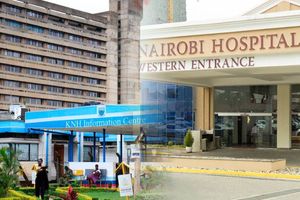
It took persuasion and counselling for him to accept an amputation at the Kenyatta National Hospital (KNH).
“I was referred to a surgeon who booked me. I returned after about three weeks and got my hand amputated,” he says, adding that he underwent further chemotherapy to get rid of any cancer cells that may have remained.
“The problem with cancer is that when someone says they have it, others avoid you. No friend wants to come close. When a person sees you, they think you are after money. Secondly, cancer is very expensive. If you don’t have something like SHA [Social Health Authority] cover to help you, you won’t manage the treatment. Many people die due to lack of money,” says Mr Wambua. “What helped me were my employment benefits. Almost all of them went to this, and I remained with nothing. I figured out that if I halted treatment due to lack of money, I wouldn’t have survived.”
David Wambua, a skin cancer survivor.
Photo credit: Billy Ogada | Nation
He goes on: “The treatment is expensive. You need to have insurance and some money on top. I have spent everything I had. Now it’s only friends who help me. My work benefits went towards educating my children and taking care of the disease. I now depend on friends to pay my SHA premiums for me. Others cater for fare and such.”
“We gather, talk and counsel each other. When you talk to a fellow patient, you feel better. You may get someone who is more overwhelmed than you are, and you consider yourself better off,” he says.
“Sometimes, when I meet people who knew me from way back, I tell them it’s an accident I had. Because if I tell them it’s cancer, they’d get worried because many think cancer leads to death,” he says.
Some people around him, he adds, are reluctant to lend him as low as Sh200 because they think he is “going”.
Living in Nairobi’s Kariobangi, he sometimes has to walk from the bus stop in the middle of Nairobi to KNH, which is about four kilometres but on a steep slope. He remembers a day he walked from KNH to the city centre right after a chemotherapy session.
Fortunately for him, the chemotherapy never weakened his body too much.
“God gave me the strength. I credit everything to God because I’ve met people who say they can’t even eat. I am quite different,” he says.
Regardless, he is finding it hard to adjust.
“Losing a part of your body is never easy. Sometimes I get weighed down by how broke I am. I can’t go job-hunting. I ask for work and someone wonders how I’ll even start. That thing affects you mentally. And there are people looking up to you,” says Mr Wambua. “I have now left it to God because when it’s too much, I tell God, ‘Didn’t you give me the children? And didn’t you give me life? This is your task, God. I tell God that and stay because I have no other way.”
He goes on: “When I was being amputated, I had three children in secondary school. As they went to school, I was receiving medication. I ran out of money and they haven’t even gone to college. They are just hustling. When I try to get them a job, the question is always: ‘What has she or he specialised in?’ If they were employed, they could have helped me. I am finding it hard even to eat. If I don’t get help from anyone, sometimes I skip clinic.”
A radiotherapy machine. A drug, Keytruda, one of the world's most effective cancer medications, promises to transform treatment by delivering life-saving therapy through a simple injection into fatty tissue beneath the skin.
Photo credit: File
Regarding the theory of cancer needing a trigger to manifest itself, he says: “As per what the doctor told me, cancer has a starting point. For me, it’s the scratch that started it. I heard another woman say that she squeezed a breast when closing the door. She started experiencing pain and when it was tested, breast cancer was detected.”
He advises anyone who might witness a persistent lump or an incurable wound to seek medical advice the soonest possible.
“If you have a [persistent] wound or see a swelling somewhere, don’t wait. Cancer in its initial stages is painless. By the time you start feeling pain, it will have spread. If you see a doctor early, you will be diagnosed early and you will receive medication,” he says. “Also, let those close to cancer patients not run away from them. This person will be treated and get well.”
In January 2026, a cancerous growth was discovered in his muscle, and now doctors have told him that he will lose his entire left hand.
“I have no option. It causes a lot of pain and I can’t cope without painkillers. It is oozing fluid and it smells. I feel uneasy when close to people,” he says.
Whereas he had learnt how to perform tasks like laundry and cooking using what was left of the arm together with his fit right one, now he will be losing the whole of the left arm and start figuring out life anew.
“They [KNH] told me they’d call me to tell me when I would be admitted,” he says.