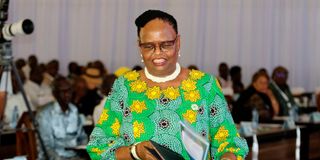
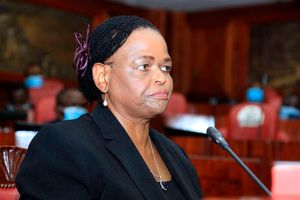
In the second instalment of our exclusive three-part serialisation of Courting Courage , Chief Justice Martha Koome’s autobiography by Moran Publishers, she writes about the rise of Fida-Kenya, a robust women’s rights organisation that is loved by some and loathed by others but hard to ignore.
One epic case involved a powerful government official, a brave catholic priest and two underage girls in pursuit of justice after exposing disturbing defilement allegations.
Courting Courage, the autobiography of Martha Koome Kenya’s first female Chief Justice. Bonface Bogita | Nation
Photo credit: Bonface Bogita | Nation
Lilian Mwaura had a calming and friendly demeanour. Her office was on the first floor of Agip House along Haile Selassie Avenue in Nairobi, where she was practising law with her brother, Kirumba Mwaura.
“You look like my daughter,” she said the first time she was introduced to me by Gichuru Mathenge. “My daughter, please come to my office and tell me what areas of law interest you.”
I told her I was interested in family law and lamented about my many struggles with issues of maintenance, property rights and succession. This seemed to excite her. She informed me that she was writing a book titled ‘Women Rights in Kenya’, which intrigued me. Lilian asked me to write a chapter on the property rights of women, which I did.
She was highly impressed with my work and requested me to write another chapter on marriage. She reviewed the chapter and said that I wrote very well. This boosted my confidence. Lilian explained to me that she was the founder and first chair of Fida-Kenya.
Established in 1985, Fida–Kenya aimed to create a society that was free from all forms of discrimination against women. It was initially affiliated to the Mexican organisation formed in 1944 by a group of women lawyers. The organisation’s spanish name is Federación Internacional de Abogadas (FIDA). I found Lilian to be an excellent mentor offering motherly advice.
She quietly helped me understand why I had to join Fida-Kenya, a membership organisation, to have an impact in the legal matters I was struggling with. The challenges I was encountering, she explained, were structurally embedded in patriarchy and I would not succeed if I decided to act alone. She pulled out a legal pad and started drawing something I could not decipher.
“We must change the Constitution of Kenya. We must change all laws that glorify discrimination on the basis of gender,” she said.
The starting point, Lilian explained, was to document the rights of women. That was the purpose of the two chapters I had written for her book. I was hooked. It was a complete paradigm shift for me. The fight for women’s rights and vulnerable people in society would start at a policy level; the constitutional level.
“Let us pierce and kill patriarchy embedded in the archaic laws,” she said as she continued to draw on the legal pad. Lilian simplified and clarified the gender issues I had struggled with since childhood
When I joined Fida-Kenya, it lacked a clear organisational structure and did not have an office. Lilian ran it from her chambers. Some members visited Fida-Uganda and were impressed. Our Ugandan counterparts had a functional office, a secretariat and a chief executive officer. The office ran well-structured programmes and was doing a lot in advocating law and policy reforms in Uganda. It played a leading role in the fight against gender violence. The impact was being felt throughout the country.
We asked ourselves how we could restructure Fida-Kenya. It was with Lilian’s guidance that the members formed a council, which elected Grace Githu—a great lawyer, organiser and leader—as chair. Grace replaced Lilian, a much-respected founder and first chairperson, who graciously allowed a peaceful transition to let her “baby” grow. Grace served as the chair between 1990 and 1993. The baby grew in leaps and bounds, beloved of oppressed women and children and loathed by oppressive men.
We secured an office, set up a secretariat and initiated several programmes. We also hired an executive director, Jean Kamau, to run the office. We set up committees on constitutional and legal reforms, sexual violence, property rights and political representation by women. We registered Fida-Kenya as an autonomous organisation in 1993. I served as a council member when Grace was the chairperson and worked under the distinguished leadership of Nancy Baraza between 1995 and 1998.
Federation of Women Lawyers Kenya (FIDA-Kenya) founder member Lilian Mwaura addresses participants at FIDA's 25th anniversary celebrations on July 23, 2010, at the Law Society of Kenya grounds, Nairobi.
Photo credit: File | Nation Media Group
The members elected me to replace Nancy as chairperson for two terms between 1998 and 2003. My leadership coincided with the end of Kanu’s rule in 2002, and the coming into office of the National Rainbow Coalition (Narc) government under President Mwai Kibaki. By the time I assumed office, Fida-Kenya had gained international recognition as a leader in women and human rights issues.
During the 2002 General Election, the majority of women who were running for political offices were financially disadvantaged. Firstly, they needed to get visibility for their campaigns, which required funds. Secondly, they had to mobilise their supporters to turn out in large numbers for the women to get nominated by major political parties.
As if that was not enough, they had to train election agents to protect their votes. This was an expensive exercise, which would hinder many women from being elected. One donor gave us a tidy sum of money to support women candidates. A good number of the beneficiaries were elected to Parliament.
Fida-Kenya was always in the news. We attracted a lot of attention from the diplomatic community in Kenya, who admired our boldness in confronting controversial issues of the day. Our achievements were, unknown to many, intentional and well-calculated.
We trained extensively on the ethos of accountability and clarified where to get donor funds. We understood our boundaries and avoided conflict of interest. We could not, as a value proposition and matter of principle, get funds from corrupt individuals or dubious donors. We had to be aligned in our values with our benefactors. We went for retreats where we thoroughly trained in capacity- and team-building.
We did not have any leadership squabbles and wrangles, remaining collegial and united. We also believed in enjoying our lives to the fullest and exploiting our full potential. It was not always work, pontification about gender inequalities and such like heavy stuff, and no play.
We engaged in fun-filled retreats with our families to recharge our overworked batteries. Koome (my husband) was always comfortable in the company of Fida-Kenya women and their children. Due to his support and presence at Fida-Kenya functions, members freely called him a “Fida husband.”
We had a functional law firm that was led by Judy Thongori as the first head of litigation. The department had competent lawyers who did public interest cases for women. The clients kept on increasing and we soon realised that we could not handle all the matters that came to us.
We decided to train women on how to represent themselves in court. We prepared forms they could fill out and file in court. We also started a mediation programme. Whenever a woman presented a complaint against her husband, a counsellor or lawyer would call the man, mediate the matter and negotiate a settlement that was satisfactory to the two parties.
The mediation programme was very successful. Some couples would be referred to us by parties whom we had assisted in resolving their disputes amicably. We would mediate and have them sign binding agreements.
We gained trust such that people started saying that they would rather take their family disputes to the “Fida Court” rather than the courts. Some assumed that we were an arm of government or a department in the Attorney General’s office. With time, we sensitised the courts on our mediation project. This led to the establishment of the Court Annexed Mediation Programme.
We also trained paralegals in the villages who would take up cases of women and children. There were many successful stories of mediation. There were hilarious ones as well.
A story is told of a distressed man who answered to “summons” from the “Fida Court” in Mombasa. The counsellor started explaining to him the benefits of an out-of-court settlement of the dispute with his wife. Suddenly, and for no apparent reason, the man started wailing loudly. This attracted a large crowd of men outside the office.
When the summoned man stopped crying, someone addressed the crowd: “Fellow men, we are finished! Fida is now thrashing wayward men senseless. Let us go home and be on our best behaviour,” he said as the crowd dispersed.
Inevitably, there was a smear campaign against Fida-Kenya and its members. We were called busybodies who were driven by donors to disturb the status quo. We were also portrayed as divorcees who were out to wreck families.
“These FIDA women sometimes hire men who they pretend are their husbands,” one prominent politician was quoted as saying. This view seemed to have gained traction. Many people I interacted with believed that I was not married. I remember attending a function with Koome. When I introduced him to a woman leader, Tabitha Seii, she was shocked that I was married. We had a good laugh when I joked that I never would have guessed she was married, given that she was such a fierce politician!
Mary Gakui from lolgorian in Transmara, carries a portrait of Father John Kaiser during a peaceful demonstration to mark the tenth commemoration since the death of Father John Kaiser, at the Holy Family Bascilica in Nairobi, August 19, 2010.
Photo credit: File | Nation Media Group
In the course of my work as a defender of the vulnerable, I met an American priest, John Anthony Kaiser. Father Kaiser was born in Perham, Minnesota, USA, in 1932. He joined the US Army as a paratrooper and was promoted to the rank of a sergeant.
He left the army and joined St. Joseph Seminary in Mill Hill, England, where he studied philosophy and theology. He was ordained as a Roman Catholic priest in St. Louis for the Mill Hill Fathers and sent to their missions in Kenya. Father Kaiser spent 20 years in missions in Kisii.
In 1993, he was reassigned to the Maela Camp for internally displaced persons in Ngong Diocese. People had fled to the camp to seek refuge following tribal clashes in the Rift Valley Province of Kenya after the first multiparty elections in 1992.
Father Kaiser and others thought that the government was fomenting the violence as part of a grand plan to grab land. He painstakingly gathered the evidence to support his views. The Maela Camp was closed by the government, notwithstanding Father Kaiser’s protests and international pressure to maintain it. T
he displaced people were forcibly resettled. Father Kaiser was arrested, beaten and left for dead in the bush. The Mill Hill Fathers reassigned him to preach to the more distant Maasai in Lolgorian Parish. In 1998, at great personal risk, Father Kaiser testified before the Judicial Commission of Inquiry into tribal clashes in Kenya, which was headed by Justice Akilano Akiwumi.
Father Kaiser gave a sworn testimony in public to the commission and named President Moi and prominent cabinet ministers as instigators of the violence.
In 1999, two underage girls sought Father Kaiser’s protection. They claimed that they had been raped by a powerful cabinet minister. One girl said that she had been defiled in the minister’s government office. The second one stated that she had been deflowered in the minister’s official car. Both cases resulted in pregnancies and forced the girls to drop out of school.
Father Kaiser referred the two girls to Fida-Kenya with a request that we represent them. We took the girls for counselling to assist them in coping with their forced situations. We also carried out our own thorough private investigations and confirmed the girls’ stories.
We decided to shelter the girls in the home of a staff member as we took legal action. Fida-Kenya gave the government a 10-day notice to take the minister to court. We informed the Attorney General, who was then in charge of public prosecutions, that if he failed to prosecute the minister,
Fida-Kenya would initiate private criminal prosecution against the suspect. This triggered a fierce counterattack. The police stormed the residence of the staff member who was sheltering the girls.
The commander leading the raid beat up the children of the staff member and claimed that he had received complaints from the girls’ mothers that the teenagers had been abducted by unknown people. He said that in line with their call of duty, Utumishi Kwa Wote (Service to All), they were assisting in tracing the girls and reuniting them with their families.
The senior policeman added that they had commenced investigations into the abduction with a view of prosecuting the abductors. This was outrageous because we were representing the girls and sheltering them with the written consent of their parents.
We protested the police action and termed it as obstruction of justice. I called a press conference and said: “We are of the view that there has been a serious obstruction of justice on the part of the police. Whose interests are the police in this country serving? Aren’t they the same people who should have assisted the prosecution of this case?”
We knew who was behind the police action. I stated clearly that the cabinet minister was obstructing justice by interfering with our private investigations and the intended prosecution.
The cabinet minister unexpectedly visited our offices in Nairobi with a prominent lawyer-cum-politician, who was representing him. They offered to settle the matter out of court.
I was shocked when the minister admitted to having consensual sexual intercourse with one of the girls and denied that she was a minor at the time of their encounter. He claimed that the girl was the same age as his second wife.
Medical tests had revealed that the girl was a minor at the time of the defilement. A council member secretly taped the minister’s confession. She intended to adduce the recording as evidence in court in the planned private prosecution.
We refused to negotiate a settlement. The minister and his lawyer left the offices infuriated. The minister thereafter publicly threatened to sue Fida-Kenya over the allegations and claimed that we were being funded by foreign agents to destabilise the Moi government.
He termed the intended prosecution as propaganda being used by two of his political competitors to undermine him. The grapevine had it that the minister had sought the support of President (Daniel) Moi in the matter.
Catholic priest Antony John Kaiser. He was found murdered on August 24, 2000.
Photo credit: File
The President is reported to have advised him to go and fight his own battles with Fida-Kenya without dragging his (Moi’s) name into it. President Moi is said to have informed the minister that he had also been sued by the same women and was in court defending himself.
We prepared a watertight case and presented it in court. When we arrived to prosecute our case, we found the courtroom full of Maasai morans (warriors) who were chanting war songs. They had incredibly been allowed in the court room with rungus (clubs) and simis (swords).
The morans had occupied every available space in the courtroom: the magistrate’s podium, the bar, the seats reserved for the court officials and the public gallery. The witness box and dock had been taken over as well.
When a semblance of order was restored, the court proceedings commenced and we made a spirited application for leave to prosecute the minister.
The Attorney General opposed the application. He informed the court that even if leave to prosecute was granted, he had instructions to terminate the case by entering a nolle prosequi, a latin phrase which directly translates to “not wish to prosecute”.
This is a legal notice that the prosecutor has decided to abandon the prosecution. The case, it was clear to us, would be a nonstarter. The police were hostile while the victims, their parents and relatives were intimidated and harassed by all manner of characters. The witnesses were also scared off and induced to recant their evidence.
The case came to an end after the victims were enticed to withdraw the instructions to FIDA-Kenya. The case had a good consequence. It increased awareness on the issue of sexual abuse of girls. This prompted calls for legal and policy reforms which Fida-Kenya, among other organisations, championed. The case also attracted international attention and was widely covered in the media.
The saga had a tragic ending after Father Kaiser, a key witness in the case, was murdered. His body was found on 23rd August, 2000, near Naivasha. What followed was a massive cover-up of the murder. It was a sad chapter for the two victims. They never got justice for their troubles. It was also an equally sad ending for their protector and witness. The criminals who killed Father Kaiser have never been brought to book.
The work we did at Fida-Kenya is the stuff that myths and legends are made of. Whether it was President Moi in the manicured lawns of State House, the cabinet minister in his office with an elegant wall-to-wall carpet or the ordinary folks in Mombasa, Lilian Mwaura’s little baby, conceived in her cosy corner office in Agip House, had come of age. It was piercing and killing the patriarchy.
Chief Justice Martha Karambu Koome making her address at the Supreme Court on May 21, 2021 soon after being sworn-in at State House, Nairobi.
Photo credit: Jeff Angote | Nation Media Group
Martha Koome made history in 2021 when she was appointed the first female Chief Justice and President of the Supreme Court of Kenya.
Prior to this, the trailblazing lawyer, who was involved in the pro-reforms movement in the 1980s and 1990s, had distinguished herself as a judge of the High Court and the Court of Appeal.
Born in 1961 and married to Mr Koome Kiragu, the mother of three holds a Bachelor of Laws degree from the University of Nairobi and a Master of Laws degree from the University of London.
Courting Courage , her autobiography by Moran Publishers, is described as a story of resilience and unwavering determination in the pursuit of justice. The book will be launched today, Friday, February 20, in Nairobi and will be available in major bookshops.