In the late 1980s, Martha Koome was a young lawyer and activist, whose most urgent priority was to find her footing in the profession, when she was unexpectedly thrust into the intensity of multiparty politics and the brutal crackdown by the Daniel Arap Moi regime.
In our exclusive three-part serialisation of Courting Courage , the Chief Justice’s autobiography by Moran Publishers, she writes about a frustrating partnership with the mercurial Japheth Shamalla, representing political detainees, including Raila Odinga, and her role in the dramatic escape of iconic opposition leader Jaramogi Oginga Odinga that tricked intelligence officers.
I worked at Mathenge and Muchemi (law firm) for three years, between 1989 and 1991. The more experience and confidence I gained, the more I felt a burning ambition to start my own law firm.
I knew it called for a lot of planning, discipline, dedication, hard work, finances and networking to build a successful legal practice.
That is why I was surprised when a colleague told me of an opportunity for a partnership with Japheth Shamalla. The route that took me to the offer was fairly predictable.
While working at Mathenge and Muchemi, I was recruited by Lilian Mwaura to Fida- Kenya, a women’s rights organisation. This was a period of political awakening and consciousness. We soon found ourselves thrust into the vortex of political agitation.
I was also an active member of the Law Society of Kenya (LSK), which played the role of an opposition party. That is the context in which I met Shamalla, who was defending political prisoners. My colleagues in the struggle informed me that he was interested in recruiting a partner.
Shamalla was a former high-profile career State technocrat. He had been a Permanent Secretary, most notably in the Ministry of Foreign Affairs between 1981 and 1985. He eventually fell out with President Moi, left public service and set up a legal practice.
He ran a politically savvy sole-proprietor law firm, Shamalla & Co. Advocates. He was mostly in public interest legal work, defending political prisoners, detainees and dissidents charged with politically instigated offences.
Shamalla was at the time representing Jaramogi Oginga Odinga, the doyen of opposition politics in Kenya. I thought that working with Shamalla would give me the right profile in my career progression.
Courting Courage, the autobiography of Martha Koome Kenya’s first female Chief Justice. Bonface Bogita | Nation
Photo credit: Bonface Bogita | Nation
As a long-serving public official, Shamalla had little hands-on experience in legal practice. We negotiated the terms of the partnership and agreed that I would be the one to run around the courts, tribunals and police stations on behalf of our clients. Shamalla would only attend court when there was a high-profile, politically significant case.
Shamalla undertook to leverage his extensive networks to get lucrative legal briefs for the firm. I accepted the offer and joined him at Corner House, at the intersection of Nairobi’s Mama Ngina and Kimathi streets within the central business district (CBD), where his offices were situated.
Corner House was an imposing building completed in 1984 by its developers, the Kenya National Assurance Company. It was a showpiece by the famous architectural firm, Triad Architects. The building was an ideal location for the kind of legal practice I envisioned. The law firm, subsequently, changed its name to Shamalla & Koome Advocates.
Since I was the hands-on advocate, I made several trips to Kamiti Maximum Security Prison to visit Koigi wa Wamwere, Mirugi Kariuki, Rumba Kinuthia and other political activists facing treason charges. I would take instructions from them, deliver toiletries and letters from family members and friends to them.
I often went to Kamiti Prison to attend proceedings before the Detainees Review Board (DRB), which dealt with matters involving the welfare of the political detainees we were representing. That is how I happened to represent Raila Odinga, a perpetual political detainee without trial, who was locked up by the Moi regime.
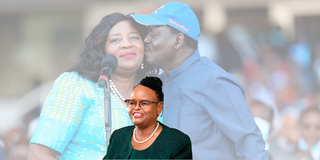
His wife, Ida Odinga, visited our offices and instructed me to take up his case. She said she had heard of a brave young lady at Shamalla’s office who could handle her husband’s case.
Chief Justice of Kenya Martha Koome (R), Former Prime Minister of Kenya Raila Odinga (C), and his wife Ida Odinga look on during the memorial service for former Kenyan President Mwai Kibaki at the Nyayo National Stadium in Nairobi on April 29, 2022.
Photo credit: AFP
My instructions were to appear before the DRB and make an application for Raila’s welfare. I made an application, demanding, among other things, that he should receive a proper diet, be allowed to correspond with his wife, watch television and read books. I was allowed to take books to him and deliver letters he exchanged with his wife.
The DRB was a quasi-judicial body established to review cases of individuals detained under preventive detention laws. Its work was anchored in a legal framework that permitted detention without trial, a practice that originated during the colonial era and was perpetuated by post-independence governments, particularly under President Moi’s administration.
The legal justification for such detentions was primarily derived from Section 83 of the then Constitution of Kenya, which allowed derogations from fundamental rights in cases of national security threats, and the Preservation of Public Security Act, which granted the Executive sweeping powers to detain individuals deemed to be a threat to public order or governmental stability.
Under the provisions of the Preservation of Public Security Act, the President and the Minister for Internal Security had the authority to issue Presidential Detention Orders (PDOs) that enabled them to detain individuals indefinitely without formal charges or trial.
These provisions were reinforced by the Public Security (Detained and Restricted Persons) Regulations, which detailed the conditions under which individuals could be detained and reviewed, though they offered little in terms of due process or legal recourse for detainees.
The legal regime governing detention was thus heavily skewed in favour of Executive control, making it a potent tool for suppressing dissent and political opposition.
The DRB was tasked with periodically reviewing the status of detainees, typically every six months, to determine whether continued confinement was warranted. However, its recommendations were subject to presidential approval, severely limiting its effectiveness as an independent oversight body.
Many of those detained were opposition politicians, lawyers, activists, intellectuals and journalists who were deemed to have been criticising the government. Among the most notable detainees were figures such as Raila Odinga and George Anyona.
Despite its formal mandate, the DRB was criticised for failing to provide fair hearings, operating in secrecy, and largely rubber-stamping government decisions to prolong detentions. Reports from human rights organisations documented the harsh conditions endured by detainees.
Detainees in Kenya during the 1980s and early 1990s —particularly those held under preventive detention laws— endured harsh, inhumane, and degrading conditions. Under President Moi’s administration, detention without trial became a common tool for political repression.
Many detainees were subjected to solitary confinement for prolonged periods. Isolation was used as a psychological weapon to break their will and suppress opposition to the regime.
President Uhuru Kenyatta with newly sworn-in Chief Justice Martha Koome at State House in Nairobi on May 21, 2021.
Photo credit: PSCU
To further frustrate detainees and their families, the government frequently transferred prisoners to remote or high-security facilities, making it difficult for relatives and lawyers to locate or visit them. When not isolated, some detainees were crammed into overcrowded cells alongside common criminals.
The prison facilities were deplorable, with inadequate sanitation, overflowing latrines, and limited access to clean water and soap. Vermin-infested cells, lack of proper ventilation, and the absence of bedding contributed to widespread respiratory diseases, skin infections, and malnutrition.
Food and adequate nutrition were deliberately restricted, with detainees receiving insufficient and poor-quality meals, typically watery porridge, ugali, and boiled beans. Many detainees suffered from tuberculosis, scabies, ulcers, and malnutrition-related illnesses without receiving proper treatment. Some were denied medication for chronic conditions, and reports suggest that those who sought medical attention were often dismissed as faking illness in an attempt to secure release.
Raila Odinga reunites with his family — his father Jaramogi Oginga Odinga (second right), wife Ida (holding Winnie), Raila Junior and Rosemary — at their Kileleshwa home in Nairobi after his release from 11 months’ detention on June 21, 1991. His release was announced by President Daniel arap Moi at the Kanu Annual Delegates Conference, Kasarani.
Photo credit: File
Beyond deprivation, detainees were subjected to physical and psychological abuse. While the government never officially acknowledged these abuses, many detainees reported severe torture and mistreatment at the hands of security forces.
Beatings, sleep deprivation, forced standing for hours, and even electrocution and sexual violence were among the brutal methods used, particularly in notorious detention centres such as Nyayo House torture chambers. The prolonged detention without trial also inflicted profound psychological distress, with many detainees developing depression, anxiety, and post-traumatic stress disorder (PTSD). Constant surveillance and fear of indefinite detention created paranoia and mental breakdowns for some prisoners, and many struggled to reintegrate into society after their release due to the deep psychological scars they bore.
Communication with the outside world was tightly controlled, with some detainees completely cut off from their family members who were not informed of their whereabouts. Family visits were rare and highly restricted, often used as a tool of reward or punishment. Even when allowed, these visits were closely monitored, with detainees prohibited from discussing their prison conditions.
Fortunately, mounting domestic and international pressure in the late 1980s and early 1990s led to significant legal and political reforms. The repeal of Section 83 of the Constitution in 1992 effectively abolished the legal basis for detention without trial, and the abolition of the Presidential Detention Orders earlier in 1991 had marked a shift towards upholding due process and fair trials.
These reforms coincided with Kenya’s transition to multiparty democracy, leading to the release of most political detainees and the eventual dismantling of the DRB. In retrospect, the DRB exemplified the use of legal mechanisms to legitimise political repression. Its operations reinforced the Moi government’s grip on power by systematically suppressing dissent through indefinite detentions. However, resistance by the civil society, legal advocacy groups, and international human rights organisations played a crucial role in pushing for the abolition of detention without trial.
Chief Justice Martha Karambu Koome making her address at the Supreme Court on May 21, 2021 soon after being sworn-in at State House, Nairobi.
Photo credit: Jeff Angote | Nation Media Group
The repeal of repressive laws in the early 1990s signified a critical moment in Kenya’s legal history, paving the way for enhanced protection of human rights and fundamental freedoms. However, the legacy of these detentions continues to shape the country’s human rights discourse and transitional justice debates to this day.
Our office hosted activists in the evenings as they campaigned for a multiparty political system. They agitated for the repeal of the infamous Section 2A of the Constitution, which had been enacted in June 1982, making Kenya a one-party State. The activists we interacted with included pre-independence politicians like Jaramogi Oginga Odinga, Masinde Muliro, Martin Shikuku and Ahmed Bamahriz. They were accompanied by a retinue of younger politicians and lawyer activists, popularly referred to as the Young Turks, who included Paul Muite, Mohammed Ibrahim, John Khaminwa, Mukhisa Kituyi, James Orengo and Gitobu Imanyara. They chose our office as a meeting point because of the legal protection it offered. The police could not arrest them when they were consulting their lawyers. The building was always teeming with State spies from the Special Branch (now known as the National Intelligence Service). It was clear to all of us that our offices were bugged and our telephones tapped. One day, we got wind that Special Branch officers had surrounded Corner House and intended to arrest Jaramogi, who was holding consultations in our office.
We devised an ingenious escape strategy. Jaramogi’s aide, who had driven with him, was given the old man’s distinctive flat cap and checked jacket to wear. He was driven out in the Mercedes-Benz Jaramogi had used and sped off. The Special Branch officers promptly gave chase, but when the aide stopped the car and got out, the shocked officers could not figure out how they had lost their quarry. Jaramogi was, in the meantime, sneaked into my small Datsun. I gave him a shawl to cover himself. I drove the stoic mzee who seemed completely unfazed by the drama, and cracked jokes about the surprise the officers would encounter when they discovered the deception. I dropped him off at Kileleshwa Estate, where Ida Odinga, his daughter-in-law, was at hand to receive him.
Ours was a legal practice with a lot of drama. Many times, I stormed police stations seeking my clients’ release. We also often followed police cars to establish where they were taking our clients. The practising lawyers in Nairobi knew each other. Whenever a lawyer, an activist or a politician was arrested, a distress call would be made and many advocates would rush to court to represent the accused. On one occasion, our colleague, Beatrice Nduta, was arraigned on a charge of assault, which was politically instigated. More than 80 advocates appeared for her. The police, to counter this strategy, would arrest some people in Nairobi and charge them in faraway towns like Kisumu or Mombasa.
I had joined Shamalla with high expectations, but soon I discovered the partnership was not as glamorous as he had made me believe. Shamalla, an astute administrator who knew many key people in the public and private sectors, was reluctant to leverage these networks to get clients for the firm. President Moi had forced him into early retirement at the peak of his career, and Shamalla, I learnt much to my chagrin, was using the law firm to hit back at Moi. While seemingly politically savvy and confident in the reform movement, subsequent events demonstrated that he lacked genuine commitment and conviction.
Shamalla was in the struggle as a self-seeking venture, geared towards personal gain. He was elected a Member of Parliament (MP) for Shinyalu Constituency during the first multiparty elections in 1992 on an opposition Ford-Asili ticket, but he soon defected to Kanu. This necessitated a by-election in which he was re-elected on a Kanu ticket and was subsequently appointed an Assistant Minister by his former boss-turned-nemesis, President Moi. It was a well-orchestrated strategy to frustrate multiparty democracy and to undermine the political opposition in Parliament.
The 1992 General Election marked Kenya’s first multiparty polls since independence, ushering in political pluralism, but also exposing the deep fragmentation within the opposition. This division allowed President Moi and the ruling party, Kanu, to retain power, with the incumbent winning the presidency with just 36.6 per cent of the vote. Despite opposition parties securing a significant number of parliamentary seats, their lack of unity enabled Kanu to maintain dominance, not just through election victories but also through strategic post-election defections.
Following the elections, the National Assembly had 188 elective seats distributed among various parties. Kanu initially held 100 seats, while opposition parties collectively controlled 88 seats, distributed among Ford-Kenya (31 seats), Ford-Asili (31 seats), and the Democratic Party (23 seats). Three smaller parties, the Kenya Social Congress, the Kenya National Congress, and the Party of Independent Candidates of Kenya, each secured a single seat.
Newly sworn-in Chief Justice Martha Karambu Koome (centre) is welcomed at the Supreme Court by Interim Judicial Service Commission chairperson, Prof Olive Mugenda (right), and Chief registrar of the Judiciary, Anne Amadi, on May 21, 2021, soon after taking her oath of office at State House.
Photo credit: Jeff Angote | Nation Media Group
However, despite the opposition’s presence in Parliament, their internal divisions prevented them from mounting a formidable challenge to Moi’s administration. Seeking to solidify his grip on power, Moi embarked on a systematic campaign to lure opposition MPs into defecting to Kanu. These defections were driven by incentives and pressure. One of the most effective tools was patronage, where defecting MPs were rewarded with ministerial and assistant ministerial positions, increasing their political influence and personal gain. Financial inducements were another key strategy, with MPs enticed with money, business opportunities, and access to State resources.
Those who resisted often faced political intimidation, including threats of prosecution, economic sabotage, or State harassment. Additionally, President Moi skilfully exploited divisions within the opposition, fuelling internal rivalries that made party leaders vulnerable to defection. A number of high-profile opposition MPs abandoned their parties and joined Kanu between 1992 and 1997, significantly weakening the opposition’s influence in Parliament. These defections allowed Kanu to strengthen its parliamentary majority, enabling President Moi to push through legislation favourable to his administration and maintain political control in the lead-up to the 1997 elections.
The consequences of these defections were profound. The opposition parties lost significant parliamentary strength, depriving them of a unified voice and further fragmenting their political movement.
Meanwhile, Kanu’s strengthened majority ensured that President Moi could govern with minimal resistance, reinforcing his dominance. The defections also undermined political party loyalty, setting a precedent for opportunistic party-switching that would persist in Kenya’s political landscape for years. By the time the 1997 General Election approached, the opposition remained deeply divided, unable to pose a serious challenge to Moi despite growing public dissatisfaction with his administration.
Ultimately, defections were a calculated strategy that not only ensured Kanu’s continued rule, but also shaped Kenya’s political trajectory for decades. The culture of party-hopping, initially used as a tool for political survival, would continue to influence election dynamics in Kenya well into the 2000s, reflecting the lasting impact of Moi’s approach to consolidating power. Our law firm had many political cases, which we handled on a pro bono basis. I had to market the firm to get clients who paid fees. As the managing partner, I found myself running a huge enterprise on my own. I undertook all the drafting and litigation work, besides looking for new business.
It was my responsibility to ensure there was sufficient money to pay rent, staff salaries, partners’ drawings—including Shamalla’s—and other office expenses. Shamalla was living large, as if he was still a privileged state technocrat in the foreign service. He had a fridge in his office that was well stocked with exclusive drinks to entertain visitors. I was shocked when he told me to ensure the office petty cash replenished the drinks whenever there were political meetings in the office, which was often the case. The firm was not only offering a free meeting space and pro bono legal services, but was also a source of free choice drinks for politicians. This was not financially sustainable.
The final straw that broke the camel’s back was when Shamalla took a small car I had bought for the firm and used it for his political campaigns. I decided to quit the partnership and start my own law firm, where I was able to control my expenses and live within my means. I was not short of role models in running a successful law firm. I admired established lawyers like Paul Muite with his grasp of the law and clarity while making submissions; the boldness of Gitobu Imanyara and the commitment and consistency of Dr John Khaminwa. Then there were the organisational abilities of Lilian Mwaura; the sharpness of Martha Karua — whom we fondly referred to as mhesh, short form of mheshimiwa (honourable) in Kiswahili—and the confidence of Nancy Baraza. They were household names; well-established and successful lawyers. I knew that to succeed like them, I needed to work hard. I was confident I would succeed. The firm of Mathenge and Muchemi had inducted me well on how to run a successful legal practice. My dalliance with Shamalla had also taught me important lessons as I single-handedly ran a very big enterprise.
Tomorrow in the Daily Nation: Loved by some, loathed by others — the rise of Fida and Kenya’s gender wars