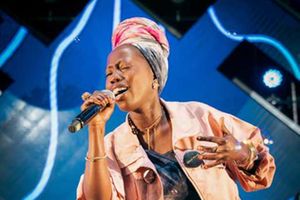
Xenia Manasseh, 29, grew up in a home where almost everyone played an instrument and singing was simply what her family did.
In an interview with Michael Ochieng', she spoke about how that childhood shaped her and as a Berklee-trained artist now building her own label, Manasseh Entertainment.
1. You’ve always said your family is very musical. What was that like growing up?
I grew up singing and was exposed to a lot of music. Everybody, except maybe one person, has played instruments; we all sing. My mom and her siblings grew up taking lessons in different instruments too, doing examinations in them. It was a good breed.
2. With that much music around you, when did you first realise you could actually sing
I’ve been singing since I was a very young girl. I sang all throughout primary, I was competing all throughout high school. It was always there, even when I told myself it came later.
3. Did competing all through school carry on when it was time to think about university?
Yes, it did. I got a full scholarship, so that made the decision a lot easier. I went to Berklee College of Music in Boston. I was there for four years, and I finished in 2018. I knew music theory, and I also had natural musical instincts. When I went to uni, everything combined, and I finally understood what I’d been doing in my music for years.
It fine-tuned what I already had, and it showed me what I already knew but didn’t necessarily know the terms for. I took lessons in so many instruments— voice, piano, guitar, drums, and bass.
My favourite instrument to play is the bass guitar. I think if I hadn’t gone, I might not have realised how much this is what I was meant to do.
4. When did you release your first track?
That was 2015; I was in music school. I think it was inevitable. It’s kind of hard to be surrounded by music for four years and not try to make any of your own, even if it’s not something you choose to pursue for the rest of your life.
5. You finished university in 2018 and had already been recording abroad. What stood out to you about how the industry runs there compared to back home?
I say this all the time, there’s just more structure and more specialisation there. A lot of starting artistes, producers, even some who aren’t starting out, function as multiple things for themselves. Overseas, one person is allocated to each of those things, so people get really good at the one thing because they do not need to divide their attention. If we had more education here for those specific roles, it would push people in one direction.
6. You brought up structure; does that gap explain why you feel music doesn’t really pay here?
Honestly, performing is what makes us more money as artistes. If you’re not booked consistently, you’re still struggling. I don’t think there’s a lack of money either, because people are booked from outside all the time.
Musical artist Xenia Manasseh performs during her album performance at Alchemist in Nairobi on November 21, 2024.
Photo credit: Bonface Bogita| Nation Media Group
If half that money went towards Kenyan artistes and creatives, we could make the changes we need. A lot of my friends in the States who aren’t full-time musicians work nine-to-five jobs to facilitate their passion.
7. Is that the reason you started your own label?
Well, I always wanted to do it. I started it in 2023. It’s called Manasseh Entertainment LLC. I’m the only person under the label right now because I need so much more capital and structure before I can bring anyone else on board. But I have ideas to build my own studio and to build my own rehearsal spaces,
8. Running your own label means you decide who you work with. What actually makes you say yes to a collaboration
I believe we shouldn’t approach music making with rules. If it feels right, it feels right, and the songs come out. There are obviously people that I listen to and I’m inspired by, and I think we would make something so cool together. I love when you go to writing camps and you’re put in a room with somebody you just met two hours ago, and you make something so magical that you can’t stop singing. I try not to be so picky, and just let the music flow.
9. Speaking of songs that came together by chance, “Beba” with Watendawili blew up in a way you didn’t expect. Walk us through how that happened.
I have no idea, honestly. We didn’t expect that at all. We loved the song, and even the way it happened was random. I saw my friends' post on Instagram that they had finished their album, and I commented under the post asking them to save one for me. I wasn’t back in Kenya yet; I was coming home in about a month. When I got home, they said, ‘we saved you a song.’ I went to the studio, we did my verse, and the song came out. I posted my video on TikTok and it just caught fire. I guess people just really relate to it. It’s a really uplifting song.
10. You spoke about your Berklee circle. Is that the same group behind ‘Flying to LA’
Wow, nobody has ever asked me about that song! It’s really interesting. That song is me, Lisa (Oduor-Noah), and our friend. We were all at Berklee together, and we were always singing together. It was one of the songs my friend was doing for her album, and she asked us to sing on it with her. It’s one of my favourite songs to date
11. Between a song like ‘Beba’ and one like ‘Flying to LA’, what actually comes first for you: the beat, the words, or something else
It depends. The feelings are always there, and it’s a range of feelings. Sometimes we go to the studio intentionally making a dance song. Sometimes we are heartbroken, and that’s what comes out. Sometimes we are happy, or in love, and that’s what comes out. I write a lot outside of music too.
I’ll watch a film and think, oh, this would be something so interesting to write about, and I’ll note it down. I also free write; I don’t want to call it poetry, but it is. Sometimes, there’s no beat at all, just a melody in my head. Freestyling is one of my favourite things to do; it sharpens my intuition and that trust that I know exactly what you’re supposed to communicate.
12. You talked about baring your soul through songwriting. What has that actually taught you about yourself over the years
My goodness, what has music not taught me? It has totally transformed my life. When I started writing songs and telling my stories, it created space for my self-awareness to expand, to admit not just to myself but to the world that I make mistakes.
I know that as soon as I write a song about something I’m not ready to confront, I’m going to have to be face to face with this thing. It’s an essential part of my life.
13. You performed at Peaches and Cream most recently. What has been the biggest stage you’ve stood on, and how did the crowd respond?
Wow, do I even remember? Maybe Blankets and Wine. The reception is always amazing. I don’t think it’s easy to explain what it feels like to be received by people for something that is so pure to you, and even very vulnerable.
Kenyan musical artist Xenia Manasseh performs during the Peaches and Cream event at Ngong Racecourse in Nairobi on September 26, 2026.
Photo credit: Bonface Bogita | Nation Media Group
14. You said you give all your energy on stage. What happens to you right after a big show ends?
After long performances, I don’t like speaking. I always prepare myself for days when I have gigs, especially big ones, because I know I’m going to interact with a lot of people, and I give all of my energy to performing. So afterwards I’m very exhausted and I like to be in complete solitude. I tell people, please don’t call me tomorrow; just give me a second to recentre myself and regain my energy.
15. What does normal life actually look like for you outside music?
Going to the gym five out of seven days a week. I play football weekly, though I haven’t in about two months — I’ve had a lot to do. I love going to the movies; I love film, and going to the beach; just being by the water and in the sun. I spend time with my family and friends too
16. With piercings, tattoos, and a look that keeps changing, how would you describe your signature style?
That one is a bit hard, because I think I have a distinctive look already, with all my piercings and tattoos. I’m also very tiny, so maybe being short is my signature. As far as appearance, I’m a creative and I like to try things all the time, so I change a lot.