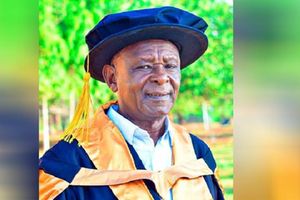
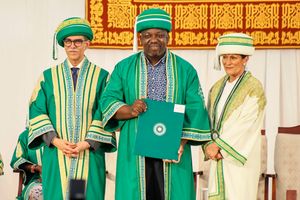
Until recently, many Kenyans, especially the younger generation, may not have been familiar with Peter Ngibuini Kuguru. That changed when the 80-year-old entrepreneur graduated with a PhD in Business Management from the Open University of Tanzania in Dar es Salaam last year.
At an age when most people are long retired, Kuguru chose to pursue the highest academic qualification. His achievement quickly attracted attention across print, electronic and social media, earning admiration from multiple generations.
Speaking to Nation Lifestyle shortly after the ceremony, Dr Kuguru shared photographs and video clips from the colourful graduation event where he was clearly the star attraction. But beyond the celebration, he says his academic journey was driven by a deeper purpose.
“The main reason I chose this path was to motivate future generations. Graduating at 80 is itself a challenge to younger generations,” he says.
Dr Kuguru’s doctoral research focused on Kenya’s coffee sector, an industry he believes holds immense untapped potential.
“The material I've gathered after eight years of research may provide policy direction for regulators. Cooperative societies can draw on the recommendations to revive their performance and generate wealth for growers. Scholars now have a framework to build further milestones in developing the coffee value chain in Kenya.”
Dr Kuguru is best known as the founder of Softa Bottling Company (Softa Soda) and the larger group Kuguru Food Complex (KFCL). He studied Food Technology at Massey University, graduating in 1972. After university, he worked in several jobs; as chief chemist at Kenya Commercial Creameries, Production Manager at House of Manji, and was among the founding team of the Kenya Bureau of Standards (KEBS).
In 1975, Kuguru began a small-scale food production company, making potato crisps at home. By 1978, he had quit formal employment and ventured into catering and baking. With a bank loan of Sh110 million, he founded his own manufacturing firm and began producing Chibuku, a local sorghum beer that was previously owned by a multinational.
Kuguru diversified over time into several production lines, including maize flour, sanitary pads, diapers, real estate and plastic packaging.
In 1997, Kuguru acquired a mineral water plant (Highlands Mineral Water), and in 1998, he launched Softa Soda, a carbonated soft drink brand in several flavours (cola, orange, lemonade, bitter lemon and pineapple).
Softa targeted the lower-income, price-sensitive segment of the market, offering cheaper soft drinks than other more popular brands.
“At its peak, Softa was a formidable competitor. By 2004, it had captured about 10 per cent of the carbonated drinks market, and by 2007, it claimed an 80 per cent market share in Nairobi and its environs.”
The business employed a large workforce, at one point over 10,000 people, including factory workers and depot staff.
Despite earlier success, Kuguru's beverage empire eventually crumbled. From the late 2000s, he says, unfair competition and strong pushback from multinationals seriously affected their business.
“Distributors were convinced not to stock Softa. Billboards were destroyed, bottles broken, and marketing channels systematically undermined,” he says.
The 2007/2008 post-election violence in Kenya significantly disrupted business. Containers and distribution networks were removed from roadsides, hurting sales and logistics. Operating costs, from power, fuel, transport, and production, were too high. In addition, the lack of government support, such as tax breaks and favourable loans for local manufacturers, made competition with global giants almost impossible.
Kenyan entrepreneur Peter Kuguru.
Photo credit: File | Nation Media Group
Despite all efforts, Softa failed to generate enough cash flow. By November 2016, Softa Bottling Company was deregistered and its assets put up for sale. Closing Softa, he says, was painful but necessary. It marked “the end of an era for a Kenyan company that had dared to challenge global beverage corporations.”
Reinvention and resilience
Failure did not end Kuguru’s entrepreneurial journey. He shifted focus to other ventures, including Cateress Milling, producing maize flour brands such as Cateress and Mpishi. Through Just Real Estate, he expanded into property development.
Always alert to opportunity, he even proposed buying locusts at Sh50 per kilogram during the invasion period to process them into animal feed. He also ventured into feminine hygiene products through Sanitary Pads and Diapers International, using imported technology to produce leak-proof pads and diapers.
His memoir, Trailblazer: Breaking Through in Kenya , chronicles his journey through business, politics and the realities of entrepreneurship in Kenya. At its heart is a simple message: Dare to dream big.
Kuguru comes from a notable family in Mathira, Nyeri County. His father, Davidson Ngibuini Kuguru, was a powerful politician in Kenya during the Kenyatta and Moi eras. The elder Kuguru reportedly resisted the tradition of simply handing down inheritance. Instead, he made his children buy their own land to instil discipline and a work ethic. Kuguru was the first among his siblings to purchase land.
Kuguru himself ventured into politics during the KANU single-party era, rising from ward chairman in 1968 to KANU national organiser in 1998. He unsuccessfully contested the Mathira parliamentary seat in 1997, 2002 and 2007, even forming the Dynamic Development Party in 2005. After his 2007 defeat, he retired from active politics.
That same year, he was appointed chairman of Nairobi Water and Sewerage Company Limited, serving until 2014.
After leaving Nairobi Water, Kuguru returned to academia. He enrolled at the Management University of Africa, graduating in 2016 with a Master’s degree focusing on the coffee value chain.
Softa Bottling Company founder Peter Kuguru speaks about the company's journey, during an interview at his Kuguru Food Complex office in Nairobi.
Photo credit: File
In 2017, he joined the Open University of Tanzania for his PhD, studying both online and with physical support sessions in Nairobi. Eight years later, he earned his doctorate at age 80.
During a recent convocation attended by Agriculture Cabinet Secretary Mutahi Kagwe and Agriculture and Food Authority CEO Bruno Mugambi, his thesis was acknowledged for its potential contribution to regulatory policy and coffee sector reforms.
Fitness, family and future plans
Even at his age, Kuguru stands 5 feet 10 inches tall and weighs between 75 and 78 kilogrammes. He exercises regularly, which is perhaps why he looks much younger than his age.
Since high school days, Kuguru has been an ardent mountain climber who has climbed many mountains, including Mt Kenya, Mt Kilimanjaro, Mt Longonot, Menengai, as well as Mt Ruapehu and Mt Cook, both in New Zealand.
“I play golf twice a week, teeing off at 6am. I have enjoyed playing golf in many courts in Kenya and across the world whenever I am travelling. Muthaiga and Nyeri are my home clubs. I also enjoy swimming occasionally, and going to the gym."
Married with nine children and 11 grandchildren spread across Kenya, the United States, the United Kingdom, the Netherlands, Singapore and Australia, Kuguru says family remains central to his life.
He plans to expand his real estate ventures and implement recommendations from his doctoral research. He is also developing short online courses focused on innovation and artificial intelligence within agricultural value chains.