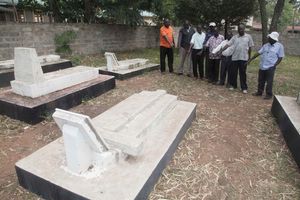
The body of 90-year-old Mburu Kinani has been lying at AIC Kijabe Mission Hospital mortuary since he died in November 2024.
Before 90-year-old Mburu Kinani died almost a year ago, he had made his wishes known as to where he was to be buried.
And as anticipated, a dispute arose following his death on November 20, 2024, as the children from his two wives could not agree on where to bury him.
The children of the first wife, Phelis Wanjiru Mburu, insisted that he had to be buried at his ancestral home in Gatanga, Murang’a County, where their mother was buried.
The children of the second house would hear none of it and maintained that it was the patriarch’s wish to be buried at his farm in Gilgil, where his second wife, Magdalene Waithera Mburu, was laid to rest.
Read: Dead in Oman, held hostage in Kenya: Man denied right to bury wife over unpaid Sh146,000 dowry
However, the documentary evidence of the elderly man expressing his wishes to be buried in Gilgil, including a video recording on his hospital bed, were disregarded by the court because of contradictions as to who recorded the video.
High Court judge Hellene Namisi then observed that the elderly man had abandoned his customary way of life and embraced Christianity- hence the Agikuyu customs had to give way.
“Secondly, the deceased contracted a statutory Christian marriage with Magdalene Waithera on 14 March 2020 at a church in Gilgil. This was after almost 37 years of enjoying a union with her under customary marriage. This created a primary legal bond with his second wife and her children, the appellants,” said the judge.
The body of the 90-year-old patriarch has been lying at AIC Kijabe Mission Hospital mortuary since he died in November last year.
The two families pitted Geoffrey Ng’ang’a Mburu, Alice Wambui, Rosemary Njeri, Regina Muthoni, and Patrick Karanja on the one hand and Ides Wairimu, Joyce Muthoni, Hannah Wanjiku, and Anthony Kinani on the other hand.
Axaxa
Geoffrey and his siblings, the children of the second wife, argued that their father had expressed his wish to be buried in Gilgil.
Ms Wairimu and her siblings said the customs dictate that the elderly man must be buried where his first wife was laid to rest, thus in Gatanga.
The judge said the wishes of the deceased, though not legally binding, should, as far as practicable, be given effect.
The court noted that the Gilgil family insisted that their father made an “express and unequivocal wish” to be buried in Gilgil next to his late wife, Magdalene.
They presented several witnesses and the video recording to support their claim.
The witnesses, including Bishop David Karethiu, said the elderly man had on several occasions, particularly around the time of the burial of his second wife, Magdalene, stated his wish to be buried in Gilgil next to her.
Read: Empty coffins, two crosses and a banana tree: Nyandarua woman’s 13-year battle to bury parents
The judge noted that the most significant piece of evidence was the video recording made by a nurse, which she allegedly recorded on her phone in 2020 at St. Mary’s Hospital. In the video, Mr Mburu allegedly stated his wish to be buried in Gilgil.
However, the court said there were contradictions in the production of the video evidence.
“Given the conflicting testimonies, inconsistencies, and lack of clear corroborated evidence, this Court finds that the oral wishes of the deceased regarding his burial place have not been proved to be unequivocally ascertainable. The trial court’s finding that the wishes of the deceased could
not be confirmed or verified is, therefore, upheld,” said the judge.
The judge, however, overturned an earlier decision of the trial magistrate directing the body to be buried in Gatanga.
Justice Namisi said for four decades, Mr Mburu chose to establish his home and family in Gilgil and even chose to enter into a statutory marriage, even after more than 30 years of a customary union.
“He chose to be with his second family. He chose to bury his second wife, Magdalene Waithera, there, where a grandchild had been interred earlier. To apply a rigid customary rule that effectively erases these profound, lifelong, and constitutionally protected choices would be to diminish his dignity in death,” said the judge.
The court added, “It is, therefore, my considered view that the trial court erred in law by prioritising a contested customary norm over the Deceased’s lived reality.”
Justice Namisi further added that there was a clear and damning picture of the irretrievable breakdown of the relationship between Mr Mburu and his first family.
She said in a letter, November 4, 2009, Mr Mburu stated that following the mistreatment by the first wife, he had decided never to return to that house.
“A corroborating letter from Phelis Wanjiru stated that she no longer wanted to live with the deceased. A further letter dated 5 November 2009 by Joyce Muthoni confirms her mother’s unwavering decision to separate,” noted the judge.
The court said the first family’s long alienation from the elderly man, contrasted with the second family’s care for him in his final years, spoke volumes about where his attachments lay.
“The final resting place of the late Mburu Kinani shall be his farm in Gilgil, Nakuru County, next to the grave of his late wife, Magdalene Waithera Mburu,” said the judge.
The court said the burial shall be conducted in a manner that respects his Christian faith and his Agikuyu heritage, with the specific arrangements to be led by the Gillgil family and who shall accommodate the participation of the family from Gatanga.