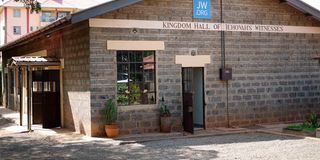
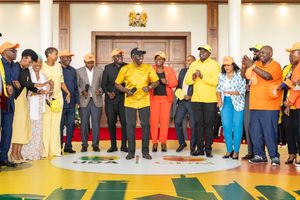
At the Kingdom Hall in Lenana, off Ngong Road, the setting is deliberately modest. There are no crosses, statues or elaborate decorations. The hall, which accommodates about 230 people, is designed to provide a quiet space for worship, Bible study and fellowship.
On this Sunday, the congregation is discussing honesty and morality, a subject being studied by Jehovah’s Witnesses in Kingdom Halls around the world. The lesson is drawn from The Watchtower, which members can also access through the JW Library app, available in several local languages.
The congregation holds two meetings: a Swahili session at 9am and an English one at 11:30am. Each lasts about an hour and 45 minutes and is divided into two parts. The first is a 30-minute biblical discourse on a practical or doctrinal subject. The second is a participatory question-and-answer discussion based on an article from the study edition of The Watchtower.
Members prepare beforehand, reading the material, examining the cited scriptures and considering the questions. They also study the Bible systematically, sharing lessons from their weekly reading as they work through the entire book over several years.
For Robbie Muchina, a ministerial servant at the congregation, this approach is central to the faith. Born and raised as one of Jehovah’s Witnesses, he began taking his religion more seriously after his baptism in 2013. Ministerial servants support congregation elders in their responsibilities.
Muchina was appointed to the position in January 2024, after being assessed against the qualifications outlined in 1 Timothy 3:8-10 and 12. These include being serious, honest, moderate in drinking and free from greed. The appointment, he explains, is not simply about holding a religious title. It is about demonstrating a willingness to serve others.
“You are given these duties so that you can serve people, so, you need to prove that you can serve them and you're motivated by love,” he says.
The elders guide prospective ministerial servants through the requirements, helping them identify areas where they need to improve. There is no separate training course or paid clergy class, instead, members receive spiritual education through the congregation's regular meetings, while men are encouraged to volunteer for responsibilities as they demonstrate that they meet the biblical standards.
Muchina combines his ministry responsibilities with his regular employment. He receives the subject and outline of a talk in advance, then prepares to explain the scriptures to the congregation. Balancing work and religious responsibilities can be demanding, but he relies on a weekly routine to manage his time. Daily Bible reading, including the organisation's daily text, also helps him navigate the challenges of everyday life.
For Aaron Lumumba, 39, the decision to remain a Jehovah's Witness came after questioning the faith he had inherited. Raised in a Witness family in Kwambera, Limuru, he had never experienced another religion. Even his grandparents belonged to the organisation.
But in his mid-twenties, he decided to examine his beliefs rather than continue practising simply because he had been born into the faith. He spent about a year reflecting on whether the organisation was shaping his spirituality in the right way and whether other denominations offered something he might be missing.
Aaron Lumumba with his son Travis and daughter Zuri at the Kindgom Hall of Jehovah's Witnesses in Lenana, off Ngong Road, Nairobi on November 8, 2026.
Photo credit: Thomas Rajula | Nation Media Group
“I came to a conclusion; yeah, I'm in the right place,” he says.
Lumumba says the guidance he received while growing up helped him navigate college life and avoid decisions that could have derailed his future. He also believes the teachings have helped him become a better person, husband and father.
“From my observation, they've done quite a good job at helping people become good human beings. You are constantly guided and helped to become a good father, a good husband, a person who interacts quite well in society,” he says.
He attends meetings with his children, Travis, 12, and Zuri, eight. Among the values he says the faith has reinforced is fidelity in marriage and respect for women, particularly in a society where patriarchal attitudes remain common.
He believes that being the head of a household does not give a man the right to disregard his wife's opinions.
“You consult and consider her views. You accord her the dignity that she deserves as a human being. She may have something very important to tell you, because whatever decision you would be making will affect her,” he says.
Peter and Milcah Chege, both in their sixties, also came to the faith after years of searching for a religious community. They became Jehovah's Witnesses around 1989 after Milcah began studying the Bible with members who visited their home. Peter later joined the discussions, curious about what his wife was learning.
One of the changes they had to explain to relatives was their decision not to celebrate birthdays and Christmas. Jehovah's Witnesses believe the Bible does not instruct Christians to observe these occasions.
They instead commemorate the death of Jesus, which they consider the central religious observance required of Christians. The Cheges say the decision initially required explanations to family members, but it also encouraged them to host relatives more frequently throughout the year.
“We became even closer as a family because we actually have more meetings and parties. They know that we will only be absent from celebrations that are not of the Bible,” they say.
The organisation does not prohibit alcohol, but teaches members to avoid drunkenness. Moderate consumption is permitted.
For Henry Wahome, 44, an elder at Lenana for the past four years, his responsibilities are driven by a desire to help others. He was baptised at 14, having decided that he had developed sufficient understanding and faith. His wife, Jackie, 39, says the opportunity to study the Bible and understand its teachings for herself was among the things that attracted her.
Today, the couple make time for family worship, a weekly discussion intended to strengthen their faith and address issues affecting the household. The couple say biblical principles help them navigate disagreements and the inevitable challenges of marriage.
Henry Wahome, his wife Jackie with their 20-month-old daughter Tasiwa at the Kindgom Hall of Jehovah's Witnesses in Lenana, off Ngong Road, Nairobi on November 8, 2026.
Photo credit: Thomas Rajula | Nation Media Group
“There is no perfect marriage or perfect family. You don't always see eye to eye, so you try and use Bible principles so that it's not maybe about my opinion or his opinion,” Jackie says.
Jehovah's Witnesses have sometimes faced hostility. In June 2026, a crowd of people reportedly surrounded and attacked eight Witnesses preaching in Kadzandani, in Mombasa's Nyali area.
The violence followed false claims by two local men that the preachers had caused their private parts to shrink or disappear through a handshake or greeting. Three police officers who responded were injured, while a generator was later vandalised and stolen from a Kingdom Hall in Bamburi. Authorities arrested two men over the claims, which medical and police investigations found to be baseless.
Victor Karoki, spokesman for Jehovah's Witnesses in Kenya, says the organisation worked with local authorities to restore calm. A public meeting was organised to educate residents, followed by an open day at the Kingdom Hall, where members of the community were invited to learn about the faith.
Karoki, who has been the organisation's spokesman in Kenya since 2023, says the incident reflects the risks members sometimes face while carrying out their ministry.
He began volunteering in 2014 after a career in information technology, including serving as regional information systems manager for East Africa at the UK Department for International Development.
He says Jehovah's Witnesses have also faced persecution elsewhere. In Eritrea, the organisation was banned after members declined to participate in the 1993 referendum on independence, citing their religious neutrality.
Karoki says 64 members remain imprisoned without trial, including 34 men and 30 women. Some have been detained for years. The organisation says 28 Witnesses were released in 2020 after serving between five and 26 years in prison, although further arrests have since taken place.
So, what distinguishes Jehovah's Witnesses from other Christian denominations?
The organisation describes its members as Christians who believe in God, whose personal name they understand to be Jehovah, and follow the teachings of Jesus Christ as recorded in the Bible.
They believe Jesus is God's son, sent to die for mankind, but do not worship him as Almighty God, citing his words in John 14:28: “The Father is greater than I am.”
They also believe in the Holy Spirit and regard the Bible as their guide for daily living. The organisation has about nine million members worldwide.
One notable feature is its absence of a “clergy class”. Karoki says all members are ministers, with men serving as elders and ministerial servants, while women participate in preaching and other responsibilities across the organisation.
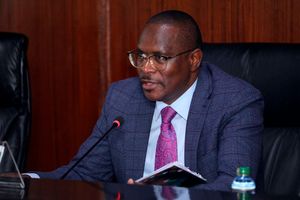
Jehovah's Witnesses, Kenya spokesman Victor Karoki during an interview at the Branch Office of Jehovah’s Witnesses – Kenya/Association of Jehovah's Witnesses in East Africa in Kilimani, Nairobi on November 10, 2026.
Photo credit: Thomas Rajula | Nation Media Group
“When Jesus Christ established Christianity, he did not set up that division. All of his followers were to be brothers and sisters. We don't have a paid clergy. Jesus was quite clear that we receive free and we give free,” he says.
This volunteer structure supports the organisation's preaching and Bible education work. Members conduct house-to-house visits, approach people in public spaces and use other methods to share their beliefs.
Although gated communities and tighter security have made home visits more difficult in some areas, the organisation has adapted through its website, JW.org, and literature carts placed in strategic public locations. The materials are offered free of charge. Karoki says members are trained to respect people's wishes and do not force conversations on those who are uninterested.
The simplicity of the Kingdom Halls is also deliberate. The buildings are designed to be affordable for local congregations and provide a space for Bible instruction, prayer and singing.
They do not display crosses or religious statues because Witnesses believe the Bible does not instruct Christians to venerate the object on which Jesus died. The faith also has particular teachings on marriage and family life.
Witnesses believe marriage is between a man and a woman, and members can choose to hold wedding ceremonies in a Kingdom Hall, at a garden venue or at a government office. The organisation has marriage officers registered by the government to conduct ceremonies.
They do not celebrate birthdays, Christmas or Easter, arguing that these observances are not commanded in the Bible and were not practised by early Christians. However, Karoki stresses that this does not mean they oppose celebrations.
“We like meeting together with family, having parties,” he says.
Family life is central to the organisation's teachings. Parents are expected to take responsibility for their children's religious education, supported by publications and resources designed for different age groups.
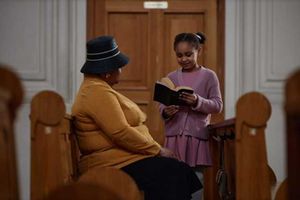
Rather than having Sunday schools, children attend congregation meetings alongside their parents. Families are also encouraged to hold weekly worship sessions, allowing them to discuss matters affecting the household and strengthen their faith together.
Becoming a Jehovah's Witness is presented as a personal decision. New converts undergo Bible study, learn what the organisation expects of its members and are encouraged to apply the teachings in their lives.
Baptism follows only after an individual chooses to dedicate their life to God and demonstrates an understanding of that commitment. Infants are not baptised because the organisation believes a person must make that decision independently.
The entrance to Bethel Nairobi, the Branch Office of Jehovah’s Witnesses – Kenya/Association of Jehovah's Witnesses in East Africa in Kilimani.
Photo credit: Thomas Rajula | Nation Media Group
Beyond ordinary volunteer work, some members join the Worldwide Order of Special Full-Time Servants, a religious order comprising people who devote their time to the organisation's preaching, teaching and administrative activities.
Karoki and his wife previously volunteered while running their own businesses. They later accepted an invitation to join the order. His wife, a dentist, now works in the purchasing department at the organisation's Nairobi branch office.
Members receive accommodation, a modest stipend for personal needs and services such as medical and hair care. Karoki says the provisions are standardised regardless of the work assigned, whether in cleaning, healthcare or legal services. Members can leave the order voluntarily.
For the Witnesses at Lenana, these structures and teachings are not simply religious rules. They are intended to shape how members conduct themselves at home, at work and in the wider community.
Their meetings, family worship and volunteer ministry are all built around the same conviction: that applying biblical principles should make a difference to everyday life.