It started with a simple touch.
A handshake. A tap on the shoulder. A brief encounter with a stranger.
But in parts of Kenya’s Coast region, such ordinary moments have become loaded with fear after a bizarre rumour spread that men’s private parts can mysteriously disappear following physical contact.
The claim, which has no medical or scientific basis, has triggered panic, violence and even death. Innocent people have been attacked by angry mobs, while police warn that criminals are exploiting the fear to create chaos and steal from unsuspecting members of the public.
The disturbing phenomenon has turned neighbourhoods into places of suspicion, where a stranger’s touch can spark accusations, crowds can quickly turn violent, and unverified claims can cost lives.
Medical experts have repeatedly dismissed the allegations, saying there is no known condition in which male genitalia can disappear after contact with another person.
Yet despite the lack of evidence, the rumours have continued spreading through social media platforms and word of mouth, creating a wave of fear along the Coast.
The panic first gained attention in Tanzania, where similar claims emerged on the mainland and later in Zanzibar.
Authorities there were forced to intervene after the allegations sparked mob attacks, injuries and destruction of property.
Police investigated complaints from people who claimed their private parts had disappeared and subjected them to medical examinations. The results found no evidence of physical changes or loss of organs.
Tanzania’s Minister for Home Affairs, Patrobas Katambi, warned members of the public against spreading the false claims or taking the law into their own hands.
“Every person who claimed their private parts had disappeared was medically examined, and specialists confirmed that nothing had happened,” the minister said in April.
He described the allegations as dangerous fabrications that had already caused harm and threatened public safety.
Weeks later, the same fear crossed into Kenya, finding fertile ground in parts of the Coast region.
On June 19, four Jehovah’s Witnesses members left for what should have been a routine door-to-door evangelism exercise in Nyali, Mombasa.
Jehovah's Witness preachers shelter inside a room in Mtopanga, Mombasa County, on June 19, 2026, after seeking refuge when an angry crowd surrounded them over false allegations linking them to the alleged disappearance of men's private parts.
Photo credit: Brian Ocharo | Nation
The four entered Mtopanga Phase Two, where they engaged residents as part of their normal religious outreach.
But within hours, a strange accusation began circulating that the preachers were responsible for making men’s private parts disappear.
The rumour spread quickly, drawing a hostile crowd that accused the evangelists of using supernatural powers.
The four men were surrounded, assaulted and threatened with lynching before police officers arrived and rescued them.
Officers rushed them away from the angry crowd and briefly sheltered them in a nearby house before escorting them to safety.
Weeks later, the incident became one of the first cases in Kenya linked directly to the false claims to reach court.
The Jehovah Witness Kingdom Hall in Bamburi, Mombasa County, where members congregate for worship and religious meetings.
Photo credit: Brian Ocharo | Nation
Two residents, Al Amin Mgunya Johnson and Kennedy Mersyden Milimo, were charged with incitement to violence over the attack.
According to the charge sheet, the two allegedly shouted words to the effect of: “These are the people removing people’s private parts.”
Prosecutors said the remarks were intended to provoke members of the public into attacking the four preachers — Brian Mwangi, Kennedy Madara, Eric Kutete and Marko Ingaanga — who sustained injuries during the assault.
Johnson and Milimo face four counts of incitement to violence contrary to Section 96 of the Penal Code.
Milimo also faces an additional charge of assault causing actual bodily harm, with prosecutors alleging that he attacked Mwangi by kicking and striking him.
The two denied the charges when they appeared in court on June 26, 2026.
Martin Henya, an elder of the Jehovah's Witnesses at the Bamburi Kingdom Hall, addresses the media at the church's gate in Bamburi on June 19, 2026.
Photo credit: Brian Ocharo | Nation
Martin Henya, a Jehovah’s Witness elder at Bamburi Kingdom Hall, dismissed the allegations, saying the religious group had nothing to do with witchcraft or supernatural practices.
“They were detained by members of the public while conducting door-to-door evangelism. People started accusing them of being part of a group responsible for making men’s private parts disappear. Those allegations are completely false,” he said.
Henya said Jehovah’s Witnesses are globally recognised for their house-to-house ministry and Bible teaching, adding that they have no connection to the claims being circulated.
The two accused were released on a bond of Sh300, 000 each with a similar surety.
While the court case continues, another tragedy linked to the false claims has left a family mourning.
John Joshua Kaleghe, 24, was killed by a mob at Marikiti Market in Mombasa after being falsely accused of making another man's genitals disappear through touch.
Photo credit: Pool
At Mombasa’s Marikiti Market, 24-year-old John Kaleghe was allegedly attacked and killed after being accused of making someone’s private parts disappear through touch.
Family spokesperson Leah Mwandaghina said Kaleghe was the last-born in the family and had been their hope for the future.
“He was the last-born, and his parents had pinned all their hopes on him. They even took him to college at NITA. We are still in shock,” she said.
The family only learnt of his death days later after a friend who had sent him to Marikiti to buy items became worried when he could not reach him.
“The person called us a few days later, saying he had given our son money to buy things. He thought our son had conned him. We started looking for him, but his phone was unreachable. We later found him at the Coast General Teaching and Referral Hospital mortuary,” said Ms Mwandaghina.
She said the family struggled to identify him because his injuries had severely disfigured his face.
“His face was deformed. No one has been arrested so far. We have lit candles and spoken to witnesses who told us police officers were nearby when he was being attacked,” she said.
The family alleges that Kaleghe ran towards police officers seeking help but was unable to escape the angry crowd.
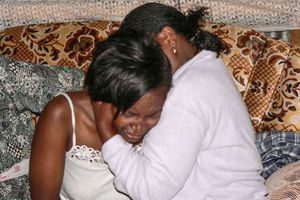
John Kaleghe's mother, Mama Dorcas Mwakoi, overcome with grief following the brutal mob killing of her son in Mombasa. Former Taita Taveta Woman Representative Ms Joyce Lay comforted the bereaved.
Photo credit: Pool
Marikiti businesswoman and content creator Odency Atieno has been using her social media platforms to warn residents against mob justice.
She said one of her employees narrowly escaped a similar attack after being accused during another incident.
“How do you throw the first stone without verifying the facts? Imagine if it were your brother. Would you still join the mob simply because someone claimed their private parts had disappeared?” she posed.
“He cannot sleep. He keeps reliving what happened and wakes up frightened. He suffers constant headaches and nightmares,” she said.
In Kilifi County, residents have called on the government to launch public awareness campaigns to stop the spread of the rumours.
“The government must move quickly to educate Kenyans because people have become afraid of even greeting one another with a handshake,” said Alfred Mtawali on his Facebook page.
Coast Regional DCI Coordinator Benson Kasyoki said detectives have recorded 19 cases linked to the claims across Mombasa, Kilifi and Kwale.
Seven cases were reported in Kwale, nine in Kilifi and three in Mombasa.
According to Mr Kasyoki, all alleged victims have undergone medical examinations conducted jointly by investigators and health officials.
“The results conclusively show zero physical harm, zero anatomical changes and zero loss of organs,” he said.
The pattern, police say, involves one person falsely claiming that their private parts have disappeared after being touched by a stranger.
John Joshua Kalaghe, 24, was killed by a mob at Marikiti Market in Mombasa.
Photo credit: Pool
As crowds gather around the accused person, accomplices allegedly take advantage of the confusion to steal phones, wallets and other valuables.
Police have also raised concerns over social media users who circulate unverified videos and fabricated claims, further fuelling panic.
The DCI has launched investigations, including reviewing CCTV footage from fatal attacks, to identify individuals involved in mob violence.
Those found to have participated in killings, incited violence or encouraged attacks could face serious criminal charges, including murder.
“Do not allow criminal gangs to weaponise fear and misinformation to cause bloodshed in our communities,” he said.
“Scientifically, it is almost impossible for a person’s genitalia to disappear. Mere physical contact cannot cause someone’s genitalia to disappear. That is simply a myth,” Dr Salman said.
He explained that some men may experience temporary changes caused by natural body processes, such as the movement of the testicles due to contraction of the cremaster muscle.
However, he said this should never be confused with disappearance.
“If a person’s genitalia truly disappeared, that individual would be unable to pass urine. Failure to pass urine is a medical emergency that can lead to kidney failure and requires urgent treatment,” he said.
Dr Salman believes the rumours are sometimes used to promote individuals claiming supernatural powers.
“In my opinion, this is a marketing strategy for people who practise witchcraft or claim to have supernatural healing powers. Someone spreads the story that a particular person can restore the missing genitalia, and suddenly that person becomes popular and attracts more clients,” he said.
But beyond the claims and counterclaims lies a more painful reality: a dangerous rumour has already taken away innocent lives.
And along Kenya’s Coast, authorities are racing against time to stop misinformation before another accusation becomes another tragedy.