My last article in this column was about places associated with three famous women: Karen Blixen, Elspeth Huxley and Joy Adamson. This one begins with a story about another woman, less internationally famous, Nani Croze – an artist whose stained-glass work can be seen in many buildings in Nairobi.
Not so long ago, I visited her place to see the transformation her son, Anselm, has achieved since taking over the management of Kitengela Glass. We had lunch in the Glasstronomique Café, watched the glass blowing at the foundry, walked through Nani’s Wonderland of fairy tale buildings and sculptures, browsed the gallery of Nani’s art, visited the amazing shop with recycled blown glass – dalle de verre tables, vases, goblets, tumblers, beads, tableware, lamps and chandeliers. But we didn’t see the accommodation that is available.
There are five houses at Kitengela Glass – all intriguingly of eccentric architecture and unusual interior design. So, we thought Helen, my niece, would enjoy a visit, particularly if we stayed the night. We booked the Pool House, which has two bedrooms. As we drove the mainly rough road from Ongata Rongai, Helen said, as so many must have said before her, ‘For a place that makes and sells glassware, how on earth do they make sure that a lot of it doesn’t get broken before it reaches the tarmac?’
As to Helen’s reaction when we actually arrived at Kitengela Glass, I am going to use a word I haven’t used before – enthralled. Yes, that’s what she was – enthralled. This is how she described it herself in the blog she was writing every night of her holiday here: ‘My goodness, what an experience; everywhere you looked, there was unfettered creativity.’
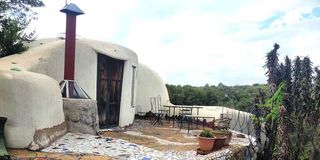
There was time to walk round before checking into our cottage. I can’t do better than use Helen’s own words again. ‘We entered Nani’s Wonderland. It is a collection of Hobbit-style cottages, hewn out of the rocky hillside and constructed of concrete, mosaic and mirror glass. There were winding paths and zany sculptures. It was as if we had entered a dream world. It was how Alice in Wonderland must have felt when she dreamt she had fallen down a rabbit hole. Everywhere, there was beauty and creativity.’
When she saw the Pool House we would be staying in, she was even more excited. ‘It was like a very up-market cave,’ she said, ‘built within the rocks.’ In the main room, the floors were made of polished concrete with insets of mosaic glass. The ceiling had blown glass spheres of different colours. To reach her bedroom, Helen took a spiral staircase, with mosaic glass treads that matched the windows.
We had a sundowner on the patio that had a view overlooking the Nairobi National Park, and we had some interesting visitors. First, there was a peacock that stayed with us until joined by a couple of playful monkeys. At night, we heard the muffled roar of a lion and the whoops of hyenas. In the morning, the peacock came again as we were eating breakfast. We didn’t need to use the catapult we had been armed with to ward off the scavenging baboons.
The house Helen used to have, a manor house in Lincolnshire in the UK, was full of art, artefacts, furniture and fabrics from China. When I visited it, I thought of the late Alan Donovan’s African Heritage House that is similarly full of art, artefacts, furniture and fabrics – but all, of course, from Africa. I knew that was a place to take her.
Friend of Joseph Murumbi, Kenya’s second Vice President, co-founder with him of African Heritage, collector of African art from all over the continent, Alan Donovan left the house he loved – the house built like an African mud palace and overlooking the Nairobi National Park – he left it as a superb gallery of the kind of art he collected, displayed and promoted. Certainly, Helen loved being there. ‘There were artefacts everywhere you looked,’ she said, ‘beautifully displayed. No bit of wall was left bare. Wonderful.’
Preparing for the three articles I have now written about Helen’s visit, I recorded a long talk with her before she left. She had said that she would like to visit historic places in Nairobi, so we took her to both the Stanley and Norfolk Hotels.
Now known as the Sarova Stanley, it began life as a modest hotel and guest house in 1902 – four years after Nairobi was founded as a railway depot; two years after it was incorporated as a township; three years before it replaced Mombasa as the capital of the Protectorate.
We had lunch with Helen at the Thorn Tree Café and then had a coffee in the Exchange Bar on the first floor – which, from 1954 to 1991 was the site of Nairobi's first Stock Exchange. Helen admired the elegance of the hotel; she spent time in the reception lounge looking at the many photos of the old city. Before leaving, she noted that most of the people sitting in the Thorn Tree Café would not have been tourists. It was still a meeting place for people of Nairobi.
About the Fairmont Norfolk Hotel, she told a different story. Built back in 1904, she felt that it has now been cut off from the city. ‘It is a shame that the Fairmont has sanitised it,’ she said. ‘You have to pick very carefully through all the newness (which is very nice) to see anything of the old hotel and the old Nairobi. Also, I can see that the Delamere Terrace is no longer a town meeting place.’
As for the Nairobi here and now, Helen, who once had her own restaurant in Taiwan, was full of praise for the restaurants we took her to. ‘I was stunned,’ she said. ‘The calibre of the food, the ambiance, the service – all were excellent. It was the same for every restaurant we went to. It’s a good place, Nairobi. A very good place.’