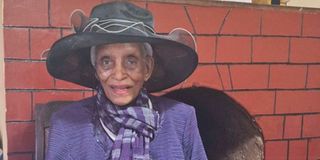
One of Kenya’s most renowned school matrons has penned a book looking back at how she got the government to enlist her help in Africanising meals in top secondary institutions after independence.
Mrs Dinah Gicuku Kivuti, 88, first made a name for herself as the matron of Alliance Girls’ High School (AGHS), introducing a local touch to the meals at the then European-run school. She writes that her success saw the Education ministry seek her guidance as it spread a diet Africanisation programme to Lenana School, Nairobi School, Kenya High School, Mary Hill School, Alliance High School, among others.
The book, titled Called to Serve, was launched on August 2 at the St Paul’s Cathedral in Embu in an event graced by former Vice President Kalonzo Musyoka . Regarding the changes she brought at AGHS where she was hired as a matron in 1965, she writes: “With my experience of African food tastes, I made a big impact. I changed a lot of things, for instance cooking hours. Instead of cooking dinner during the lunch hour, I had them cook it from 4pm, and instead of serving githeri separately from the gravy, it was fried together. The food tasted better, fresh, and it was hot.”
“I then discovered that because the schools would be in session when maize was green, I could buy green maize and boil it for the students. I did the same when I noticed there were sweet potatoes on the farms.”
The changes did not go unnoticed. At the end of her first term, during a speech day attended by Vice President Jaramogi Oginga Odinga as the guest of honour, the headmistress publicly complimented Mrs Kivuti’s improvement of the students’ food.
“In the following year, 1966, the Minister of Education had heard of my catering ability. Because they wanted to Africanise the menus of many schools in the country, I was asked to change the menus,” she writes, noting that besides the top secondary schools, she also worked with Thogoto Teachers College and Musa Gitau Primary School. In the book, AGHS alumna Mary Khimulu recalls the changes Mrs Kivuti introduced.
“She was greatly loved by the students, not only because she improved our school diet but because she took a sincere and personal interest in our well-being and development,” writes Dr Khimulu, who was Kenya’s first fully-fledged ambassador and permanent delegate to the United Nations Educational, Scientific and Cultural Organisation. The book also carries the testimonial of Enid Micere Kivuti-Kariuki, one of Mrs Kivuti’s children, who flashes back to her mother’s matron days.
“At Alliance Girls, she nurtured students with the warmth and care of an African mother; mentoring, training, loving and correcting,” writes Ms Micere, a US-based engineer.
Before Alliance, Mrs Kivuti had cut her teeth in institutional catering as matron at Kigari College, where she pushed back against resistant kitchen staff and instilled new standards of discipline. This included personally tasting food before it reached students, a practice initially resisted by cooks loyal to the old order. After AGHS, Mrs Kivuti went on to manage the ACK (formerly CMS) Guest House in Nairobi, turning down a higher-paying offer from the Hotel Intercontinental. There, she again paid special attention to local dishes.
“I worked very hard to introduce new ideas of African menus because previously, the main meals consisted of potatoes, rice, spaghetti and macaroni. I introduced dishes like mukimo, bananas, nduma, beans, and matoke,” she writes.
Mrs Kivuti is a woman of many achievements, credited for founding the Kamuthuago Christian Women’s Group that later started the Ena College that is today a government-run catering and hospitality institution. The women’s group campaigned against female genital mutilation, using schools and church networks for awareness work. She writes that the founding of the women’s group was due to a call from God that she simply could not turn down.
Dinah Gicuku Kivuti, a Christian women leader and a former matron.
Photo credit: Pool
Given a Head of State Commendation in 2004, and listed among the prominent sons and daughters of Embu by the Daily Nation in 2001, Mrs Kivuti has been a woman of faith at the Anglican Church, and she notes that she was saved at a very young age.
In the final chapters of the book – which has been put together over the years with the help of her granddaughter Vicky Murungi and daughter Emily Obwaka – Mrs Kivuti’s lifestyle in her late eighties is described in detail. Because she is managing diabetes, high blood pressure and the after-effects of two strokes, she is keen on her diet and exercise.
“I suffered a second stroke seven years after my first stroke. I was almost unable to walk, but the Lord kept me strong again,” writes Mrs Kivuti, noting that despite the vagaries of age, she enjoys great support from family and friends.
Rev Dr Obwaka writes that her mother, who lives with her, leads a very structured life.
“She normally wakes up at 7.30am to bathe, then is ready to have breakfast at 8.30am. Between these two times, she has her blood sugar checked and enjoys a glass of warm water,” writes Dr Obwaka, the wife of former Harambee Stars and Gor Mahia footballer William Obwaka.
“She takes a few walks and a mid-morning break, lunch at 1pm and a siesta time in the afternoon. Towards the end of the day, she does at least 10 laps walking with assistance in the garden, after which she is ready for the evening mini-bath and to change into night gear ready for dinner at 7.30 pm. Mum is a stickler for the evening news, which she watches without fail at 9pm. Bedtime is at 10pm after our evening prayer time,” she adds.
Mrs Kivuti writes that she was born in 1937 in Eganjagi village in Embu. She did not know the precise date of her birth, and she later settled on December 29. Her book details at least three instances where she nearly died but somehow made it, including a time when she was so ill with typhoid that her mother laid her by the road to wait for death.
“I was taken to the roadside by my mother. I had told my mother that it was likely that I might die and that she should not bother herself to bring me back home for burial. Instead of the cost of burial at home, I insisted I would rather be buried in Embu Graveyard. We had heard that many girls were not surviving the disease, so I said goodbye to my mother and sisters. At the roadside, they placed a 10-cent coin for transport [in case a motorist chose to carry her to hospital] on top of the blanket that covered me. The few vehicles coming by passed, and by God’s grace, at about 4pm, a white woman driving a Land Rover pulled over,” she writes.
“She uncovered me and spoke to me in English. I let her know I was very ill. The woman helped me into her vehicle and took me to the hospital. Not only did she take me to the hospital, but she looked for a doctor,” she adds. “After two weeks, I recovered and was discharged. No one visited me in the hospital. However, I did not blame anyone because, first and foremost, money was rare to come by and there was no public transport. Moreover, no one was informed of my whereabouts.”
In another instance, she missed a bullet fired by a colonial military officer by mere inches. She had decided to visit home at the height of the State of Emergency when the Mau Mau and the colonial government forces were in a full-blown war.
“An army man was shooting towards me as I reached outside my mother’s house. Fortunately, the bullet missed me! Within the next few minutes after the bullet had been shot at me, about four army men were instructing young people to collect and carry the bodies of young people they had shot dead a few metres from our house,” recalls Mrs Kivuti.
She also contracted tuberculosis in the late 1950s, surviving miraculously.
“During the time of my illness, medication for tuberculosis was very bitter, including the required ingestion of a glycerine powder which one would put in water and stir for ten minutes before it dissolved. After drinking it, one would get very thirsty,” she recalls.
From surviving death in her early life, Mrs Kivuti tells the narrative of meeting her late husband – Lay Cannon Nelson Andrew Kivuti – the first boy from their area to be admitted to Alliance High School. They got married in 1959.
“We committed ourselves to work so we could support our family because we had had a child before marriage. The little money we earned could not support us. During our marriage ceremony, I had to hire a gown from my friend for Sh10. My husband had only the trousers he used in high school for that day, and because he needed a coat, he borrowed one from a friend. Nevertheless, this condition did not discourage us because we were very ready to protect our marriage and our love, so other things would come later,” writes Mrs Kivuti.
They lost their first child, Lucy, at about nine months. They then gave birth to four more, whom they have raised to adulthood.
“Nelson and I were able to bring up four responsible children who grew up, acquired degrees, got married and settled in their own families,” she writes.
Some of the highlights of her life shared in the book include those from the 1984 famine in Embu and Mbeere. Touched by the plight of locals, she wrote to companies and overseas friends seeking flour, milk powder, clothes and other aid. For about a year, she carried supplies from Nairobi on weekends and distributed them to elderly people, children and nursing mothers.
“People would turn up in large numbers, including the youth. I had no option but to divide whatever I could raise for the many who needed help,” she writes.
“Surprisingly, even when you help people, they might never come back to you to say thank you or show any appreciation, but the joy of giving never dies. To date, I still feel the joy and fulfilment in giving because I receive news of the sons and daughters of many people I have helped who are doing great things. Of course, even when you are not paid by anybody for help and kindness, the Lord gives back to you a bigger reward and a double portion.”
Mrs Kivuti’s guest house work and church connections have taken her to more than a dozen countries, including England, Wales, Germany, Denmark, Sweden, Switzerland, Israel, Ethiopia and the United States.
“I have worked with many organisations, travelling to more than 16 countries, doing counselling and helping people in their communities,” writes Mrs Kivuti.
Replete with vivid recollections, family moments, faith in action and testimonials, Mrs Kivuti’s autobiography ends with an encouragement to everyone to pen down their story at some point.
“Tell your story. Your story is not only for you. Everyone is a walking book so that they can help others,” she writes.