Sex is a major reason why people get married. It is possibly a non-negotiable reason for men more than women. So I was not surprised when Purity came to the Sexology Clinic in distress two years ago, having been threatened with divorce by her husband.
"I thought we agreed that, for better or worse, we would never leave each other," Purity lamented. "We didn't say that an inability to have sex was a reason for separation."
The couple had only been married for one year. They were both in their late twenties. Purity was an accountant in a government-owned company, while her husband, John, worked for an NGO as a project officer. The couple did not yet have a child.
The trouble for this couple started on their wedding day. While they were dating, they abstained from sex. They were both religious and had decided that they would only have sex after marriage. However, as fate would have it, sex was impossible because Purity experienced severe pain during penetrative sex. A year later, there had been no improvement, and Purity had become averse to sex, refusing to try at all.
"I suspect that my husband has moved on and started seeing someone else," Purity lamented, her eyes filling with tears. "He has become increasingly uncaring, spends nights out, and wants nothing to do with me."
Further investigation revealed that Purity experienced excruciating period pains. These started when she began having periods and had worsened over time. She now experienced dull pelvic pain even when she was not on her period.
"I had to give up demanding jobs because of my condition," she said. "In fact, I would have liked to do a Master's in finance, but I don't have the energy — the suffering is too much."
Purity had been treated several times for a pelvic infection. Each time she went to hospital, she was given antibiotics. The tormenting pain and the risk of losing her marriage had pushed her into depression. She was already seeing a psychologist, who referred her to me.
I examined Purity and, without a doubt, she was experiencing pelvic pain, which could easily be mistaken for pelvic inflammatory disease, a common pelvic infection. However, tests, including ultrasound and other imaging scans, did not confirm the diagnosis.
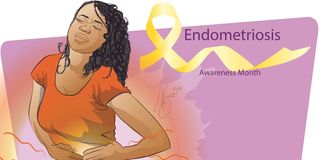
March is Endometriosis Awareness Month, and it occurred to me that Purity could actually have the condition.
Medical and surgical treatments
Endometriosis is usually difficult to diagnose without laparoscopy, a procedure in which the doctor looks inside the pelvis through small incisions in the abdomen.
"At this point, I am ready for anything, doctor," said Purity. "If laparoscopy is needed to make the diagnosis, please go ahead."
Purity underwent laparoscopy and was indeed found to have endometriosis. It is estimated that over 200 million women worldwide have endometriosis. On average, one in ten women has the condition. Due to a lack of knowledge about the disease, both the public and the healthcare system do not consider it, and many women are diagnosed after suffering for more than ten years.
Biologically, endometriosis is a condition in which the inner lining of the uterus, which normally sheds as blood during menstruation, grows in other organs outside the uterus. These tissues can be found in the fallopian tubes, ovaries and intestines. In severe but rare cases, they can be found in organs as far away as the lungs and even the brain. As menstruation occurs every month, the endometrial tissue in these organs also bleeds. This causes pain. Inflammation from internal bleeding can cause scarring and adhesions, leading to additional pain even when there is no menstruation.
As well as causing non-resolving pelvic and sexual pain, endometriosis can lead to infertility. This is not only because it makes it difficult or impossible to have sex, but also because inflammation of the internal organs can cause damage that makes conception impossible. Damage to pelvic nerves can lead to additional pain that extends beyond the pelvis and sometimes into the lower limbs.
“It sounds awful!” Purity said, sobbing. “Is there anything good I can look forward to in this life?”
Well, there are medical and surgical treatments available, and most women live fairly normal lives depending on the severity of the condition, although a permanent cure is rare. Hormone-modifying drugs and painkillers are commonly used. In advanced cases, surgery is performed to remove the abnormal endometrial tissue.
With good treatment, many women are able to live near normal lives, have sex and have children. The greatest challenges are the lack of timely diagnosis and the socio-cultural myths surrounding the symptoms of the disease. This is why March has been designated Endometriosis Awareness Month, to spread the message and raise awareness of the condition's global impact on women.