The curse of authors being accused of using ‘Artificial Intelligence’ (AI) to give a steroid boost to their creativity has struck again, this time at the prestigious Caine Prize for African writing.
The 2026 winner, Zimbabwean writer Simbarashe Kunduzeza, was exposed in an article in ‘The Atlantic’ as having used AI in his 2026 Caine prize-winning story, ‘The Blue Fighter,’ setting off the latest firestorm in a year where ‘AI’ will surely be the buzz word of the year – having been on everyone’s lips, but also, unfortunately, on too many writers’ fingertips.
The Commonwealth Short Story Prize mid-year was marred by a similar controversy – and although Jamir Nazir got to keep his award (for ‘The Serpent in the Grove’), the stylistic red flags for A.I. were enough for Granta to withdraw its publishing deal with the Commonwealth Foundation that administers this literary competition.
Haitian-Canadian author Thelysen Orelien also had his book c’etait ca ou mourir (It Was Either That or Die) pulled out of both the ‘Prix Goncourt’ Award longlist, and the short list for the Fnac novel prize, the former especially being a prize to die for in France.
After essayist Samuel Fitoussi exposed him, Orelien denied using ‘AI’ for his book, but following further exposes on ‘X,’ he admitted to having plagiarized sections of separate, older works, completely destroying his creative credibility.
For Jerry Falade, a Nigerian author, the AI fallout for his book “Call Me, I’ll Hide the Body” was especially bitter. Having made a dream debut, the brand new Nigerian author was offered $2 million (Sh 250 million) from Minotaur, owned by Macmillan US, the plan being to bring out this debut book in 2028.
But an email sent to publishers by Falade’s agents in August said: “Jerry Falade produced an incredible manuscript that dazzled us and the top publishing professionals around the world. Unfortunately, we are no longer able to authenticate how the manuscript fully evolved, from origin to completion.”
It continued: “During the submission process we vetted the manuscript with Jerry for AI and felt trusting in his reassurance that it was written without utilising AI as a resource in the writing or editorial process. We can no longer substantiate that, and we are withdrawing the book.”
Europa opted against using AI-detection software to check the manuscript, saying Falade was “clear and credible” in his explanation.
However, after a meeting on 29 July, 2026, when “aspects of [Falade’s] story changed”, the agency decided to cut ties, citing the “need to have total faith”.
“We feel terrible for putting this into the universe and the firestorm it has caused,” the agents added. “The book itself is genius – however it came to be drafted, it’s amazing.”
The fact that it is his own double agents, who each stood to make $ 100,000 dollars (Shs 13 million each) from the deal only lends credence to the devastating charges against the debut Nigerian author – and whilst older authors who have never used ‘AI’ in their works are unlikely to start now (due to reasons both for reputation and out of technological ignorance), it can be tempting for younger writers to reach for the “booster steroid” of AI, which they are often already well-versed with, including as tools to write (their) college essays.
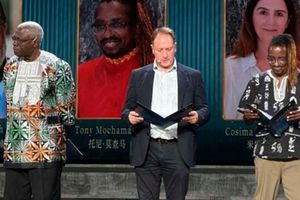
2026 winner, Zimbabwean writer Simbarashe Kunduzeza, was exposed in an article in ‘The Atlantic’ as having used AI in his 2026 Caine prize-winning story, ‘The Blue Fighter'.
Photo credit: Photo I Pool
In the latest Caine’s case involving the writer Simbarashe, the Caine Prize chairperson Ellah Wakatama stated that the organization is handling the allegation with a “human-centered approach rather than relying on software tools as a final arbiter,” further noting that AI detectors, including Pangram, are not infallible (tools of) detection.
Having attended and trained at a week-long ‘AI and the Arts’ conference in Shanghai a couple of years ago (at which Wole Soyinka was present and pleaded with writers to use O.I. – ‘original intelligence’), this writer decided to put Kunduzeza’s ‘Blue Fighter’ story through an arbitrary ‘human-centered’ approach to AI-detection.
"We can't afford this house anymore," she said one evening, placing the notice in front of him while he tested the seal on his newest creation. Not with anger, but with the quiet resignation of someone who had known all along this moment would come. (That second sentence is AI, with AI's typical seesaw sentence balance).
There was no denying it now. We had fallen, and the neighbourhood knew it. The children on our street watched us with curious eyes as we arrived, instantly categorising us as outsiders. Not quite poor enough to have always lived in Ngoni, but no longer wealthy enough to stay wherever we had come from. (That last sentence, you are beginning to see the sentence seesaw, is AI whipsaw).
Government workers were seen as either corrupt, connected, or complicit, especially those who still got paid on time, or at all. And anyway, what was my father now? Not the civil engineer he'd trained to be. Not the small business owner he'd attempted to become. Certainly not someone the government would be eager to claim. (The sentences with 'not' are not not AI).
The fish were transferred to plastic bags, their colours dulled by confusion, gasping in their shrinking prisons. Shamu loaded the empty tanks onto his truck with the casual efficiency of a man who trafficked in other people's failures. (A brilliant first sentence, followed by the casual efficiency of AI that thrives in the failures of people's ideas).
Mother was counting the money again, sorting it into a neat pile. "Yes," she said simply. "But anger burns out eventually. Hunger doesn't." (Aiiii, pure AI).
That night, I heard them talking in low voices in their bedroom. Not arguing. Their tones were too measured for that. But negotiating something fundamental between them. I pressed my ear against the thin wall, but I couldn't make out specific phrases, just the rhythm of their exchange:
Father's voice rising with emotion, then Mother's steady response pulling him back to earth.
Over and over, like waves against a shore, gradually wearing down resistance.
(This paragraph is like waves - one human sentence hits the shore, then for sure the next one is AI, and so on & so forth, to-and-fro, foam, froth).
(VII) She accepted it with a nod that contained neither victory nor submission, just acknowledgment of a new arrangement between them.
(VIII). And I thought, maybe that was us, too. Not broken, just learning how to live differently. Alone, sometimes. But still moving. (Can you spot the AI sentence by now)?
Anyway, those are the 8 definite AI 'catches' I caught on a thorough human-centered reading of ‘The Blue Fighter.’
If they do, the prize should go straight to Kenya’s own Gladwell Khavaiye Pamba for 'The Last Shop,’ a story that was published by ‘Jahazi Press’ in an anthology (Let Us Conspire And Other Stories), and workshopped under Duke University lecturer Billy Kahora.
One can compare its clean, creative prose, with the fishy ‘Blue Fighter’ story we sliced and splayed to display sentences that sound suspiciously like AI, which does have its own ‘style.’
“There was an open coffin she’d been working on. Its white satin interior reminded me of my parents’ duvet; the one Mother bought from the Egyptians who drove around Bukembe, selling bedding and kitchenware on hire purchase. I wondered whether the dead loved the feel of satin on their skin, whether it produced sparks in the dark when rubbed. I watched the Maersk truck on the Malaba highway as it panted uphill. The driver, chewing miraa, looked groggy. Madam Supreme emerged from the backdoor of her shop, holding out a brown sugar bag. I stared at the creases on her hands as I took the sugar. I wanted to shout my gratitude, but my tongue felt as though the world rested on it and so I smiled at her and she smiled back. That evening, I returned to Supreme Coffins with the China mug I’d won during a junior drawing competition. I found her drilling a plank, the fine dust falling like flour from a posho mill. The whirring sound swallowed my knocks and I stood at the entrance until she finished. She pushed the goggles atop her head, gesturing me to a stool, but my legs had grown roots. She gazed at me with an amused smile. ‘You think death will leap out of the boxes and grab you?”
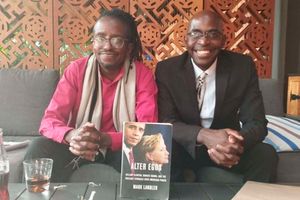
Tony Mochama is a multiple-award winning author who hopes to use AI someday, 2060 [email protected]