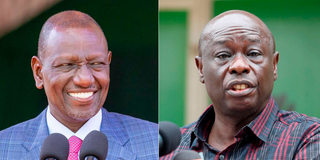
Former Deputy President Rigathi Gachagua has stood eyeball to eyeball with the powers that be, swapping gazes in a dangerous game of power. A seemingly capricious guardian of Kenyan political fate, it is hard to picture him doing mundane things: having his head held firmly over the back of a chair, his throat menaced by a razor wielded by an absent‑minded barber who talks with a phone clamped to his shoulder, his neck doing the work of a hand.
Instead, it is easy to picture him like a Mafia don, stroking his moustache and puffing on a cigar, a boss encouraging his young mafiosi to wreak havoc between two warring factions.
Gachagua careens from dark humour and sentiment to invective and even aggressive language. Yet beneath all this, he reminds one of Brutus in Shakespeare’s Julius Caesar . In the play, after Caesar is assassinated, Brutus addresses the crowd, believing that politics is a matter of logical reasoning. His speech is direct and straight to the point: “Romans, countrymen, and lovers, hear me for my cause.” He appeals first to citizenship, then to reason, and only lastly to affection. He assumes (sometimes wrongly) that the public will respond to straight talk. He tells them, “Not that I loved Caesar less, but that I loved Rome more”, believing that truth will triumph over everything.
In that way, Brutus is like Gachagua, the self‑styled “truthful man”. He relishes delivering the hard “truth”, no matter how hurtful it is, and sometimes uses words his opponents consider raw and coarse but which he considers “truthful”. Brutus cries out, “Sic semper tyrannis” (thus always to tyrants) at Caesar’s assassination.
In the battle between Gachagua and President William Ruto , Gachagua is closest to Brutus and President Ruto to Mark Antony. In Julius Caesar , Antony — a soldier, a charmer, and a lover of feasts — understands something different. He knows that politics is theatre (spectacle, in fact) and that crowds are moved not by “truthful” words but by emotion. He begins with a warmer, more intimate address: “Friends, Romans, countrymen, lend me your ears.” He brings the crowd close as “friends” before he draws them close as citizens.
Gachagua is like Brutus in several ways. First, he is a man of plain speech (he rarely uses proverbs, winding or even diplomatic language). In this way, he is unlike the late Prime Minister Raila Odinga , who was known for speaking in riddles (vitendawili ) and other coded language. Brutus speaks directly, almost bluntly; Gachagua often uses literal, unadorned language that assumes simplicity and rawness equal persuasion. It is a formidable method, but it has its weakness, and that is also Brutus’s weakness. Gachagua’s speeches feel like Brutus, who said, “I speak plainly for the Republic.” Ruto’s speeches often feel like Antony’s, something like: “Let me take you on a journey.”
The second is an appeal to duty. Brutus frames his actions as service to the Roman Republic, just as Gachagua frequently positions himself as defending “the people”, especially Mt Kenya, from perceived neglect.
Third is moral framing. Brutus believes his motives are pure and expects others to see them as such; Gachagua often speaks as though his intentions should be self‑evident and that he is defending the people of Kenya, who should join him in his fight against President Ruto.
DCP leader Rigathi Gachagua addresses journalists at the party's headquarters in Nairobi on May 25, 2026.
Photo credit: Billy Ogada | Nation Media Group
Fourth is literal persuasion. Brutus believes that politics is a debate; Gachagua often assumes that explaining a grievance plainly and in simple language will move the public.
Fifth is underestimation of theatre. Brutus misreads the crowd’s emotional temperature; Gachagua sometimes misjudges how symbolic gestures and mere spectacle outweigh literal, “truthful” statements.
Sixth is regional loyalty. Brutus appeals to Roman identity; Gachagua appeals strongly to Mt Kenya identity, which can resemble Brutus’s narrower base of moral authority.
On the other hand, Ruto mirrors Antony in several ways. The first is emotional persuasion. Antony knows crowds respond to feeling, not logic. In the same way, Ruto often uses religious imagery, empathy, and narrative arcs to shape mood. Second is the use of symbolic gestures. After Caesar’s assassination, Antony moves over to the body, lifts Caesar’s cloak, and shows the wounds.
Ruto is ready to break at any moment and let the flow of tears down in churches or during prayers and other public rituals that create emotional resonance. He frames narratives through victimhood, resilience, and divine favour. A good example is the way he framed the “hustler” narrative that propelled him to power in 2022.
Third is the use of crowd choreography. Antony reads the crowd’s temperature and adjusts; Ruto often modulates tone, pacing, and symbolism depending on the audience.
Fourth is the use of indirect blame. Antony repeats “Brutus is an honourable man” to shift perception without direct attack; Ruto frequently uses indirect phrasing to frame opponents without naming them (he will use nicknames and descriptions but rarely names opponents directly).
Gachagua, on the other hand, goes for direct attacks using people’s names. Fifth is performance instinct. Antony understands politics as theatre; Ruto often treats rallies as staged emotional experiences rather than mere speeches.
In ancient Rome, as in Kenya, the crowd decides who wins the current debate; but history decides who was right. The presidential election in August 2027 will tell us who the crowd believed between Gachagua’s opposition brigade and President Ruto’s team. What it will not tell us — not yet — is which man Kenya will one day call most noble.