President William Ruto's decision to introduce monthly stipends for village elders while significantly improving the welfare of chiefs and assistant chiefs has thrust Kenya's provincial administration back to the centre of political debate, reviving memories of an institution that has long oscillated between being celebrated as the backbone of government and criticised as an instrument of political control.
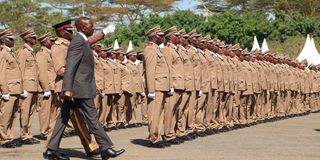
For decades, the provincial administration, now dubbed National Government Administration Officers (NGAO), was one of the State's most extensive and influential grassroots structures, stretching from the Office of the President to the country's smallest villages.
During former President Daniel arap Moi's administration, chiefs, assistant chiefs and provincial commissioners were not merely civil servants, but embodied the authority of the State, implementing government policy, maintaining law and order, collecting intelligence and mobilising support for the ruling party Kanu.
The same network, however, became one of the most contentious symbols of State power during Kenya's struggle for multiparty democracy in the 1990s.
Opposition leaders and other second liberation campaigners, repeatedly accused the provincial administration of intimidating critics, manipulating elections and suppressing dissent.
Reformists demanded that the institution either be dismantled or fundamentally restructured to prevent political abuse.
The 2010 Constitution and the introduction of devolution appeared to reduce its influence as county governments assumed many local administrative responsibilities.
Yet successive governments retained the network, simply renaming provincial commissioners as regional and county commissioners while preserving the administrative chain linking Nairobi to the grassroots.
Now, 16 years after the Constitution sought to redefine governance, President Ruto has gone a step further than his predecessors by formally integrating village elders into the National Government Administration system, offering them monthly stipends, medical cover and other benefits.
Supporters argue the move finally recognises thousands of grassroots leaders who have served communities for decades without pay, while critics see the timing as politically significant, coming just as preparations for the 2027 General Election begin to gather momentum.
The decision has reopened an old national conversation as to whether the State is merely strengthening grassroots service delivery or rebuilding one of Kenya's most potent political mobilisation machines.
Speaking at State House, Nairobi, where he hosted more than 10,000 village elders drawn from across the country on Tuesday, President Ruto announced that 106,000 village elders had now been formally incorporated into the National Government Administration structure.
President William Ruto.
Photo credit: PCS
Beginning immediately, each elder will receive a monthly stipend of Sh3,000, ending decades during which they performed government duties voluntarily.
The President said the government was also working on additional welfare measures, including payment of Social Health Authority (SHA) contributions, provision of smartphones to support their work and deployment of more Administration Police officers to strengthen security at the grassroots.
The Head of State further directed Treasury Cabinet Secretary John Mbadi to allocate funds in the forthcoming supplementary budget to enable the government to pay SHA premiums for village elders, their spouses and children from January 2027.
According to the President, the reforms are intended to formally anchor village elders within the Presidency through the National Government Administration framework, giving them a clearer administrative mandate and strengthening coordination with chiefs, assistant chiefs and other government officers.
He described the elders as the closest link between government and ordinary citizens because of their deep understanding of community dynamics, saying they would play an even bigger role in security, dispute resolution, implementation of government programmes and dissemination of public information.
Interior Principal Secretary Raymond Omollo described the announcement as a landmark moment in Kenya's governance history.
The PS said successive governments had acknowledged the important work performed by village elders but had never institutionalised their welfare.
He noted that after President Ruto assumed office, discussions involving the Interior Ministry and Parliament culminated in the decision to formally recognise the elders as part of the National Government Administration.
Dr Omollo said the inaugural July stipend payments represented the fulfilment of a presidential commitment and recognised the indispensable role village elders have continued to play in community development, conflict resolution and implementation of government programmes.
The PS termed the payments historic, saying: “they marked the first time Kenya had officially recognised village elders through a structured monthly stipend.”
He argued the move would strengthen grassroots leadership, improve service delivery, enhance community cohesion and reinforce effective governance.
Throughout President Moi's 24-year rule, provincial administrators formed the backbone of government authority.
Chiefs and district commissioners exercised immense influence over local affairs, often controlling public meetings, overseeing development programmes and acting as the government's political eyes and ears.
As pressure mounted for constitutional reforms and multiparty democracy in the late 1980s and early 1990s, opposition politicians increasingly portrayed the provincial administration as an extension of Kanu's political machinery.
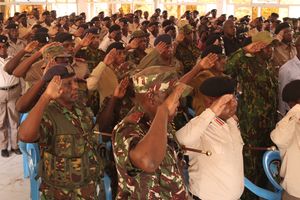
President William Ruto addresses more than 10,000 village elders when he hosted them at State House, Nairobi on August 4.
Photo credit: PCS
Former Prime Minister and opposition supremo, the late Raila Odinga, Kenneth Matiba, Charles Rubia and other reformists accused chiefs and provincial administrators of frustrating opposition activities through permit requirements, surveillance, intimidation and selective enforcement of public order laws.
The demand to dismantle the provincial administration became one of the defining issues of the second liberation movement, eventually influencing constitutional reforms that culminated in the 2010 Constitution.
Although the institution survived, it was substantially restructured to fit within the new devolved governance system.
Despite government insistence that the reforms are administrative, political messaging dominated the State House meeting.
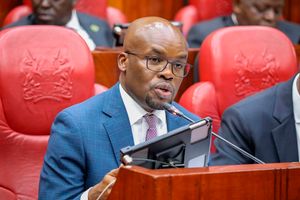
National Assembly Majority Leader Kimani Ichung'wah told village elders that President Ruto had succeeded where previous administrations had failed by finding resources to compensate them.
He urged the elders to remember the President's support and suggested that their appreciation should be reflected politically.
When he asked whether they supported president Ruto serving two terms, thousands reportedly responded in unison, "Two terms."
"You have waited for this recognition through successive administrations. President Ruto has honoured that promise. Remember him for standing with you, and when the time comes, stand with him,” Mr Ichung'wah asked, drawing loud chants of "Two terms! Two terms!" from the assembled village elders.
Mr Ichung'wah also encouraged the elders to become ambassadors of the Social Health Authority programme within their villages while urging them to reject what he termed tribal politics and narratives aimed at undermining the government.
He expressed hope that after the next election, the government would be in a position to further improve the monthly stipend.
The remarks immediately fueled criticism from opponents who argued that the gathering had blurred the line between government administration and political campaigning.
Representing the Council of Governors, Mombasa Governor Abdulswamad Nassir praised President Ruto for according village elders unprecedented recognition by inviting them to State House.
He described the elders as much more than administrators, saying they often function as village judges by resolving disputes before they escalate, teachers by encouraging children to attend school and mobilisers who assist in national registration exercises.
Mr Nassir openly declared his support for President Ruto's re-election and challenged the elders to back a second term, drawing another affirmative response from the gathering.
"You have raised the bar for recognising village elders. The President who succeeds you in 2032 will have a difficult benchmark to match. My stand is clear—William Samoei Ruto is a two-term President. Elders, are we together?" Mr Nassir said, drawing chants of "Two terms!" from the audience.
According to the governor, the reforms had raised expectations for future administrations, arguing that whoever succeeds president Ruto in 2032 would inherit a much higher benchmark for recognising grassroots leadership.
Prime Cabinet Secretary Musalia Mudavadi also framed the initiative as part of broader efforts to strengthen national governance.
He assured village elders that government would continue supporting them to enhance security and public service at the grassroots.
Mr Mudavadi further linked the President's domestic leadership with his growing diplomatic profile, arguing that Dr Ruto had increasingly become Africa's voice on international matters.
"As your government, we will continue supporting you so that you can protect Kenyans at the village level. Today, President William Ruto is not only leading Kenya but has become Africa's voice on the global stage. His speeches and positions are increasingly recognised as representing the continent. If you speak with one voice across all villages and support him for two terms, that influence will continue to grow," the Cabinet Secretary for Foreign Affairs said.
He suggested that continued political stability under president Ruto would reinforce Kenya's and Africa's influence globally.
Opposition leaders, however, dismissed the initiative as election-year populism.
Former Deputy President Rigathi Gachagua accused President Ruto of misleading village elders by promising benefits that, he claimed, might never materialise.
He argued that chiefs were still waiting for electronic tablets previously promised by government and questioned whether smartphones pledged to village elders would actually be delivered.
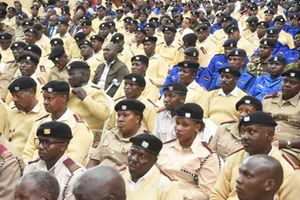
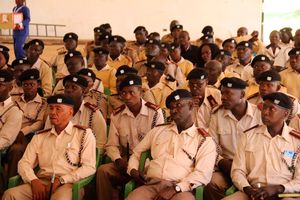
Police officers and national government administrators follow proceedings during a Jukwaa La Usalama forum at Gulab Lochab Hall in Eldoret City, Uasin Gishu County on July 23, 2025
Photo credit: Jared Nyataya | Nation Media Group
"The President promised chiefs tablets, but they are still waiting to this day. Now he is promising village elders smartphones. Why should they believe him when earlier promises remain unfulfilled?" Mr Gachagua posed.
The Democracy for the Citizen’s Party (DCP) Leader also claimed that some village elders had contacted him expressing dissatisfaction, saying the Sh3,000 monthly stipend was insufficient against the rising cost of living and mounting school fees.
Drawing comparisons with the recent Ol Kalou parliamentary by-election, where UDA suffered a heavy defeat, Mr Gachagua alleged that many elders were determined to punish the President politically despite the new stipend programme.
"They are saying Sh3,000 cannot solve the problems they face every day," he claimed, insisting that the government had failed to address broader economic hardships.
Political analysts say the renewed investment in grassroots administration reflects both practical governance considerations and political realities.
Village elders have long served as the first point of contact between citizens and government, helping resolve disputes, identify vulnerable households, coordinate disaster response, support security agencies and implement government programmes.
Formal recognition and financial support could improve their effectiveness while strengthening accountability.
At the same time, the expanded administrative network inevitably carries political significance.
With more than 106,000 village elders now formally integrated into the national administration alongside chiefs, assistant chiefs, county commissioners and regional commissioners, the government commands one of the country's largest organised grassroots structures.
“Whether the network remains focused on public service or becomes a vehicle for political mobilisation will likely remain one of the defining debates as Kenya heads towards the 2027 General Election,” advocate Chris Omore says.