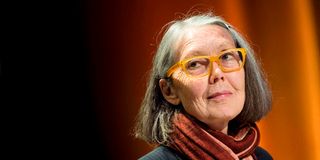
anadian poet Anne Carson performs her work "Antigonick" at the Moderna Museet art gallery in Stockholm, Sweden, in this file photograph dated May 8, 2015.

By the time the Swedish Academy announced on 8 October that Anne Carson had won the 2026 Nobel Prize in Literature, I was feeling tired, battered, and sad.
A few weeks earlier, I had lost my elder sister Josephine Kajomba. It was then that I stumbled on one of Carson’s poems that seemed to speak directly to me in my grief.
A critic once said that it’s the very smallest things in a work of art that draw us in and seize us, that stick in the memory and call us back.
I was drawn to Carson’s poem entitled "When Rhinestones Star the Night and You Find Yourself Thinking Fondly of Dave Hickey," in which she writes, “Oh tell me, is it not nearly day? /(you said and I said)/ Look, the blessings should surprise you, /Not the pain. Pain is normal. After all, we die! Our fathers die. / Or refuse to, their sweaters still hanging in the kitchen, / making us ‘leftover Dave’ in the living room, / wondering why it’s called that.”
“The sweaters still hanging in the kitchen” is the image that stuck with me: the dead man’s sweaters, still hanging in the kitchen. The dead leave their things behind, and it’s devastating. The day before Josephine died, she was on an IV drip at her daughter’s home. When her condition worsened, my younger sister Christine Mwaduwi and Josephine’s daughters rushed her to hospital, and she did not return.
When her daughters Beatrice Jumwa and Grace Jumwa returned to the house afterwards, everything was as she had left it: the drip stand by the bed, the empty saline bags, the coiled tubing of the giving set, the torn wrappers of cannulas. Her handbag was still intact, packed and closed as if waiting for her to pick it up and go. Inside were medicines she would no longer need.
Things a dead person leaves behind
Joan Didion also grappled with this: the things a dead person leaves behind. In The Year of Magical Thinking, she confesses that she could not give away her dead husband’s shoes because some part of her believed he would need them when he returned.
At Josephine’s own home, there is an empty seat. It’s haunting. Carson’s sweaters hang in the kitchen; my sister’s seat waits in the sitting room. Whenever I called her, before she said anything, she chuckled first. But I cannot now remember the sound of her laughter.
There is another Carson poem in which she conjures the language of loss. In “The Glass Essay,” the long poem at the heart of Glass, Irony and God (1995), she observes that one of the hardest things about losing someone is having to watch the year repeat its days — the same light, the same weather, coming again without the person who shared them last time. I have already felt it. The instinctive urge to reach for the phone to call my elder sister’s number and realising she cannot pick the call. The silence.
However, Anne Carson directly addresses grief in Nox, a strange and poignant collection of poetry to grieve her estranged brother. Carson made it after the death of her brother, Michael, who had left Canada as a young man, wandered Europe, and died in Copenhagen in 2000. She had seen him only rarely in more than twenty years.
Nox is not a conventional book but a box, holding one long sheet folded like an accordion: a facsimile of the notebook she kept after his death, with photographs, scraps of his letters, and, page by page, a word-by-word dictionary study of Catullus’s poem 101, the Roman poet’s elegy for his own brother.
Catullus travels a long distance, crossing seas to stand and address his brother’s grave, giving us some of the saddest words in history: Ave atque vale — hail and farewell. Having failed to find the right words, Carson turns to the Greek historians in Nox. Carson struggles to find the words and her brother remains partly a stranger, even in death.
Carson's book is built from fragments because fragments are all that the dead leave us: a letter, a photograph, a handbag, a chair, and an IV drip line. We mourn with the fragments that remain: memories.
Deepest guide to grief
“Memories are by definition of times past, things gone. Memories are the school uniforms in the closet, the faded and cracked photographs, the invitations to the weddings of the people who are no longer married, and the mass cards from the funerals of the people whose faces you no longer remember. Memories are what you no longer want to remember,” wrote Joan Didion.
The image of the sweaters in the kitchen is not new in Carson. Decades earlier, in Men in the Off Hours (2000), she wrote “Father’s Old Blue Cardigan,” a poem about her father’s cardigan hanging on the back of a kitchen chair after his decline into dementia.
Carson’s deepest guide to grief, however, has always been Greek tragedy. In Antigonick (2012), her own version of Sophocles, she returns to the famous Antigone, who defies the king of Thebes to give her brother Polynices a decent burial.
Antigone understood what every Kenyan family understands: we take our dead home and bury them properly. This is why we took my elder sister back to her matrimonial home in Bungule, in the shadow of Kasighau Hill. Alone, rising from the level of the plain and seemingly adrift in the wide savannah, the hill lifts its massive shoulders into the sky. The Bungule-facing side is beautiful, lush and lavish.
As we gathered around her grave, with Kasighau Hill was a detached but melancholic witness. With the hymns and the eulogies and the crowded compound, we were doing what Greek tragedy did for Athens: turning private devastation into a shared rite to alleviate the grief. We had our own version of the Greek chorus with relatives, church members, and neighbours.
The Swedish Academy has honoured Anne Carson for making new forms out of old ones. I honour her because in a season when I had no words, she lent me hers, and taught me: Ave atque vale, Josephine. Hail, and farewell.
The writer assists people in documenting their memoirs • [email protected]
Follow our WhatsApp channel for breaking news updates and more stories like this.