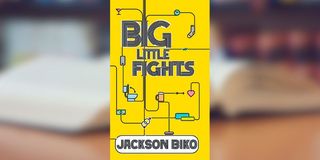
Jackson Biko interviewed me 10 years ago. I returned the favour a few weeks ago. I wanted to deepen this review of his latest novella, Big Little Fights . It was also because I enjoy Biko’s writing and I wanted to learn more about how he does it – how he goes about his creative life.
On this last point, in the book he says he started it at Castle Forest Lodge on the slopes of Mount Kenya and in a small, round and wooden cottage surrounded by the silence of the rain forest. He says it is "my kind of place".
I told him that this surprised me, because I have imagined, from his slick writing, that he is a man who relishes the noise of the city and being surrounded by chattering company. “No, not at all,” he said, “I don’t do people, I don’t do parties – I’m a leopard. I’m not a community animal. I am a leopard.”
As to Big Little Fights , it is – to use the cliché – a must-read book. Since I was given a copy, I have seen it being passed around by my group of friends. Sometimes, it is hilarious; sometimes, it is sad; occasionally, it cuts close to the bone. It tells 20 stories – stories told by 20 individuals about times they have been in big little fights with their partners. The fights might be based on such things as jealousies; old wounds being re-opened, irritations being exposed.
I now know that Biko interviewed only 19 people, because one of the stories is his own. “Can I ask which one?” I chuckled. “Of course not,” he said. “You can ask, but I won’t tell you!”
Biko dedicates the book to “all those poor souls who don’t know they are in relationships”. He was thinking of Kenya’s Gen-Z youngsters, who indulge in dating without really understanding the challenges, pitfalls and pleasure of sustained relationships. In my opinion, this book could be relished by people – young or old – in many other countries and across the world.
For my old self, it rings a number of bells about my own relationships in times past. All the couples in the book are called Rose or Ian. As Biko writes, “After all, aren’t we all just Roses and Ians, stumbling through life?”
To give you a flavour of the writing, let me focus on just one of the stories. It is about listening to the sound of silence. This is how it starts: “I was dating a man who had kids. He was a divorcee. Divorced men are fragile. They come with a torn instruction manual.”
This Rose and this Ian had been seeing each other for four years. She was in Nanyuki and Ian was living in Nairobi. The opening scenario is them sitting in Rose’s living room sipping wine. The TV was on in the background. It was a cold night and they had a throw over their thighs.
And then came the first of a sequence of problems. Rose had actually forgotten that it was Ian’s birthday. Her attempt to make amends was a failure.
The next day, when she showed him a message from her neighbour – “You have locked yourself in the house for too long, are you having babies?” – he refused to accept that it was just a tease. When she went to bed, he searched through her phone and found a year’s-old message from a man she had cheated with. “I can’t compete with all the men you can’t let go of,” Ian said.
The rows and the pleading lasted some time and, eventually, Ian left. When later he rang, Rose hung up. She packed all the things he had left in her house and sent them to him by G4S.
Then he rang again, and this is how the relationship and the story ended: “I answered the phone and didn’t say anything. He didn’t say hello. We held the phones to our ears and we both said nothing. We listened to the silence between us that was filled with history, love and pain. Two broken people holding the phones to their ears, saying nothing. That’s the last I heard from him.”
I am intrigued by the italicised sections of the book that follow each of the stories. As Biko says, they come from the conversations he had with those he persuaded to tell their stories. With all of them he had asked the question “How did your upbringing shape the romantic partners you’ve chosen?”
Reading through these sections again, I see that many of them could be said to be according to the script that their parents wrote for them. For example, there is the Rose whose parents showered her with love, attention and acknowledgement. She said about herself that she hugs and kisses a lot; she says “I love you” and “I miss you” a lot. She says she is not afraid of getting hurt.
In contrast, another Rose said that her father was a violent and unavailable man. She grew up with access to all the material things needed but not the emotional things. So her adult romantic relationships have been her picking unavailable men. “That’s what was programmed” she says.
I have looked for the opposite parental influence – for what we can say is creating a counter-script for yourself. I found one. It is the man who said that his father was a Putin in his home – powerful, autocratic, loud, violent and always right. He said that the reason why he is so expressive is because he had to build it so he could counter some of those autocratic traits his father had.
Big Little Fights is an amusing book; it also has a disturbing depth. I am reading it again because, now I know more about Biko, I think I’m in a better position to guess which one of the stories belongs to him.