It must have been tough being the son of a top cop in the years after the end of mzungu rule in Kenya, one would imagine. Growing up under a father whose main job was to trace, track and trap criminals, and who kept his pistol under the bed must have felt like a movie thriller life.
But Dan Okwiri didn’t see it that way. Yes, there were thrilling moments in his life, like waiting for daddy to come home at night with chicken and chips. However, for the children of detective Okwiri, life was ordinary enough. Dad insisted, though, that hard work was the only guarantee of a good life. Good grades in school would lead to a good job and a decent life in future. Who hasn’t been sold this creed?
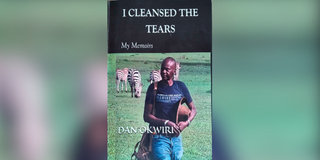
Wuod Baba — son to the father, as Okwiri refers to himself —did not disappoint his father. He would pass his exams at St Mary’s School. But the father had a surprise in store for him. He sent the son to India when the young man least expected. That was the early life of Dan Rodi Okwiri as told in his memoir, I Cleansed the Tears (House of Wealth Publishers, 2025).
However, like a good son, Dan took it all in his stride and studied hard, avoiding the two pitfalls for many young Kenyans who went to India: drugs and alcohol. When he graduated, young Okwiri came back to Kenya and joined Kenya Airways, the national airline. Then KQ, as it is known, was bigger than those airlines from the Middle East.
Okwiri writes that before the Douala Crash in May 2007, KQ was the big boy of African airlines. Nairobi was way ahead of many cities in Africa in the 1970s into the 1990s, and offered a good life, if you allow the cliché, for those with money and opportunities. The young Okwiri and his age-mates - women and men - ate life with a big spoon. Alcohol was affordable and relationships between men and women were less stricter. However, as Okwiri recounts, many of his friends, companions and workmates would be swept into early graves by the ravaging HIV/AIDS.
Okwiri survived the tumultuous social life and thrived at KQ. He would work his way up the workplace ladder to become the KQ Cargo Capacity Revenue Manager in 2005. It was a tough job but his creativity drove him on.
Cover of the book ‘I Cleansed the Tears’ by Dan Okwiri.
Photo credit: Pool
He recounts the story of KQ and miraa exports to Europe, which KQ had stopped to airlift. British Airways was making a killing transporting miraa to England. KQ would mint Sh22.5 million per week from air freighting 30 tons of miraa per week, according to Okwiri. But miraa is a complicated plant that is surrounded by intrigues. It involves cartels, which can make it a tricky business. Eventually the deal collapsed. This is just one of the many anecdotes in I Cleansed the Tears.
The memoir is written from the heart. Okwiri eschews all the rules of conventional writing to tell his story. Thus, the memoir is many things thrown into a narrative bowl. It is part conversation, part monologue, part a collection of anecdotes, part reminiscences, part philosophy, among many others.
The book is an attempt to share with others memories of his time at the one workplace that most influenced his life - Kenya Airways. This is where he was first and last employed, in a manner of speaking. But as he writes on the book’s blurb, this book is about letting go of images of a life-changing moment, the Douala Air Crash. He says, “The one hanging fire which haunts me fresh as daisy is the KQ507 air crash in Douala on May 5, 2007. Been torn for years whether to share it, & it’s time to blaze out the emotions that have battled in a mind embattled, for future generations.” Is this about writing as a form of therapy, allowing the author to exorcise demons that haunt her or him?
In some ways, I Cleansed the Tears is a tragic tale. For Okwiri, to be asked to fly to Douala to resolve the crisis of the bodies of the victims of the accident, which had remained unidentified and released to their relatives for burial six months after the accident was quite unexpected. He did not speak French, the dominant language in the country. He did not know anyone in the South African forensics team that was given the task of identifying the remains of the dead. He had no contacts in the local or national government in Cameroon. He was unprepared for the intrigues that he would face — difficulties working with the forensics team.
It would take a lot of diplomatic efforts for the government of Cameroon — through the Governor of Douala - to clear the bodies for repatriation. The families of the dead were more than incensed by the delays in concluding the matter. But Okwiri, through ingenuity and sheer determination, managed to resolve the crisis.
But the matter left Okwiri with scars that probably would never heal. Surprisingly, but for him not so unexpected, he would be sacked from KQ not so long after the Douala crisis. Did this make him bitter? Does he present himself as a man treated unfairly? Not really. He simply cautions his readers against over-investing one’s time and resources in an employer. He warns that the corporations have this uncanny ability to suck juices out of one’s life and dump the remaining shell, sometimes without any appreciation or ceremony.
Indeed, Okwiri suggests that one needs to always look out for themselves, in order to avoid the disappointment of receiving that career-ending notice - letter of retirement or sacking or demotion etc. Having a side hustle, which has become a common edict, is really old wisdom, as Okwiri shows by narrating how he ran a taxi service and managed an eatery in Kamukunji whilst working at KQ in the mid-1980s.
After KQ, Okwiri relocated to Migori and patiently established a hotel business alongside farming that he had been doing whilst still employed. Here is a city boy turned wise countryside dweller, with endless anecdotes of visitors to his hotel and the lives of his neighbours and friends.
The writer teaches literature, performing arts and media at the university of Nairobi. [email protected]