One morning, in 1979, a few months after my father, Ngũgĩ wa Thiong’o, was released from Kamiti Maximum Security Prison, where he had spent almost a year detained without trial, I found him outside with a jembe. Sweat drenched his shirt. His sleeves were rolled up to his elbows, red Limuru dust clung to his corduroys, and his shoes were caked with stubborn Limuru soil. I watched him work the soil, wondering whether to join him or wait until he took a break.
Then I heard a car drive along the road leading towards our driveway. My heart jumped. What if it was the police coming for him? I tore off along the side of the house and burst into the living room, searching for my mother, Nyambura wa Ngũgĩ. She sat gently cooing over the family’s newest arrival, my sister Njoki wa Ngũgĩ. Baba’s fellow detainees had fondly nicknamed her kaana ka bothita (post office baby) because the first time he ever saw her was in a photograph mailed to him while in detention. I told her about the car. She looked at me, listened for a moment, and turned her attention back to Njoki. But then she soon passed the baby to me and went out to see what was happening. Voices and laughter from outside confused me.
After placing Njoki in her cot, I stood up slowly and peeped through the window. My father was saying something to my mother, and she was bent over in laughter at one of his jokes. I felt the tightness in my limbs begin to fade after my mother returned to the house and assured me there was nothing to worry about. The car I had heard belonged to a neighbour. “Will they ever come again?” I asked. The question had weighed on my mind ever since Baba’s return. “Who, the police?” She placed a hand on my shoulder and glanced outside, where Baba lifted the jembe and drove it into the soil. “It is highly unlikely.”
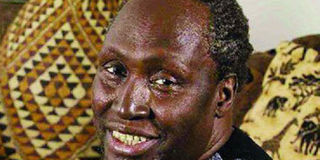
Renowned author Ngugi wa Thiong'o during an interview on February 7, 2019.
Photo credit: File | Nation
After a brief moment of silence, she suggested I go out to help my father with the weeds. I grinned and took off before she could say anything else. I was not about to be drawn into manual labour this early in the morning. I don’t recall whether my father ever finished plowing the piece of land, but a few years ago, when I visited him in Atlanta, Georgia, I reminded him of the incident.
He did not clearly remember that particular moment but he remembered working the land and picking pyrethrum for pennies in his youth. As we talked, my mind drifted to the bad years. The night they picked him up. The long year he was in detention, the threatening phone calls, and the break-ins to our house at night. The friends and family who would cross the street to avoid being seen with us. The isolation. How the house that was once full of activity, filled with people, became quiet and frightening.
Talking with my father about family was never a formal lesson but a story that unfolded naturally, one that situated relatives within seasons and historical events. His stories moved clearly through places, people, and current affairs. And they inevitably circled back to us. “I’m truly thankful for Nyambura, your mother. I look at you all and just thank her for all she did. She held this family together while I was in detention and then exile.” There was no bitterness, just a tender voice that had carried time preciously.
“It’s where we got it from,” I said to him. “The resilience. The passion. And the farming from Cũcũ and from Mami.”
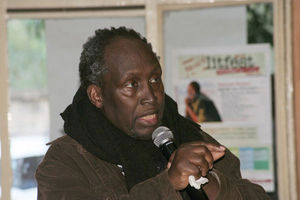
The late Ngugi wa Thiong’o during a past event.
Photo credit: File | Nation Media Group
Our conversations, beyond writing, often returned to farming, food, and sustainability, circling the same questions in different ways, as if we were slowly working toward something neither of us could yet fully name. Then the idea began to take shape. What if the place we called home could also become a space where families could access healthy food, where children could learn and participate in food production, extending education beyond the classroom? What if, we wondered, we embraced regenerative, sustainable agricultural principles that moved away from GMOs, chemical fertilisers, and mono-cropping? Baba funded it, while my brother Tee and my sisters Ngĩna, Wanjikũ, and Njoki agreed to begin the work of transforming our Gitogothi family home into the Nyambura Organic Farm, in tribute to our mother, honouring not only her legacy and memory but also the strength she embodied. The farm became yet another family project, shaped by our shared spirit.
After about a year or so, our first harvest of beets, cabbage, kale, and spinach was modest. Followed by a humbling failure of cucumbers, lettuce, and tomatoes. We planned, planted, and reshaped the land, working to restore the soil to health. For us, however, the triumph was never in the yield. It was in the return and reconnecting with our home. We had come full circle, back to the land that raised us, despite the unpleasantness of the violent break-ins, the threats, and the separation. Like with the post office baby, my father could only experience the farm’s transformation through photos, and it soon became part of our daily ritual.
“Is that red kale or Swiss chard?” he’d ask. “What is happening to the apple trees? They have no leaves!” “Ask Nyokabi and Ngũgĩ to send me some strawberries they look delicious.” His voice always carried the curiosity and delight of a farmer.
On many occasions, when his friends visited him in Georgia, he’d take them on a pictorial tour of the farm, describing every development or setback as if he were there himself. He would ask those who travelled to Kenya to visit the farm and enjoy the organic fruits, vegetables, and sounds.
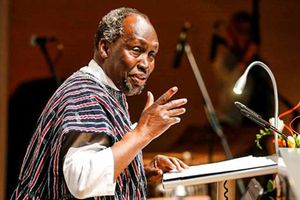
Kenyan author Ngugi Wa Thiong'o.
Photo credit: File | Nation
So you see, Limuru, and indeed Kenya, never left him. Baba’s connection to this land and farming was embedded deep in him. My paternal and maternal grandmothers were both small-scale farmers with techniques as unique as their personalities. They worked bent at the waist, hands deep in the earth, reading the soil’s texture by touch and moisture content almost by smell. There were no hasty, impatient, or haphazard placements of seeds. Weeds were turned over and piled into compost to be returned to the soil.
Unlike the days I fortuitously planned my escape from helping my father with his jembe, I now turn to it willingly, with a deeper understanding that the health of mind and body begins with nutrient-dense food. Tending to this land is for us a remembrance of the place that nourished and shaped us, where our resilience is rooted, an embrace of the soil as a curator of memories. The Ngũgĩ wa Thiong’o Cultural and Arts Centre, now taking shape on this same ground, grows from that same spirit. It is a living archive of determination and beauty, where culture, nature, and nurture are not in contradiction but in harmony. This is the home that Ngũgĩ and Nyambura built, beyond the sounds of silence.