“Ave, Imperator, morituri te salutant. (“Hail, Emperor, those who are about to die salute you.”
These words were uttered in AD52 to the fourth Roman Emperor, Claudius, by doomed combatants called gladiators.
When a blow landed on a fighter, the crowd cried, “Habet!” – he has had it. When a beaten man raised a finger to ask for mercy, the crowd roared, “Mitte!” Let him go, or “Iugula!” Cut his throat.
The heavy fighter, the Murmillo, advanced into the fighting arena. He carried a huge rectangular shield, the scutum, which covered him from shoulder to knee, and a short straight sword called the gladius. On his head was a heavy helmet.
On the other side, another fighter advanced towards the Murmillo. This was the Thracian, named after the land of Thrace. His shield was small. His armour was light.
In his hand was a short, curved blade called the sica, bent like a sickle. It was bent because a straight sword thrust at the Murmillo simply bounced off his shield. The curved sica could reach around the shield and strike from the side.
The Thracian could not win by pushing. He won by good strategy: watching, waiting and darting in at the right moment. Crowds loved him for it. He was the David against Goliath.
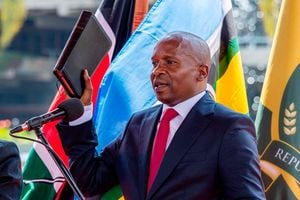
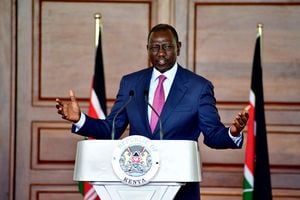
The battle of these two gladiators is like the fight between President William Ruto and his former deputy, Rigathi Gachagua.
As the two Kenyan gladiators advance towards each other, estimating each other’s depths and guessing each other’s moves, we can feel the ground snapping into place.
They are ready for a street brawl. When the President recently called Gachagua “Mr Texas,” Gachagua’s response was swift and decisive.
He called the president “Mr Taxes.” It was a draw. The President is a hard-nosed politico who knows to hit where it hurts, but Gachagua is equally ruthless, abrasive and with no-holds-barred defiance. No matter how hard the President hits, Gachagua doubles down and is the dedicated opposition’s consigliere and attack dog who doesn’t shy away from a good fight.
If Ruto and Gachagua were Roman gladiators facing each other, they would be fighting as they gaze at each other’s eyes; displaying contemptuous hooded-eye scowls and snarling demeanours.
There is a certain scowl when Gachagua is talking of the President as “Kasongo”. Equally, there is a cheeky, even sly, sense of satisfaction on the President’s face when he is talking about Gachagua as “Mr Texas” or dismissing his other rivals – Kalonzo Musyoka as “Mr 40” and Edwin Sifuna as “Mr Empty”.
Ruto is the Murmillo with the heavy shield. He is the embodiment of the state like Rome itself: organised, disciplined, powerful and hard to knock over.
President William Ruto (left) and former Deputy President Rigathi Gachagua.
Photo credit: Alex Odhiambo and Boniface Mwangi | Nation Media Group
Gachagua is the Thracian. Pushed out of the centre of government after his impeachment, he now stands where the outsider stands.
His shield is smaller. He has no ministries behind him and none of the machinery a sitting president commands.
He has the support of ministries, governors and MPs, and the long arms of government. No challenger walks into the arena with protection like that.
His fighting style is also interesting. President Ruto has stamina. He rarely leaves the arena and can even do many political rallies in different places in a day.
In his recent trip to Ukambani, he addressed crowds as late as 9pm. Whether facing opposition coalitions, rebellions within his camp or doubtful elites, his instinct is to keep pressing forward. He wears opponents down by energy.
The irony is that Ruto himself once campaigned as the outsider, the man taking on the establishment. It is Gachagua who is now campaigning as the outsider. And his weapon? Gachagua’s sica is his tongue.
It can bend and reach behind the President’s shield. Gachagua has weaponised public frustration and regional grievances against the Head of State.
He also uses the President’s many promises people feel were not kept and the sense of betrayal some voters feel.
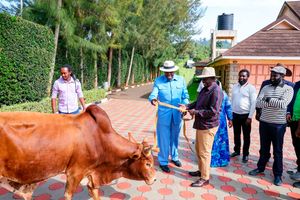
President William Ruto (left) and former Deputy President Rigathi Gachagua.
Photo credit: File | Nation Media Group
Each of these attacks is designed to curl around President Ruto’s heavy shield of the state and find the soft places behind it.
As the Murmillo, Ruto is vulnerable. All that protection of a heavy shield comes at a price. The bigger the shield, the harder it was to turn. That is what incumbency has done to Ruto.
He is running against his own record, and that is not usually easy. The opposition doesn’t have that weight; they just have to criticise the government, and in every government, there is a lot to criticise.
As the Thracian, Gachagua also has weaknesses. With little armour, one solid blow could finish him.
President Ruto has state machinery and more resources. Gachagua, like the Thracian, has agility, which is a good thing until the big man lands a hit. Like the Murmillo, Ruto can afford to make mistakes, but Gachagua, as the Thracian, cannot.
In the end, elections are seldom won by strength alone. They often go to whoever aligns with the public mood. The 2027 elections will decide whether the Murmillo or the Thracian side wins.