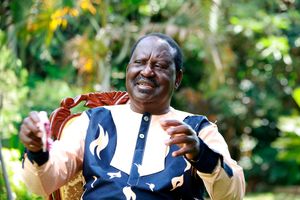
Former Prime Minister Raila Odinga was a politician whose words were unquenchable, inextinguishable and infinitely curious — always in a kind of convulsive rush — the capacity to leap across the airwaves to confront us. Whether we agreed with him or not, his appeals were personal and passionate, sometimes tearful and sometimes teasing, often humorous but never dull.
But who was he? What made him tick? A lifetime was apparently not enough to answer these questions. As he passed away on Wednesday, October15, 2025, death only deepened his mystery.
In his memoir, The Flame of Freedom , Odinga emerges in the poignant voice of autobiography, and pierces us. This voice, amplified, communicates his aloneness, his “unknownness”. Paradoxically, he has always been largely unknown to his people. But the sense of his opaqueness, of his hidden life, is precisely what gives him authenticity. An inscrutable subjectivity haunts his memoir. The portrait of this singular figure is, of necessity, incomplete. As the book shines a light, the man Odinga remains enigmatic, as though he holds a secret, remaining behind in the shadows.
Former Prime Minister Raila Odinga signs a copy of his autobiography "The Flame of Freedom" in Nairobi on November 30, 2013.
Photo credit: File | AFP
Odinga was the memoirist’s dream subject because of the richness of his life. In memoir, there is a seepage between author and subject that runs both ways. Across a threshold of susceptibility, the memoirist is touched by the subject. Memoirists work slowly, all at once, and always on someone else’s terms. And when the dream subject was Odinga, it was harder. I could only catch a fractured glimpse of the man who seemed to slip through my grasp, somehow, always out of reach. His calendar was a world full of appointments.
Like a rare bird, he left behind only brief sightings — snatches of conversation, half-finished sentences and half-heard laughter. He could be landing at Kisumu’s rippling Lake Victoria runway, disembarking at Berlin’s sleek terminals, slipping into Addis Ababa amid the rumble of high heels on marble floors, or hiding behind the bougainvillea-clad walls of his house in Karen, Nairobi.
Then one morning, on Thursday, July 3, 2025, I got the opportunity to meet him. I drove in the half-heartedness of Nairobi rain, in the haze of diesel fumes, humidity and the menacing snarl of boda bodas. The landscape flattened and the visible horizon expanded in every direction, so that the sky grew bigger and more vaulted. Matatus with graffiti-washed flanks bore down on the road, careening past me like rabid dogs in a crescendo of honks, revving engines, and shouts.
On the drive, I pictured his father, Jaramogi Oginga Odinga — moustachioed in the sepia photographs I had seen, looming like a shadow beside the austere Mzee Jomo Kenyatta with the flywhisk that seemed to ooze raw power. Like father, like son: Jaramogi and Odinga, in the tangled thread of destiny, were born restless in a land quick to dim the lights of sons it considered rebellious. Two men in one country flirting with things that are quite dangerous, at great personal cost.
The two men sacrificed greatly as they opposed oppressive regimes. They had the stubborn patience required to stay alive in a country that loved nothing more than to chew up its sons. Two men who though sometimes exhausted from the losses and devastation of seeing Kenya’s social structure overthrown, contributed to moving it from the brink with tottering steps and putting her back on the march towards her exalted destiny.
Former Prime Minister Raila Odinga addresses guests during the launch of his autobiography "The Flame of Freedom" at the Aga-Khan Hall in Kisumu on December 21, 2013.
Photo credit: File | Nation Media Group
I reached the venue a few minutes before Odinga arrived. Then his convoy nosed up the drive. The cars were immaculate — pristine chrome, spotless windows, police lights washing the compound walls in sapphire and scarlet pulses. There was a metallic hiss and then the lead car eased to a stop with precise finality. Other cars whispered to a halt, the taillights flashing like disco lights.
One of the guards stepped out before the driver had shifted to park. He circled, hand already on the rear passenger door, scanning the empty air as if for a security threat. The door opened, but only after a pause — an orchestrated beat, so that Raila, when he stepped out of the car, could do so with the dignity reserved for men whose faces had been stamped on presidential ballots.
He stepped out. Ahead, the house waited. He walked the distance to the door and into his office. A few other people and I were ushered into another room to wait for him. Occasionally, we looked at the door expectantly. Then, at first, I saw the silhouette of the man through the transparent glass part of the door. I expected aides, a phalanx of men in suits to rush in first, but Raila walked into the room alone. The air conditioning hummed. For a few seconds, the man who had once brought Kenya to the edge of mutiny stood before me, before he took his seat.
It would have been easy to mistake him for a tired man. The voice was gentle, occasionally hesitant. The hands stayed folded on the desk. Yet there was something else, a subliminal current that ran beneath the stillness. We shared a meal — rice, beef, chicken, both white and brown ugali and other delicacies — while the clink of cutlery punctuated his stories.
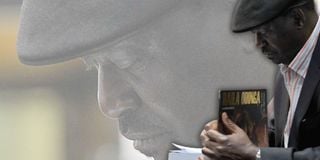
Former Prime Minister Raila Odinga reads a copy of his father Jaramogi Oginga Odinga's book "Not Yet Uhuru" at his Karen home in Nairobi.
Photo credit: File | Nation Media Group
And then later, we got into business. “What do you think about your second memoir?” I asked. “I am fine with it. Let’s do it,” he said, looking at me, kindly yet intensely.
As I left Odinga’s office that day, I was glad for the things he had said, but there were many things unsaid. I felt the way a man feels behind a half-opened door. I hoped the door would open fully for me to do his second volume of memoirs covering 2013-2025, with the working title The Flame Rekindled . This was not to be.