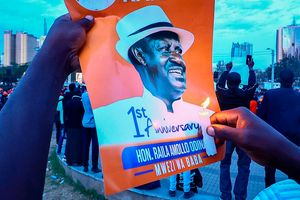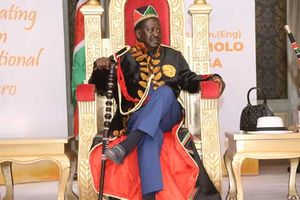
Former Prime Minister the late Raila Odinga.
All the world’s a stage, and all the men and women merely players; They have their exits and their entrances, and one man in his time plays many parts, His acts being seven ages.
William Shakespeare gave us the above memorable verse in his play, As You Like It, through a monologue by its lead character, Jaques.
In this verse, Shakespeare visualises the world as a stage in a theatre, and all of us merely acting our lives as roles assigned by a creator from birth to death in old age. And like in a theatre, all characters enter and exit the stage after performing their dramatic roles.
One such man who has been eulogised as Kenya’s most consequential politician exited the stage a year ago (heck, it still feels like yesterday!) having played many parts during his 40-odd years in the country’s political odyssey. For Raila Odinga who died in India, on October 15 last year, was such an energetic, yet enigmatic, personality that many are still trying to decipher even in death.
The news of his death across the Indian Ocean early that morning came like a thunderbolt and hit our shores like a tsunami. When he was alive and roaring from myriad political rostra, “tsunami” was a regular metaphor that he invoked to warn of massive political change. The aftershock of his exit from the stage still reverberates across the country like an earthquake.
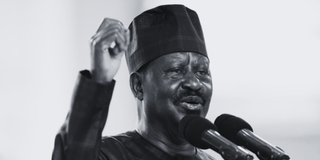
Kenya's former Prime Minister Raila Odinga.
Since then, Raila is still the most talked-about man in town. He has been discussed, debated and dissected in different fora and from different perspectives, depths and breadth, like an epic character in a compelling book. And the more we talk about him, the less we appear to have known him. Ignorance underlies knowledge!
His widow, Mama Ida Odinga, said at his burial in Bondo that in choosing to marry Raila, she was choosing the mechanical engineer, then teaching at the University of Nairobi, because (it was clear in her mind that) she didn’t want to be married to a politician. “Little did I know that I was marrying a political engineer,” she confessed.
His mystique is such that even his last word remains contentious. The top leadership of his political behemoth, the Orange Democratic Movement (ODM), bickered to near fisticuffs over what his “last standing instruction” was. The party has since splintered into two factions, each proclaiming allegiance to his true spirit.
As Kenyans contemplated the former Prime Minister’s political stature and character, the spectre of Lemuel Gulliver in Lilliput, In Jonathan Swift’s 1726 novel Gulliver’s Travels, easily came to mind. His “man mountain” political personality can’t be carried by a handful of men to the King. It will take thousands of us to lift him!
When the Lilliputians discovered Gulliver, lying asleep on the shore, they thought the King must view such a wonder. They carried him to the palace, where he became an emergency to the king. Several rooms and beds had to be broken to accommodate him.
One day a fire broke out in the palace and Gulliver was brought in to quell it. He easily did it by just urinating on it. Forget the outrage and embarrassment that came with it!
Fast forward to 2024 in the +254 Republic. When the tsunami of a Gen-Z protest against a Finance Bill overran Parliament and threatened to sweep upwards to the gilded house on the hill. The president frantically summoned the country’s only version of Gulliver to calm the storm. Did the president dismantle the cabinet and government structure to accommodate “Gulliver” in the resultant broad-based outfit?
Similarly, President Daniel arap Moi in 2000 had to reshuffle his Cabinet and the Kanu party hierarchy to accommodate Tinga during the short-lived merger between the ruling party and Raila’s NDP. The post-election violence of 2007/8 also forced President Mwai Kibaki to rearrange his government structure, complete with a new Prime Minister’s office for Raila under the government of national unity arrangement.
Gifted playwright
The person who created Raila Odinga as a character and placed him in Kenya’s political theatre stage must have been a gifted playwright – probably a Shakespeare himself in heaven. For if Raila were to be a character in a literary work he would fit smugly in the category of complex or dynamic characters.
Literary scholars define a complex character as one who evolves in a story with multi-dimensional facets. One that bears conflicting traits or motivations that make him or her realistic and interesting.
Unlike flat or static characters, complex characters, also known as round characters, are said to often have internal struggles, moral dilemmas, or ambiguous qualities that challenge readers' perceptions.
Did Raila portray such qualities? His memorable tenure on the stage, from being implicated in the foiled 1982 coup against President Moi to being ensconced in the broad-based government in 2025 by President William Ruto is a tremendous 43 years of dramatic stage presence.
Former Orange Democratic Movement (ODM) party leader, the late Raila Odinga.
While eulogising her dad at the memorial service at Nyayo Stadium, Winnie Odinga rhetorically enumerated the seven monikers ascribed to her father during his life. First, she recalled that when he was growing up in Bondo, Raila was referred to just as a Luo, then he became (Jaramogi Oginga) Odinga’s son. Later, they called him Tinga and, at some point, Nyundo.
As Raila’s political character evolved into more complex nuances, his supporters called him Agwambo, then Enigma and finally Baba (Father). These seven nicknames, sounding like chapter headings in a book, symbolised the seven ages of his political Acts as outlined by Shakespeare.
Each of those names not only reflects a phase in Raila’s complex character but also signifies the twists and turns, the points at which the plot thickened, in Kenya’s political history. As Ray Bradbury observes: “Plot is no more than footprints left in the snow after your characters have run by on their way to incredible destinations.”
And as we ponder our political stage and storyline without Raila, many have resorted to another of Shakespeare’s gems from the play Julius Caesar: “Here was a Caesar! When comes such another?” It was a lament by Mark Antony as he mourned the murdered Roman Emperor, Julius Caesar.
As we survey the remaining characters lining up as possible heirs to his immense role in the next episode, we hear some voices with Mark Antony’s lament: “Here was a Baba! When comes such another?”
Well, it might be a long search and wait for a Raila replacement on our political stage. But we may wish to recall Luchino Visconti’s description of The Prince in Giuseppe Lampedusa’s novel “The Leopard.” The Prince, he said, was a very complex character - at times autocratic, rude, strong - at times romantic, good, understanding - and sometimes even stupid, and above all, mysterious.
In the one year that Raila has been absent physically from us, his spirit has lived and loomed over every conversation. His party, ODM, has split spectacularly as disagreements over his true intentions and instructions take centre stage.
A major road in Nairobi city was named after him while he was still alive. Posthumously, a new stadium has been named after him. An airport bearing his name is being contemplated… A referral hospital here and a university of science and technology there may also emerge in the coming days if only to immortalise the enigma of Kenya’.
It was American detective novelist Raymond Chandler who observed that the character that lasts is an ordinary guy with some extraordinary qualities.
Follow our WhatsApp channel for breaking news updates and more stories like this.
Mr Kibet is an editor in Nairobi. [email protected]