As protests intermittently disrupt movement across the country, a familiar explanation has emerged among workers who fail to report on duty: Kulikuwa na Maandamano (There were protests). But how far does that defence go in law?
According to lawyers Mary Audi and Fridah Muriithi from MMTK Law (Muri Mwaniki Thige & Kageni LLP Advocates), missing work due to protests is not automatically considered misconduct.
“The key legal question is whether the employee had a lawful cause for absence and whether the absence was reasonable in the circumstances,” they say.
The lawyers point to the Employment Act, 2007, which treats absenteeism as misconduct only where an employee is absent without leave or a valid explanation. Where demonstrations result in road blockades, transport shutdowns or genuine safety concerns, an absence may be justified—but not automatically.
“The employer must show absence without lawful explanation,” they note, adding that the legitimacy of the excuse will often depend on the scale of the disruption and whether the employee made reasonable efforts to communicate.
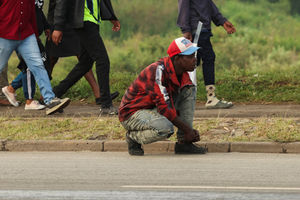
A man ties his shoelaces as others walk during a strike by public transport operators driven by rising fuel costs, linked to global supply pressures following the war in Iran, in Nairobi, Kenya May 19, 2026.
Photo credit: Monicah Mwangi | Reuters
Kenyan law does not define absenteeism by a fixed number of days. Instead, context is key. Audi and Muriithi explain that employers must establish that the absence was unauthorised, lacked reasonable justification, and that the employee failed to communicate where possible.
“A pattern of repeated unexplained absences is more likely to justify disciplinary action than a single isolated incident caused by extraordinary public disruption,” they say.
Even where absence is established, termination is not automatic. Under the law, employers must prove both a valid reason and follow due process.
“A dismissal based purely on absence, without considering the surrounding public disorder or transport paralysis, risks being declared unfair,” the lawyers warn, emphasising the need for notice, a hearing, and an opportunity for the employee to respond.
They add that employers are expected to act reasonably during large-scale disruptions. Where protests pose safety risks, forcing employees to report physically without considering those risks could raise legal concerns.
Still, employees are not entirely off the hook. Communication, they stress, often determines whether absence is justified.
“Employees are generally expected to notify employers as soon as reasonably practicable,” they say. “Failure to communicate can significantly weaken the employee’s defence.”
The distinction becomes sharper where an employee chooses to join protests instead of attempting to report to work.
“If an employee deliberately skips work to participate in demonstrations without authorisation, particularly where attendance was reasonably possible, the employer may lawfully treat the conduct as misconduct,” they caution.
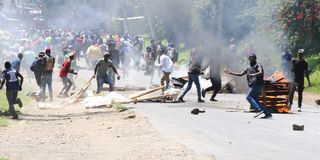
Matatu strike: Rioters in Kiratina, Nakuru County take to their heels after anti-riot police engage them in running battles on May 19, 2026.
Photo credit: File | Nation Media Group
They also distinguish protest-related absence from participation in a protected strike under the Labour Relations Act 2007, noting that strikes follow a formal legal process and attract statutory protections, unlike general demonstrations.
In workplaces where remote work is possible, the expectations may be even higher.
“Failure to log in without an explanation may amount to misconduct,” they say, although employers are still expected to consider practical challenges such as power or internet disruptions.
Ultimately, the lawyers say courts will not accept blanket excuses.
“Courts are unlikely to accept a statement that ‘there were protests’ without evidence showing how the protests actually prevented attendance,” they note.
In the end, while protests may explain absence, they do not automatically excuse it.