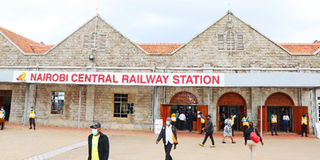
When the sun set on October 31, 2006, it also marked the end of careers for more than 500 employees of Kenya Railways.
On that Tuesday following an agreement between the government and a private investor, operations of the national rail corporation were handed over to a concessionaire and hundreds of workers found themselves out of their jobs.
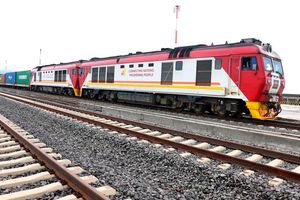
In November 2006, a private company Rift Valley Railways (RVR) formally took over rail operations under a 25-year concession. What was then described as a temporary “tour of duty” has nearly two decades later morphed into a protracted pension and employment dispute.
More than 520 former and current employees are now locked in a standoff with Kenya Railways over an estimated Sh500 million in benefits.
“We are looking at approximately Sh500 million,” said Joseph Owaga, one of the employees’ representatives.
At the time of the transition, affected employees were presented with limited and difficult choices. Those identified for transfer to RVR were compelled to accept the offer.
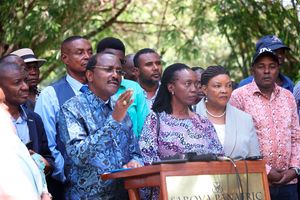
Joseph Owaga (left) and Fredrick Muthoka, representatives of Kenya Railways current and former employees, during the interview at Nation Centre on February 11.
Photo credit: Francis Nderitu | Nation
A circular from Kenya Railways stated categorically that “that employees offered employment but decline, will not qualify for the proposed retrenchment package but will be entitled to their normal retirement dues.”
According to Mr Owaga, the transfer to RVR was meant to be treated as a continuation of service under Kenya Railways Corporation (KRC) management directives.
“In 2006, when we were transferred to Rift Valley Railways on ‘tour of duty,’ it was to be considered a continuation of service from Kenya Railways Corporation,” he said.
The arrangement lasted from November 1, 2006 until August 31, 2017 when the High Court (HCC No. 136 of 2017) terminated the concession and directed an orderly transfer of employees and assets back to Kenya Railways and the government within 30 days.
Following the termination of the concession, affected employees were divided into five distinct categories based on how they were treated.
The first group comprises staff who did not transfer to RVR and remained with Kenya Railways throughout the concession period. This category continues to earn salaries from Kenya Railways, draw pensions and are enrolled in the current provident fund.
The second group includes employees who were retrenched by Kenya Railways, paid their terminal dues including retrenchment packages and began earning monthly pensions.
Some were subsequently employed by RVR where they earned salaries while continuing to draw pensions. After the concession ended, they were re-employed by Kenya Railways. These employees continue to earn both pension and salary and are members of the provident fund.
The third category consists of staff who were retrenched by RVR, paid their terminal dues and started earning pensions.
They later returned to Kenya Railways some on permanent terms and others on contract. They continue to receive both salaries and pensions, with permanent staff also enrolled in the provident fund.
Documents show a fourth group includes employees who initially joined RVR and served until the concession ended but did not apply for advertised positions at Kenya Railways immediately after. They later rejoined Kenya Railways and are now earning salaries, pensions and contributing to the provident fund.
Kenya Railways Corporation Managing Director Philip Mainga before the National Assembly Public Investments Committee on Commercial Affairs and Energy on Tuesday, October 24, 2023.
Photo credit: File
This group comprises employees who were originally hired by Kenya Railways before the 2006 concession and transferred to RVR under the “tour of duty” arrangement until July 31, 2017.
After the concession was terminated they worked for three and a half years on temporary contracts before being employed afresh by Kenya Railways on permanent terms on March 1, 2021.
Commonly referred to as “deferred pensioners,” the more than 520 employees say they have dedicated most of their working lives to Kenya Railways but now feel short-changed.
After the court terminated the concession in July 2017, Mr Owaga said they expected a seamless transition back to Kenya Railways.
“We knew our transfer back to Kenya Railways was supposed to be smooth and automatic but Kenya Railways did not absorb us back immediately. Instead, we were employed on short-term temporary contracts for three and a half years,” he explained.
The employees argue that their service during the concession period should count toward their pension and retirement benefits as initially communicated.
“We take issue with the discrimination. We don’t understand why we are being treated this way. It now feels like we wasted our day and our only problem was being loyal employees,” Mr Owaga said.
According to him, efforts to engage Kenya Railways management over the matter have yielded no resolution.
On Monday, the Nation reached out to the Kenya Railways Corporation Managing Director Philip Mainga for comment through his publicly known phone number. Mr Mainga said he was held up in a meeting and by the time of publication he was yet to respond.