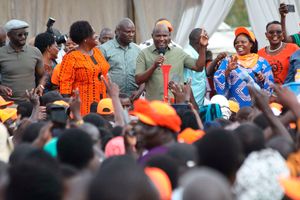
The Ministry of Education has banned politicians and other well-wishers from visiting schools and giving donations, seeking to keep learners out of the political currency market as the country edges towards an election campaign season.
Education Cabinet Secretary Julius Ogamba said donations to schools and learners have become a Trojan horse that some individuals use for selfish interests in politics and other sectors.
The CS noted that Kenya is inching closer to the campaign season for the 2027 General Election and such activities interrupt the normal school programmes.
The ministry also holds that children’s rights are put at risk during such events, with some individuals taking public photographs of minors without consent from their parents or caregivers.
In such a directive seen by the Daily Nation , which was copied to the Director General of the Ministry of Education, the Nyanza Region Director of Education, education officials in Nyamira, the Teachers Service Commission County Director, and all principals and head teachers of public senior and comprehensive schools, there has lately been an influx of politicians in schools.
"The circular applies to the whole country but being handled county per county," Mr Ogamba said.
The ministry stated that these photos are then used for cheap publicity and advertising across social media platforms.
In the Nyamira circular signed by County Education Director Joshua Kaga, the ministry noted.
"We have witnessed cases where well-wishers visit our schools and are allowed to disrupt the school programs and take photos and videos with pupils/students just because they have made a small donation to the school," Mr Ogamba said.
"This practice is unlawful and should not be allowed to happen in any school. We are heading towards campaign season, and politicians may wish to use schools for their selfish interests," the circular further reads.
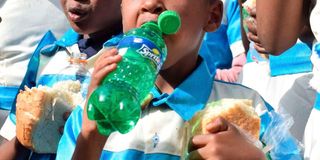
Schoolchildren enjoy bread and soda donated by then Nyeri Senator Ephraim Maina at Karatina Children’s Home in Nyeri county on January 20, 2019.
Photo credit: File | Nation Media Group
The ministry clarified that such actions from leaders should be handled administratively without involving the pupils or disrupting the school programme.
"Please take caution, and let us abide by the rules and regulations within the sector," the ministry further warned.
Speaking later at Senator Kebaso High School during a briefing ahead of the Kenya Certificate of Secondary Education (KCSE) examinations, Mr Kaga revealed that some politicians have been giving learners 'small donations' of soda and bread.
They then take photographs with the learners and post images on social media platforms, warning that the practice risks violating child protection laws.
The official explained that this practice is against education guidelines and could also violate children's privacy laws.
However, some residents have read an ill motive in the letter, saying it was meant to derail some opposition-aligned politicians from Nyamira who have been feeding learners in schools.
"We have those who have been giving bread and soda to learners. They started long ago, but because they are becoming popular, a scheme has been devised to stop them," said Mr Joshua Keriga, a resident.
"We have been seeing others visiting schools in the name of empowerment and prayers. Why are they being allowed? You saw one last weekend claiming he was attending a candidates’ prayer session. But because he supports the government, there is no any wrongdoing on his part," he added.
Safeguarding children's dignity
Kenyan law protects children on social media through a multi-layered legal framework that penalises online exploitation, mandates strict data privacy, and enforces corporate responsibility for digital service providers.
Under Section 27 of the Children Act, 2022, children in Kenya are afforded protection from arbitrary or unlawful interference with their privacy, family life, private affairs, correspondence, honour, and reputation.
This section emphasises the importance of safeguarding children's dignity and autonomy, especially in the digital space where privacy violations can easily occur.
Additionally, the law mandates that any processing of personal data related to a child must comply with the Data Protection Act, 2019. This ensures that children's data is handled with care and respect, in line with their rights.
Section 33 of the Data Protection Act specifically addresses the processing of personal data concerning children.
It stipulates that such data should not be processed unless explicit consent is obtained from a child's parent or guardian.
Moreover, any data processing must prioritise and advance the child's rights and best interests.
This provision is crucial in the context of social media, where children may be vulnerable to exploitation or misuse of their personal information.
These legal frameworks collectively aim to create a safer online environment for children, protecting them from potential harms associated with social media while ensuring their rights are upheld.
Former Education Cabinet Secretaries, including Dr Fred Matiangi, Ezekiel Machogu and the late Prof George Magoha, issued similar directives during their tenures.
In March 2022, Prof Magoha prohibited political rallies and visits to educational institutions until the completion of exams. During a visit to Kimunyu Primary School, he stressed that all schools would remain off-limits to politicians.
Prof Magoha urged politicians to hold their events in stadiums, emphasising that students should have a peaceful environment for their exams.
He warned that anyone violating this ban would face legal consequences, reaffirming the commitment to providing a conducive atmosphere for students during the exam period.
In May 2017, the then Education CS, Dr Matiang'i, banned political rallies on school grounds.
Dr Matiang'i also stopped the use of school buses to transport people to political rallies. He instructed school heads to adhere to this rule, as it was meant to ensure the safety of staff and school property.
“We should not create unnecessary anxiety and disrupt school programs by allowing political rallies in schools,” warned Dr Matiang'i.
In 2024, Mr Machogu banned head teachers from administering examinations with papers bearing the portraits or names of politicians.
He stated that it was wrong to allow politicians to exploit innocent children in their quest for power. He noted that the practice had become common, as politicians used children to appeal to their parents.