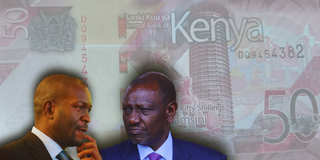
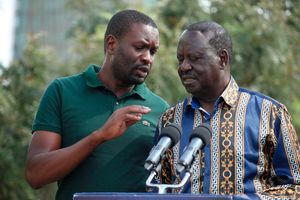
Nairobi Senator Edwin Sifuna has hit back at President William Ruto over his remarks about politicians who drink expensive liquor in Nairobi but portray themselves as ordinary people when they travel to other parts of the country, turning the spotlight on the controversy surrounding small donations from market women to fund his political activities.
Mr Sifuna defended contributions from women traders and other well-wishers, saying the donors had given the money voluntarily and should not be dictated to on how it should be spent.
In a pointed response, the senator joked that the women could send him another Sh10 each over the weekend to buy Johnnie Walker whisky and celebrate, arguing that the money belonged to them and that they had not attached conditions to their contributions.
“So, I want those market women to know that it’s the weekend. Let them send some Sh10 bob so that we can get some Johnnie Walker na tupige sherehe because it’s Friday,” Mr Sifuna said during a media roundtable on Friday.
“The money belongs to them. So, you can’t dictate to people what they do with their money. It’s a choice. People have chosen.”
The remarks bring into sharper focus the emerging political contest over the funding of Linda Mwananchi activities ahead of the 2027 General Election, with Mr Sifuna presenting the donations as evidence of a direct connection with ordinary Kenyans, while Dr Ruto has questioned politicians seeking financial support as they position themselves for the next election.
What next for Sifuna? Linda Mwananchi movement projects to complete rebranding in three weeks
The exchange also places the everyday contributions of small-scale traders at the centre of a wider debate about political financing, public trust and the relationship between aspiring leaders and the people they seek to represent.
Mr Sifuna said other donations from well-wishers had reached about Sh13 million, according to the fundraising website he referred to during the interview. He challenged those questioning the donations to check the platform for the amount collected.
The senator said the donations were particularly meaningful because some came from women who had spent the day selling fish, charcoal, sugar cane and other goods to earn a living.
He recalled an encounter with traders at Kiminini and Kamukuywa markets in Bungoma County, where women handed him Sh50 notes, saying the experience convinced him that his political journey had reached a turning point.
“I’m telling you, it has been the most humbling thing and Kenyans know, when that thing happened first in Kiminini, when I saw these mamas bringing me those Sh50 bobs, that’s when reality dawned on me that there can be no going back,” he said.
Mr Sifuna questioned what it took for a small-scale trader to earn Sh50, arguing that dismissing such contributions as insignificant overlooked the sacrifice behind the money.
The senator said the donations had an emotional significance beyond their monetary value, describing them as a reminder of the people he wanted his politics to serve.
He insisted that he had not spent any of the Sh50 notes handed to him by the traders, saying he had kept them as a personal reminder of their support.
“That money, I wish we were in my office, I have kept all of it. I have kept it to remind myself who I am doing this for,” he said.
Mr Sifuna added that the collection had grown so large that he intended to carry the bucket containing the money to State House and place it on his desk if he eventually secured the presidency.
“I will carry that bucket to State House and put it on my desk to remember those women from Kiminini and Kamukuywa market for making us get into that office,” he said.
Nairobi Senator and The Equitable Party (TEP) leader Edwin Sifuna during a joint media engagement at Four Points By Sheraton Nairobi Hurlingham on October 9, 2026.
Photo credit: Evans Habil | Nation Media Group
The account offered a glimpse into how the senator is seeking to frame his political appeal as not simply around opposition to the government, but around a relationship with ordinary citizens whose small contributions he says represent a personal investment in his political future.
The response follows Dr Ruto's remarks during his Coast tour on October 2, when he warned traders against politicians he accused of seeking financial contributions as they position themselves for the 2027 presidential election.
Speaking in Watamu, Kilifi County, the President described the politicians as “matapeli sugu” and “extortionists”, alleging that they would move around the region asking for money while presenting themselves as presidential hopefuls.
“Wafanyabiashara wa huku nawatahadharisha, kuna matapeli watakuja huku ati wanakuja kuomba pesa, ati wanatembea na mabakuli, ati wanatafuta vyeo katika nchi hii,” Dr Ruto said.
He also took aim at politicians whom he claimed enjoyed expensive lifestyles in Nairobi but adopted a different image when visiting other parts of the country to seek support.
“Wale watu wakiwa kule Nairobi wanakunywa pombe ile kali sana iko na majina mawili mawili, sijui Johnnie Walker na zingine hapo, lakini wakifika hapa wanajifanya ati ni maskani,” he said.
The remarks appeared to speak directly to the emerging Linda Mwananchi fundraising debate, in which leaders seeking to challenge the President in 2027 are attempting to mobilise resources and build support beyond established political networks.
Dr Ruto also accused Mr Sifuna of engaging in extortion linked to his criticism of the proposed Dangote East Africa Refinery project in Lamu, alleging that the senator was acting on behalf of a political sponsor. Mr Sifuna has disputed the President's characterisation.
Ruto: Kenya is too modern, complex and sophisticated to be run by a 'fool'
The President's criticism has come amid a broader political confrontation over the refinery, with opposition figures demanding greater transparency about the agreement between the government and Nigerian businessman Aliko Dangote. Mr Sifuna has called for the terms of the deal to be made public, arguing that Kenyans should have access to information about the project.
Dr Ruto, however, has insisted that questions about the refinery should be raised through Parliament and other proper channels rather than political rallies.
Opposition leaders raise fresh concerns over the multi-trillion-shilling Dangote refinery project
The dispute over the contributions highlights a broader question likely to feature prominently as politicians prepare for the next election: how they raise money, who provides it and what obligations, if any, accompany those contributions.
For Mr Sifuna, the small denominations are central to the political message he wants to project. By highlighting Sh10 and Sh50 contributions, he is portraying his fundraising as a grassroots effort in which ordinary Kenyans can participate without needing substantial financial resources.