Nairobi Senator Edwin Sifuna has offered a glimpse into how his political life has changed since the death of his mentor, Raila Odinga. He describes a new existence shaped by security concerns, political uncertainty, and the burden of leading a movement without the man who protected him for over a decade.
Mr Sifuna says that the transformation has extended beyond his public responsibilities to the most ordinary aspects of his private life, from being a regular visitor to social joints to having to reconsider where he goes and what he eats and drinks.
His recent Senate remarks, in which he joked that the restrictions imposed on him had kept him away from Fred Obachi Machoka’s ranch, offered a lighter but revealing account of the personal cost of his changing political circumstances.
“He knows that before my life changed dramatically, I was a regular visitor at his premises,” he told senators.
The remarks came against the backdrop of a politician who says his circumstances have changed profoundly since Raila’s death and the subsequent fallout within the Orange Democratic Movement (ODM).
The senator has also described a new level of caution in his public engagements, including the need to think carefully about what he says and how he says it as he navigates his emerging presidential ambitions.
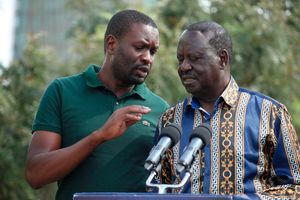
The late Raila Odinga (right) with Nairobi Senator Edwin Sifuna at Capitol Hill in Nairobi on February 2, 2024.
Photo credit: Sila Kiplagat | Nation Media Group
His recent remarks about being unable to speak freely without a written speech, for fear of saying something he should not as a presidential aspirant, capture the tension between the outspoken political persona that made him prominent and the discipline demanded by a national campaign.
For a politician whose public identity has been built around sharp exchanges, unscripted interventions and direct criticism of the Government, the prospect of having to measure his words marks a significant adjustment.
Speaking during a media roundtable in Nairobi on Friday, October 9, Mr Sifuna revealed that the more fundamental change was the loss of the political protection he enjoyed under Raila, whom he describes as his mentor and defender.
“I personally miss my mentor,” he said in the interview, reflecting on the changes that have followed Raila’s death.
He recalled that when Raila was alive, the responsibility of managing difficult questions within ODM did not rest entirely on him. There was always a senior leader who could intervene, decide or shield younger politicians from internal pressure.
“When Baba was around, the sense of responsibility was not as heavy as now because we knew that even when there were difficult issues for the party, it was not up to you to make that decision,” he said.
Mr Sifuna added that ODM members knew Raila could step in and tell them to leave a contentious matter to him.
“Now, it is you. You are supposed to now give direction, as I have always said, give direction to the party.”
That responsibility has become more complicated since Raila’s death, which Mr Sifuna says has left some party members without the political space they previously occupied.
He said he had participated in numerous efforts to reconcile the competing factions, including meetings at the homes of party officials, where he believed progress was being made.
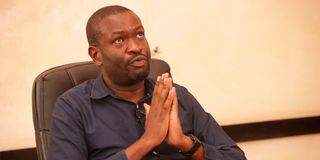
Nairobi Senator and The Equitable Party (TEP) leader Edwin Sifuna gestures during a joint media engagement at Four Points By Sheraton Nairobi Hurlingham on October 9, 2026.
Photo credit: Evans Habil | Nation Media Group
But those efforts, in his account, did not prevent a decision to remove him as ODM secretary-general, deepening a dispute over the party’s direction and the future of its relationship with President William Ruto’s administration.
Mr Sifuna argued that he and his allies wanted ODM to retain a distinct political identity rather than become indistinguishable from the broad-based arrangement with the Government.
The dispute has since moved beyond an internal disagreement over party positions, becoming a defining feature of his political transition.
In September, the Political Parties Disputes Tribunal upheld his removal following fresh disciplinary proceedings, after an earlier decision had been invalidated over procedural concerns. The party had accused him of contradicting official positions and engaging in unauthorised political activities, allegations he disputed.
For Mr Sifuna, the de facto leader of Linda Mwananchi, the loss of his position and the breakdown in relations with some of his former colleagues have coincided with a new political journey that he says he did not plan.
“Honestly, it is a very emotional moment for me, but I have known one political party and one political leader my entire life,” he said, describing the attachment he had developed to ODM and Raila.
He even joked that he had so many orange T-shirts at home that he did not know what to do with them.
“Even just changing those colours. It’s a tough emotional break, but it has to be done,” he said.
The remark reveals the personal dimension of a dispute often discussed in terms of party control, political alliances and the 2027 General Election.
For Mr Sifuna, the break is also with a political home in which he had built his career and with a leader whose approval, he says, helped him withstand repeated attempts to remove him from office.
He recalled that, throughout his eight years as secretary-general, reports predicting his imminent dismissal were a recurring feature of political coverage.
Nairobi Senator and The Equitable Party (TEP) leader Edwin Sifuna during a joint media engagement at Four Points By Sheraton Nairobi Hurlingham on October 9, 2026.
Photo credit: Evans Habil | Nation
He said Raila repeatedly intervened when party colleagues questioned his conduct or objected to his statements.
“I was always being fired,” he said, recalling how Raila would tell his critics to leave the young politician alone and allow him to express himself.
According to Mr Sifuna, Raila understood the importance of permitting younger leaders to challenge established positions, even when their approach caused discomfort within the party.
He said the former Prime Minister would sometimes acknowledge that his language had been too harsh but would still defend his right to raise substantive questions.
That protection, Mr Sifuna says, gave him the confidence to speak forcefully, knowing that his political future did not depend entirely on whether every senior party figure agreed with him.
Without Raila, he now faces the challenge of defending his positions while managing the consequences of his own decisions.
Mr Sifuna told journalists that threats had come from different directions and that he had been compelled to become more cautious about his movements and everyday interactions.
“You need to be a bit more careful where you go, what you eat, what you drink,” he said.
He described an incident during a public engagement in which a member of his staff handed him a bottle of water. Members of the crowd, not recognising the woman, nearly turned on her.
Nairobi Senator and The Equitable Party (TEP) leader Edwin Sifuna gestures during a joint media engagement at Four Points By Sheraton Nairobi Hurlingham on October 9, 2026.
Photo credit: Evans Habil | Nation Media Group
Mr Sifuna said the incident illustrated the atmosphere of suspicion surrounding him and the need for people close to him to be identifiable to his supporters.
He also spoke of concerns that political opponents could monitor his movements and those of his associates.
His account reflects his own assessment of the risks he faces, although he did not provide independent evidence that any particular person had attempted to harm him.
Nevertheless, he said the experience had forced him to change his habits and approach public engagements differently.
The political transition has also brought a different kind of pressure: the need to define himself beyond the role of ODM secretary-general.
As the party’s chief administrator and spokesperson, Mr Sifuna was accustomed to explaining its decisions, defending its positions and responding to criticism. He now has to establish a separate political identity while persuading supporters that his movement can offer an alternative direction.
He said the reception his team had received during tours of areas traditionally associated with ODM had encouraged him, although he acknowledged that the future of the movement would depend on its ability to sustain that support.
“We have been amazed at just how positive the reception has been,” he said.
Nairobi Senator and The Equitable Party (TEP) leader Edwin Sifuna during a joint media engagement at Four Points By Sheraton Nairobi Hurlingham on October 9, 2026.
Photo credit: Evans Habil | Nation Media Group
He added that the initial days had been difficult because members of the group had been subjected to insults and criticism.
The challenge, he said, was to keep explaining their position to supporters rather than spend too much time revisiting disagreements with former colleagues.
Mr Sifuna has framed the emerging movement around a people-centered approach to leadership, arguing that political leaders should remain responsive to the concerns of ordinary Kenyans.
In the interview, he acknowledged that he did not possess every technical skill required to govern and said he wanted qualified professionals to help shape the agenda.
“I am a lawyer,” he said, adding that he accepted he did not have all the answers on economic theory and other specialised fields.
He argued that the country needed leaders willing to listen to experts and allow their proposals to inform government decisions.
Mr Sifuna has not presented the transition as an easy one. He says Raila’s absence has left him feeling exposed at a time when he must make decisions that previously belonged to the party leader.
He also insists that he bears no personal grudge against those with whom he has fallen out, saying they were his comrades for a long time and that their disagreement concerns the direction ODM should take.
“I have forgiven all those who insulted me or called me names. It is water under the bridge,” he said.