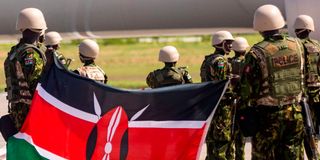
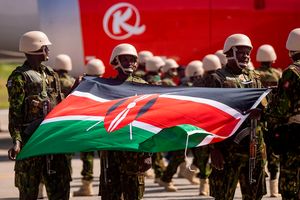
Kenya says it welcomes discussion on the future of a police mission it leads in Haiti, some two months before its mandate is reviewed.
At the Organisation of American States (OAS) meeting this week, delegates discussed a plan to bring in more foreign peacekeepers, potentially reducing the dominance of Kenya in the Multi-National Security Support (MSS) Mission.
The proposal comes just weeks before the Mission’s mandate, extended to October 2025, comes to an end. The OAS comprises 34 independent states in the American and Caribbean region. Kenya is an observer state.
Dr Korir Sing’oei, Kenya’s Foreign Affairs Principal Secretary, told the Nation that Nairobi welcomes such discussions — as long as they are intended to restore peace in Haiti.
“The interest of Kenya from the word go was to ensure that peace is restored in Haiti. Already, the US has proposed an establishment group of partners with the aim of revamping the security force in Haiti, which is right,” Dr Sing’oei said.
Principal Secretary for Foreign Affairs, Korir Sing’oei.
Photo credit: Dennis Onsongo | Nation Media Group
He said that Kenyan officers who have since June 2024, when the first contingent arrived in Haiti, have had to deal with gangs that were well prepared.
There are 700 police personnel from Kenya in the MSS, the largest contingent. Guatemala (150), el Salvador (78), Jamaica (23), Bahamas (6) and Belize (2) also have troops in Haiti under the MSS.
“Our officers have done so well and it is evident from media reports that they have secured a number of areas in a foreign country despite operating on low capacity and limited finance,” he said, adding that there was no need of making any conclusion from the ongoing discussions about the future of MSS.
President William Ruto has separately called on the United Nations to continue backing the mission, underscoring Kenya’s preference for an extended, well-funded operation rather than a phased exit.
In a phone call on Tuesday night, Kenya’s President William Ruto told US Secretary of State Marco Rubio that the UN should back the Mission to ensure it is fully facilitated to defeat the gangs.
It is the latest signal that Kenya wants the mandate of the Mission it leads extended, rather than ended when its time comes in October.
It is also the second time Kenya has pushed for an expanded UN role for the Mission, which, even though endorsed by the UN Security Council, is fully dependent on volunteer donors and troops.
“We concurred on the imperative and support for a resolution at the UN Security Council that establishes a UN support office for the Multinational Security Support (MSS) mission in Haiti, to aid efforts to stabilise and secure Haiti,” Ruto said on X after the call.
Rubio didn’t confirm the concurrence but a US State Department statement said Rubio commended “Kenya’s continued leadership and ongoing efforts to restore peace and security in Haiti.
“They reaffirmed our strategic partnership and discussed commercial opportunities to further strengthen economic cooperation between the United States and Kenya,” it added.
The US plans to double foreign force in the Caribbean based nation and scale down Kenya’s role in the mission were revealed by US Deputy Chief of Mission Ms Kimberly J.
Penland who spoke during the meeting where he revealed that the US is currently drafting a plan which will be presented to the United Nations Security Council (UNSC) on how gang territorial control can be scaled down.
“Should the UN Security Council pursue this model, then we will also seek robust regional participation to provide strategic leadership of the force,” she said.
The US interest in restoring peace in Haiti was this week stamped by sentencing Michael Adrian Nieto, a former officer attached to Haiti National Police (HNP) to three years in prison.
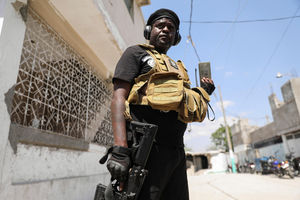
Immediately, after his imprisonment, the US indicted gang leader Jimmy Cherizier alias Barbecue accusing him and a US citizen, Bazile Richardson, of running a "broad conspiracy" to funnel money from the Haitian diaspora to fund gang violence.
Barbecue, leader of the Viv Ansanm gang alliance is now considered as a terrorist by the US even as he said that he was willing to cooperate with officers attached to the Federal Bureau of Investigations (FBI).
Since May, talk has been that there could be deployment of Latin American troops to Haiti which would operate under OAS. The US has also mooted the idea of deploying private militaries.
Kenya first entered Haiti in June 2024 after President Ruto agreed to send its officers to the Caribbean-based nation to help quell gangs that have made the country ungovernable.
Since Kenya entered Haiti, the UN says that more people have died in a span of one year compared to the previous years have also been made. At least 1500 people have died in the last four months.