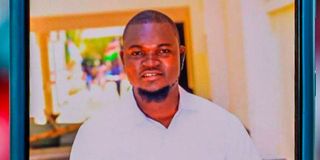
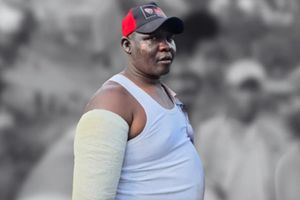
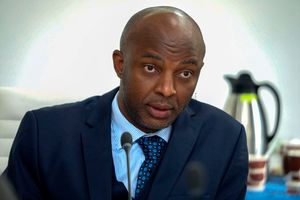
The murder trial over the death of teacher and blogger Albert Ojwang has suffered a setback following the death of a police officer who had been listed as a key prosecution witness.
Stephen Maina Nderitu, 54, who was attached to Central Police Station, died on Monday shortly after leaving work.
According to sources, he collapsed and was taken to hospital, where he was pronounced dead. A postmortem conducted at Kenyatta National Hospital reportedly attributed his death to underlying medical conditions, including acute ulcers and high blood pressure.
CCTV shows Albert Ojwang arrived at Central Police Station in black SUV in the company of six men
Nderitu was expected to testify about events at Central Police Station following Ojwang's arrest and death, particularly matters relating to police records and the handling of information at the station.
The trial is being conducted by the High Court in Kibera. Witnesses who testified told the court that Ojwang's death was preceded by an assault and followed by attempts to interfere with CCTV evidence.
Opening the trial, the prosecution said they will table evidence showing that Ojwang's death was not accidental or self-inflicted, as initially reported, but followed an alleged assault while he was in police custody.
Former Central Police Station commander Samson Tallam is charged with murder alongside police officers James Mukhwana and Peter Kimani. John Ngige Gitau, Jim Ambao and Brian Njue are also facing murder charges.
The prosecution has alleged that the accused persons participated in events leading to Ojwang's death and that there were subsequent attempts to conceal what happened.
John Mutua, an Independent Policing Oversight Authority (IPOA) crime-scene investigator, told the court that investigators discovered the station's CCTV system had been interfered with after Ojwang's death.
He said the Digital Video Recorder (DVR) had been disconnected and that its storage drives had been formatted. Investigators subsequently recovered about 489 gigabytes of deleted footage from the system.
The recovered recordings, which were played in court, allegedly showed Ojwang arriving at the station on June 7, 2025, in apparently good physical condition. The footage showed him walking unaided and making phone calls before he was later escorted towards the cells.
Mutua said the recordings also captured several officers moving around the station during the night.
CCTV footage shows police carrying Albert Ojwang's lifeless body
Another CCTV technician, Alon Okwako, told the court that he found the DVR switched off, with its power supply disconnected and hard drives removed. He said recordings covering June 6 and June 7 had been deleted.
A protected witness, identified as D.A.N, also testified about the alleged deletion of the footage. The witness told the court that he was summoned to the station on June 8 and was asked to retrieve recordings from the previous two days.
According to the witness, he was subsequently instructed to format the DVR, which resulted in the deletion of the recordings. His evidence, including allegations concerning who gave the instructions, will be tested during the trial.
A police records officer who worked at Central Police Station also testified about events following Ojwang's death. She told the court that she saw a report describing the death as a suicide and later viewed CCTV footage with another officer.
The court heard that investigators later recovered footage from Mbagathi Hospital showing Ojwang's transfer to the facility.
Ojwang had been arrested in Homa Bay County on June 7, 2025, following a complaint over a social media post. He was taken to Nairobi and booked at Central Police Station, where he died hours later.
Albert Ojwang: CCTV footage shows 2 mystery men at central police station
His death triggered widespread public protests and prompted investigations by IPOA and other agencies.
A postmortem found severe head injuries, neck compression and multiple soft-tissue injuries. Pathologists concluded that the injuries were externally inflicted and consistent with assault, findings that differed from the initial account of his death.