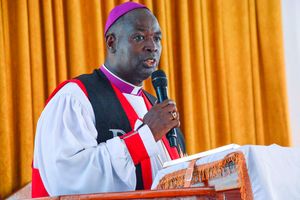
Archbishop Maurice Muhatia (left) along with other members of the Kenya Conference of Catholic Bishops at Queen of Apostle Mission Parish in Nairobi November 14, 2024. Court has ruled that the Kenya Conference of Catholic Bishops is the lawful owner of property registered as Eldoret Municipality Block 14/19.
The Environment and Land Court has declared the Catholic Church the rightful owner of a prime property in Eldoret but allowed a state oil pipeline to remain, sharply limiting the Church’s control over its own land.
In the judgment, the court ruled that the Kenya Conference of Catholic Bishops is the lawful owner of property registered as Eldoret Municipality Block 14/19, ending a protracted ownership dispute with Kenya Pipeline Company (KPC) Limited.

The court found that the Church held a valid certificate of lease issued in 2017, confirming its legal and beneficial ownership of the land for a 99-year term from 2008.
However, the ruling stopped short of granting the Church full control over the property after finding that an underground oil transportation pipeline installed in 2014 created an overriding legal interest in favour of KPC.
“The defendant herein does have an overriding interest over the suit property based on section 28(i) of the Land Registration Act No.3 of 2012,” the court ruled, adding that the KPCs continued use of the land “is lawful and legitimate hence cannot amount to trespass.”
The dispute centred on a contested easement agreement signed in 2013 between the pipeline company and the Catholic University of Eastern Africa, which occupies part of the land.
The Church argued that the university, a tenant on the land, had no authority to grant access rights or transact over the property.
In defence, KPC denied trespass and said it had a valid easement agreement granting it access to the land. It argued the pipeline was installed lawfully with approvals from relevant government entities and served a critical public function.
The firm also maintained the underground pipeline posed no environmental or safety risk.
Eldoret Law Courts.
However, the court agreed with the church declaring the easement agreement “illegitimate, illegal and unlawful.” It noted that the university “did not have the capacity and/or legal rights over the suit property” to create such rights.
The church, through the registered trustees of the episcopal conference sued in September 2021 seeking a declaration of the land's ownership and a finding that its property and environmental rights had been breached by KPC.
It also sought a permanent injunction, removal of the pipeline installations, rehabilitation of the land, damages for trespass, and costs.
But despite the court invalidating the lease agreement, the court found that the pipeline’s existence predated the Church’s formal registration and therefore qualified as an overriding interest under land law.
This legal doctrine allows certain rights, including pipelines, to subsist even if they are not recorded in the land register.
As a result, the Church’s claims for trespass, eviction, removal of installations, and damages were dismissed.
The court also rejected a bid by the pipeline company to recover Sh2.3 million allegedly paid for the easement, finding that the funds were remitted to a separate entity, AMECEA Pastoral Institute, and not the university.
“The third party and AMECEA are separate and distinct entities,” the judge said, dismissing the indemnity claim.
The case further raised environmental concerns, with the Church arguing that the underground pipeline exposed students and clergy to potential hazards, including leaks and explosions.
While the court found no evidence of actual harm, it acknowledged potential risks and ordered fresh environmental safeguards.
“It is important that the defendant takes appropriate measures in consultation with the occupants of the suit property in ensuring that the environment and social well-being is taken care of in line with Article 42 of the Constitution," the court said.
It directed the KPC to conduct a comprehensive environmental impact assessment within 180 days and file a report in court within 210 days.
According to the orders, the assessment must involve the Church and other stakeholders and identify mitigation measures against risks such as leaks, fires, or vandalism.
The land hosts educational and pastoral institutions, including a university campus and a pastoral institute, with a significant population of students and clergy.
The pipeline, buried underground, runs across a defined corridor measuring three metres wide and 343 metres long.
Follow our WhatsApp channel for breaking news updates and more stories like this.