Hello

Your subscription is almost coming to an end. Don’t miss out on the great content on Nation.Africa

Ready to continue your informative journey with us?

Hello

Your premium access has ended, but the best of Nation.Africa is still within reach. Renew now to unlock exclusive stories and in-depth features.

Reclaim your full access. Click below to renew.

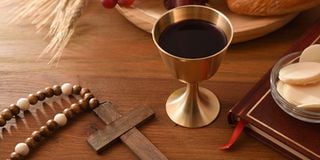
Wine glass and consecrated hosts on wooden table with christian cross
Caption for the landscape image:

Catholic: The church that preaches wine…and drinks it

Scroll down to read the article

In the Old Testament, wine appears frequently as a symbol of joy, celebration, and divine blessing.

Photo credit: Shutterstock

The most important role of sacramental wine in the Catholic Church is in the celebration of Holy Communion, or the Eucharist.

During this sacred ritual, Catholics consume consecrated wine as a symbol of the blood of Jesus Christ.

This tradition traces its roots back to the Last Supper, when Jesus gathered with his disciples in accordance with Jewish custom and shared bread and wine.

In choosing these simple but profound elements, He gave them new meaning, commanding his followers to “do this in memory of me.”

The relationship between wine and faith is as old as the Scriptures themselves.

In the Old Testament, wine appears frequently as a symbol of joy, celebration, and divine blessing.

One of the earliest references is the story of Noah, who planted a vineyard and made wine after the flood.

The Psalms, too, describe wine as a gift from God that “gladdens the human heart.”

The newly approved Catholic altar wine on display at the Catholic Bookshop in Nakuru City on October 7, 2025. 

Photo credit: Francis Mureithi| Nation Media Group

The New Testament brings wine even more clearly into the story of salvation.

At the wedding at Cana, Jesus performed his first miracle by turning water into wine—a sign not only of joy but also of transformation.

The most significant moment, however, came on the night before His crucifixion, when he raised the chalice at the Last Supper. That gesture forever cemented the role of wine at the heart of Christian worship.

The making of wine from grapes was already a long-standing Jewish practice when Christianity was born.

As the faith spread across the world, wine accompanied it, both as a practical necessity and as a theological symbol.

Over centuries, the Catholic Church became deeply entwined with the cultivation, preservation, and refinement of winemaking traditions.

The Reverend Father Stephen Mbugua, Vice Chancellor of the Catholic University of Eastern Africa (CUEA), underscores this heritage.

“Catholics worship a God who made and drank wine,” says the professor. “The symbolism of the water and wine mixed in the chalice represents the blood of Christ and the unity of believers, a tradition dating back centuries.”

Wine glass and consecrated hosts on wooden table with christian cross

In the Old Testament, wine appears frequently as a symbol of joy, celebration, and divine blessing.

Photo credit: Shutterstock

From the first Christians who gathered in secret homes to the grand cathedrals of medieval Europe, wine has been a constant presence at the altar.

For reasons both historical and theological, the Church has often stood at pivotal moments in the history of wine.

Monks in particular became custodians of vineyards, carefully cultivating the vines that produced not only sacramental wine but also some of the finest vintages in Europe.

France is perhaps the most celebrated intersection of Catholicism and wine.

For centuries, monks in Burgundy, Champagne, and Bordeaux tended vineyards with patience and devotion— helping establish the reputations of regions still revered today.

France is not alone. Across Italy, Spain, and eventually the United States, Catholic communities nurtured vineyards and protected the traditions of sacramental winemaking.

Catholic scholars note, however, that history has not been one of unbroken progress.

Wars, social upheaval, and changing economies often forced monastic lands to be repurposed.

The pack rides past vineyards and a French flag in the 217 km and thirtheenth stage of the 2012 Tour de France. PHOTO | JOEL SAGET | AFP

In France, for example, many vineyards cultivated by generations of monks were lost during times of labour shortages and political unrest.

However, signs of renewal continue to emerge.

In recent decades, several French monasteries have returned to winemaking. The French Catholic author Marc Patier, in his book Les Vignerons Du Ciel: Les Moines et Le Vin (The Winemakers of Heaven: Monks and Wine), chronicled this revival, noting how what seemed like a lost tradition is once again bearing fruit.

In countries like the United States and Italy, some parishes have launched “Sacramental Wine and Vineyard Ministries,” planting vines on church grounds for both liturgical and community use.

In contemporary Catholicism, the Eucharist remains the central sacrament where wine retains its deepest significance.

However, new challenges have emerged, like in Kenya, where the Church has had to issue strict guidelines for sacramental wine to protect its sanctity and meaning.

According to Father Lawrence Mbogo of the Catholic Diocese of Nakuru, the sacramental wine must be made from pure grapes, naturally fermented, and free from additives or artificial ingredients.

“Such standards preserve both the theological symbolism of Christ’s blood and the authenticity of the tradition,” said Fr Mbogo.

 The newly approved Catholic altar wine on display at the Catholic Bookshop in Nakuru City on October 7, 2025. 

Photo credit: Francis Mureithi| Nation Media Group

Prof Mbugua emphasises that the enduring power of wine in Catholic worship lies not only in ritual but also in its symbolism.

“When the priest mixes water and wine in the chalice, it reflects the mystery of Christ’s divinity and humanity and the unity of believers gathered at the altar,” he says.

The story of Catholicism and wine is ultimately one of faith and culture growing together like vine and trellis.

From Noah’s vineyard to Cana’s wedding feast, from medieval monasteries to today’s parish vineyards, the fruit of the vine has been inseparably linked to the life of the Church.

“For Catholics across centuries and continents, every drop of sacramental wine poured into the chalice continues to echo that first cup shared as a symbol of unity, sacrifice, sign of salvation and divine love,” said Fr Mbogo.

Follow our WhatsApp channel for breaking news updates and more stories like this.