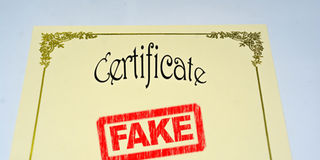
Almost 3,000 public servants, including heads of parastatals, senior police bosses and even investigators used fake academic papers to gain employment in government, a new audit shows.
This is according to a recent survey conducted by the Public Service Commission (PSC) to authenticate academic and professional certificates held by public officers.
Speaking during the Ethics and Anti-Corruption Commission’s (EACC) Conference on enhancing integrity of academic and professional qualifications, Head of Public Service Felix Koskei termed this scourge of fake certificates a threat to unravelling government objectives.
“Falsified certificates have been found in almost all sectors of the public service, in the national and county governments, in parastatals and in commissions and independent offices alike,” he said.
Mr Koskei then went on to reveal the disturbing findings of PSC which showed that so far, out of the 28,000 cases forwarded to the National Examination Council by 91 public institutions, at least 1,280 certificates were confirmed as forgeries.
Additionally, another 787 public officers out of a total of 29,000 working across 195 ministries, departments and agencies, as well as universities and other tertiary institutions, who underwent the authentication were found to have secured employment, promotion and re-deployment using fake documents.
Chief of Staff and Head of Public Service Felix Koskei.
Photo credit: File| Nation Media Group
“This will likely blow on CEOs, chairpersons of parastatals, board members, police officers and investigators across all these institutions and just imagine the product of these fake fellows. They will drive the country in the opposite direction not because they want, but because of their limited knowledge,” he said.
The report, the Head of Public Service said, showed that these forgeries did not just affect tertiary education but all levels of education from primary school.
Data from 2023/2024 report on the certificate verification revealed 358 institutions had reported conducting authentication exercises for 116,000 officers, out of which 859 officers were found with fake academic certificates while 24,000 were not authenticated at all, Mr Koskei said.
Leading the charge of cases with falsified academic certificates are State corporations which the Head of Public Service revealed accounts for about 70 percent of forgeries, followed by public universities with 116 cases.
However, only 49 institutions reported having forwarded the names of implicated officers to EACC and the Public Service Commission yet 43 institutions could not provide actual evidence of having done so.
Of these 49, the report found that four submitted lists of implicated officers that did not merge the number of confirmed forgeries within their organisations.
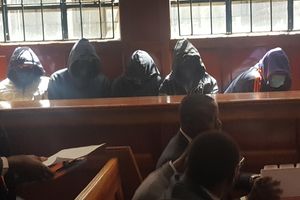
In January, the government sacked 449 civil servants out of the 1,019 staff found to have used fake academic certificates to get employment.
Photo credit: File | Nation Media Group
“We can go on and on and simply put, it paints a very dark space that the people that our citizens have delegated power to run their affairs are incompetent, they have failed and are still occupying offices,” he said
For PSC chairperson Anthony Muchiri, the fact that the issue under discussion had necessitated a conference to discuss how forgery of academic papers can be handled, revealed that the situation was becoming worse.
Mr Muchiri then challenged the veracity of academic papers issued even for PhD scholars saying that during interviews for senior roles, several applicants who come bearing the title of “Doctor” cannot even express themselves casting doubt on their qualifications.
“We have people coming for interviews with PhD papers but what is coming out of their mouth is different. Some of them are genuine, even their papers are genuine but their brains are not genuine,” the PSC boss said.
Mr Muchiri added that in February 2024, the PSC called for a verification of academic papers of 53,000 certificates presented by public servants between 2012 and 2022.
Public Service Commission chairman Anthony Muchiri.
Photo credit: Sila Kiplagat | Nation Media Group
“Out of the 53,000 certificates, over 2,500, almost 3,000 have been found to be forged. Mind you, this number does not include genuine academic papers that were acquired fraudulently! All certificates held by public servants, from secondary school to PhD must be authenticated,” he said.
On his part, EACC CEO, Abdi Mohamud revealed that since 2022, the Commission has received and has investigated 549 reports of forgery of academic and professional certificates.
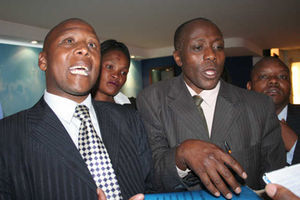
“Out of these, 134 investigation files have been completed with 85 files being forwarded to the Office of Public Prosecutions and 33 matters pending in court. At least 20 cases have been concluded in court resulting in 13 convictions and seven acquittals,” he said.
Mr Mohamed further revealed that the anti-graft watchdog is seeking to recover at least Sh460million paid to officers who obtained employment through fake academic papers.
EACC Chairperson Bishop David Oginde described the cases of fake academic papers in the Public Service as a pandemic that has spread its wings across several sectors.
He further revealed that he has been receiving a lot of backlash ever since the Commission announced it would be going for salaries paid to culpable officers with many justifying that the accused persons had used their energy to serve Kenyans.
“These people built their houses on sinking sand, the foundations for their houses are wrong, yes they delivered services but the probability that they delivered substandard service is very high,” he said.
The rot at the Public Service, Mr Oginde said, is a pointer to a similar problem that could be a reality in the private sector adding that Kenyans cannot get value for their services they pay for because “they are delivered by people who do not qualify to offer them”.
Should this culture not be stemmed, then Kenya’s good name for producing qualified human capital will be dented.
“The rampant reports and cases of falsification of academic and professional certificates that continue to flood the news channels will definitely have a negative impact on the products that we put out to the stiff competition in the job market,” he said.