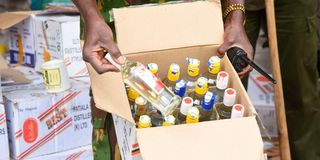
Action will be taken against landlords who lease their premises to serve as illicit alcohol outlets while members of the public will be empowered to report any illegal distillation centres, in new rules aimed at combating illicit alcohol and drugs.
The proposals are contained in a report by the National Steering Committee on Combating Illicit Alcohol and Drugs handed over to Deputy President Kithure Kindiki.
The report, themed ‘Okoa Jamii, Jenga Taifa’, sets out the required strategies covering legislative and administrative interventions to ensure long-term success from the ongoing operations.
The committee also proposes that vehicles, machinery and other properties used to transport illicit alcohol be impounded by the police as the war on combating the alcohol menace heats up.
“A landlord who leases property to an illicit liquor outlet is liable as an aider and abettor where it is proved that the landlord knew, or deliberately ignored that the premises were used for illicit trade,” reads the report.
The committee also wants citizens empowered to act as key stakeholders in reporting unauthorised manufacturing plants or illegal distillation centres.
According to the report, the government will provide a toll free number where members of the public will report to the government directly of any unauthorised illicit alcohol centres.
“The reporting system shall provide for anonymous reporting and protection of whistleblowers in line with the Witness Protection Act, 2026 and verification of each report before action is taken shall comply with data protection protocols in line with the Data Protection Act, 2029,” reads the report.
The operation to tackle the illicit alcohol will be undertaken by the Anti-Counterfeit Authority, Kenya Bureau of Standards, Kenya Revenue Authority, National Authority for the Campaign against Alcohol and Drug Abuse (NACADA) and the National Police Service.
According to the report, alcohol manufacturers will also be required to provide a traceability mechanism as one of the ways in weeding out killer fake alcohols in the country.
“Traceability will be required to fully document and map out their distribution chains. Towards this end, products must carry secure, digital authentication markers to prevent cloning,” reads the report.
War against harmful alcohol
The committee has also recommended for zoning restrictions where all bars located near basic educational institutions and residential areas are declared null and void and should be closed immediately.
While receiving the report, Prof Kindiki declared war against harmful alcohol and drug abuse as well as providing recourse for addicts. The Deputy President said the Charter for the National Steering Committee on Combating Illicit Alcohol and Drugs enhances ongoing operations being conducted by a multi-agency team across the country.
“The Charter provides the framework for coordinating this exercise, the role of different organs of state, including the national government, county governments, and private sector actors, civil society and members of the community,” Prof Kindiki said.
He also said the tax regime will be tightened for all the actors in the sector to ensure none evades obligations as spelled out in the law.
“We are going to strengthen taxation in this industry to ensure that all people in this sector adhere to their tax obligations because we have discovered only a few licensed manufacturers are honouring their tax obligations,” Prof Kindiki said.
The committee report comes just three weeks after the Alcoholic Drinks and Drugs Control Laws (Amendment) Bill, 2026 which sets tough conditions to both manufacturers and sellers of alcoholic drinks.
The proposed law bans the sale of alcohol to a person who is armed with any offensive weapon, concentration of points of sale of alcohol in an area, bans online advertisement of alcohol and sale of any alcoholic drink 300 metres from any learning institution.
According to the Bill, premises where alcohol will be sold will be located 300 metres away from any nursery, primary, secondary or other learning institutions for the persons under the age of 21 years.
Public officers either in national or county government who will be involved in the enforcement of the act once it comes into force will not be permitted to own or operate an outlet selling alcoholic drinks directly or through proxy.
The Bill also bars landlords from leasing their premises for manufacturing, storing or selling alcohol if the premises is in a residential area or within a prohibited distance from any learning institution.
The Bill also introduces Solatium compensatory levy imposed on manufacturers and importers of alcoholic drinks.
The levy shall be charged at the rate of two shillings per litre of any alcoholic drink that is manufactured or imported by a licensed manufacturer or importer in that financial year.