On the dusty plains of Kalisasi village in Kitui County, about 170 kilometres from Nairobi, stands a church whose beliefs set it apart from many others.
Our journey takes us through Mwingi town before we travel another five kilometres into the village, where Pastor Mulyungi Ndithya welcomes us to a one-acre compound.
A few buildings dot the compound, including a brick walled church and a neighbouring structure. Nearby stands a long shed with a tin roof, resembling a parking bay. A wheelbarrow carrying a thin mattress rests close to the fence on the day of our visit.
Inside the church, the walls are yet to receive their final coat of plaster, although some finishing work has been done. A pile of mattresses sits at one end of the sanctuary, while more than 50 plastic chairs are stacked in a corner. It is not a day of worship.
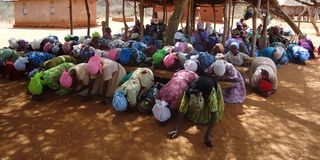
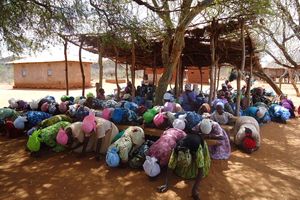
We move to the shed, where the lighting is better and a group of invited congregants is waiting.
Pastor Ndithya, dressed in a sharp blue suit, is joined by several men. Three women arrive in long, pleated dresses, their heads covered in scarves that leave no hair exposed.
Kavonokya preacher Mulyungi Ndithya during an interview with the Daily Nation at Mutanda Village in Kitui County on November 5, 2026.
Photo credit: Pius Maundu | Nation Media Group
There is a clear order on sitting arrangement: men on one side, women on the other. Mixing is strictly prohibited, we are told.
Then, one of the women breaks into song. With no musical instruments for accompaniment, her voice fills the shed, drawing the others into an unpolished but spirited harmony. The singing soon gives way to dancing.
It is an introduction to a religious community whose practices have often attracted curiosity, criticism and, in some cases, misunderstanding.
The church's original name, members tell us, is Kanisa La Wokovu (Church of Salvation). But its unconventional practices and the way these are perceived by the wider community have earned it another name: Kavonokya, a Kamba corruption of a word associated with being saved.
The name first came with stories that were difficult to believe. A former teacher and businessman, Daniel Munyali, recalls hearing tales about adherents praying on top of trees and jumping around during worship. At the time, he was a member of the African Inland Church (AIC), and the stories piqued his curiosity.
“I wondered [how] they were doing that and not falling… I went to confirm and I found it was not that way,” Mr Munyali told the Daily Nation.
His encounter, however, revealed a different side of the congregation, particularly its strong sense of community and equality. He says members share what they have, with everyone treated equally, including during meals.
“When people eat, everyone is served and treated equally,” he says.
The exact number of the membership is hard to tell. But the church is commonly found in the areas of Kitui and Tharaka Nithi counties. It has a number of strict teachings touching on healthcare, politics, marriage and the place of women in society.
Pastor Ndithya is quick to take issue with the name, which he considers derogatory.
“People call us Kavonokya here. It is a lowly name. But the only reason why people are against us is because we do not take medicine. But I do take medicine in the form of prayer,” says Mr Ndithya.
He traces the teaching on healing to the Bible, particularly Mark 16:17, which speaks of the signs that would accompany believers, including laying hands on the sick. But he insists that members are not necessarily forbidden from seeking conventional medical treatment.
“Everyone is allowed to take their type of medicine. In our church, if you want to take western medicine, we do not stop you. But you do it while away from the congregation. And when you want to come back, you will have to seek permission from church elders and they will decide to let you in or not,” says Mr Ndithya.
This belief has shaped some of the most important moments of life for some of the congregants as Gloria Musyoka says. She has delivered all her seven children at home, with assistance from fellow women in the church.
Kavonokya adherent Gloria Musyoka during an interview with the Daily Nation at Mutanda Village in Kitui County on November 5, 2026.
Photo credit: Pius Maundu | Nation Media Group
“I decided to join the church so that after my days on earth are done, I see eternal life. When I got my children, I did not go to hospital, I was just assisted by my fellow women,” explains Ms Musyoka.
Yet, she says, her beliefs do not prevent her from visiting friends and neighbours admitted to hospital, where she prays with them.
On questions surrounding access to government services, Pastor Ndithya disputes claims that members do not acquire national identity cards. He produces his own, but says he does not have Social Health Authority (SHA) cover.
“I do not have SHA. My SHA is prayers,” he says.
Politics is another area where the church draws a firm line. Members, he explains, do not participate in elections, preferring prayer and fasting to choosing political leaders.
Whenever an election approaches, he says, the congregation dedicates a full week to fasting and prayer.
“If three people that I know are going for a seat, if I choose one, then I will not have been fair,” says Mr Ndithya.
The church's rules also extend to its internal leadership, where women have limited roles. They cannot preach from the pulpit or occupy leadership positions, although they can share religious teachings among themselves.
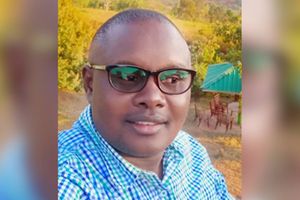
Kavonokya adherent Makau Mang'ara during an interview with the Daily Nation at Mutanda Village in Kitui County on November 5, 2026.
Photo credit: Pius Maundu | Nation Media Group
“God created man, and gave him the power to rule. A woman came from him so there is no way a woman will lead here. Even if she has queries, she cannot ask them and she needs to go to the husband and ask him the queries and she will get answers,” says Mr Ndithya.
The rules are equally visible in how women dress. Ms Musyoka says members are expected to keep their heads covered, wear long dresses reaching the ankles and avoid plaiting their hair, although washing it is permitted.
“There are those who will be convicted for wearing clothes not meant to be worn in church. How do women wear trousers that are meant for men? That is against the word. Colour on their nails [is another redline],” says Ms Musyoka.
The congregation is also opposed to family planning, which members consider contrary to God's will.
“This family planning is just immoral. Let me ask if Kenyatta engaged in it, would we have Uhuru? If Moi did, would we have Gideon?” she argues.
As our visit comes to an end, the congregants bid us farewell with a parting appeal: to live according to the word and avoid sin.
Mr Makau Mang'ara, whose father was the first preacher of the church in the area, leaves us with a reminder about fidelity and personal conduct.
“If you are saved, you will not go out to cheat or jump from one woman to the other yet you are married. When you go, remember that,” he says.