A recent High Court decision in Mombasa has once again thrust into the spotlight a question that has long troubled Kenyan courts: when does a relationship become a marriage, and can a marriage be treated as having ended even without a formal divorce?
The case concerned the estate of businessman Prem Lal Ramnath, who died in November 2019 leaving behind assets worth more than Sh200 million.
The succession dispute pitted Ms R.B against Ms A.G and her children, Mr V.L and Ms Y.G.
Ms R.B produced a marriage certificate showing that she married Ramnath in 1999 at the Registrar’s Office in Mombasa and later petitioned for letters of administration as his widow.
Her claim was challenged by Ms A.G and her children, who argued that she remained Ramnath’s lawful wife because their Hindu marriage had never been dissolved. They further alleged that the marriage certificate describing Ramnath as a bachelor had been fraudulently obtained.
Evidence before the court, however, painted a different picture.
Mr V.L admitted during cross-examination that his parents had not lived together from 1999 until Ramnath’s death in 2019. Ms A.G testified that she relocated to Canada in 2001 and only returned once before Ramnath died.
The court heard that Ramnath lived with Ms R.B until his death and that she cared for him during his illness, including donating a kidney to him in 2012.
A temple chairman testified that the pair were regarded as husband and wife, while a representative of a hospital in India confirmed that Ms R.B had been recorded as Ramnath’s wife during treatment.
The judge ultimately declined to revoke the grant of representation issued to Ms R.B, finding that she was Ramnath’s wife.
In reaching that conclusion, the court observed that Ramnath and Ms A.G had effectively lived separate lives for many years, while Ms R.B remained by his side.
“There was not much of a marriage” between Ramnath and Ms A.G at the time of his death, the court stated.
The court went further and held that this was one of the rare instances where it could presume that a divorce had occurred despite the absence of a formal decree.
Contentious battles over alimony and property are often fueled by unhealed emotional wounds and personality clashes rather than legal necessity.
Photo credit: Photo | Photo
The decision highlights an emerging legal issue, which is whether, in exceptional circumstances, a court can recognise that a marriage has effectively come to an end even where no formal divorce proceedings were undertaken.
The ruling also comes against the backdrop of growing judicial scrutiny over claims of presumed marriage, an area of law that has evolved significantly in recent years.
For decades, Kenyan courts frequently encountered disputes involving couples who had lived together for years, raised children, acquired property and presented themselves to society as husband and wife, only for one party to later deny that a marriage existed.
The common assumption was that prolonged cohabitation and public recognition as a couple could be enough for a court to presume the existence of a marriage.
Courts, however, have repeatedly cautioned that cohabitation alone does not create a marriage.
A person seeking to rely on the doctrine of presumption of marriage must demonstrate more than merely living together. The court must be satisfied that the parties intended to marry and were generally regarded by the public as husband and wife.
In a 2021 decision, CWN v DK, High Court judge Jairus Ngaah explained that a marriage may be presumed where there is evidence that the parties intended to marry and even underwent a marriage ceremony conducted by a duly ordained clergyman, despite the absence of formal documentation.
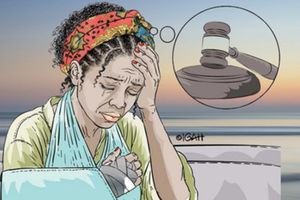
Court rules that living apart can mean divorce.
Photo credit: Shutterstock
Earlier, in a 2009 decision, the Court of Appeal held that prolonged cohabitation could, in appropriate circumstances, crystallise into a marriage.
The appellate court observed that a long cohabitation was not merely friendship and that, where circumstances justified it, a court could safely presume the existence of a marriage.
But the law took a decisive turn in 2023 when the Supreme Court delivered its landmark judgment in MNK v POM.
The apex court noted that disputes involving cohabiting couples had increasingly become a social reality as more people chose to live together outside marriage while acquiring property jointly.
The judges acknowledged the challenge of resolving such disputes. The court observed that a hands-off approach could lead to injustice, particularly where one party was economically vulnerable or contributed less financially to the relationship.
At the same time, the court warned that an overly interventionist approach risked creating uncertainty and forcing courts to place monetary values on personal relationships.
The Supreme Court was emphatic that courts should not automatically assume that two people sharing a home are married.
The judges noted that modern society has seen a rise in interdependent relationships outside marriage and that many adults deliberately choose to cohabit without intending to enter into a marital union.
“In addition, in our ever-changing society, current statistics reveal that a man and a woman can choose to cohabit with the express intention that their cohabitation does not constitute a marriage,” the court observed.
The dispute before the Supreme Court involved a claim by POM against MNK over property acquired during their relationship.
The High Court dismissed the claim in 2017, finding that although the parties had cohabited for a long time, the doctrine of presumption of marriage could not apply because MNK was already married to another woman, identified as KM.
The Court of Appeal overturned that decision, holding that the existence of KM had not been proved and presuming that MNK and POM were married. It consequently ordered an equal division of the disputed property.
Deputy Chief Justice Philomena Mwilu, who presided the bench, stressed that long cohabitation and public reputation alone were insufficient to establish a marriage.
“To conclude on this issue, we find that the circumstances in which presumption of marriage can be upheld are limited. In other words, a presumption of marriage is the exception rather than the rule,” the court said.
The judges held that marriage is a voluntary union and that courts should not impose one on people who never intended to enter into it.
The court consequently set out the requirements that must generally be met before a marriage can be presumed.
The parties must have cohabited for a long period, possessed the legal capacity to marry, intended to marry, consented to the union and held themselves out to the public as husband and wife.
The Supreme Court also added that the doctrine of presumption of marriage is “on its deathbed” and should only be invoked sparingly where there is cogent evidence supporting it.
At the same time, the judges recognised that marriage continues to carry profound religious, cultural, social and economic significance for many Kenyans.
Yet they acknowledged that a growing number of adults choose long-term cohabitation without any intention of marrying.
“This court recognizes that there exist relationships where couples cohabit with no intention whatsoever of contracting a marriage,” the judges said.
The court added that where there is clear evidence that parties did not intend to marry, a presumption of marriage should never arise.
The Mombasa succession dispute demonstrates how complicated these questions can become. While the Supreme Court has made it harder for courts to presume the existence of a marriage from cohabitation alone, the recent ruling shows that judges may still be called upon to determine the true nature of relationships where formal legal documents do not tell the whole story.
Courts place greater emphasis on the intentions, conduct and circumstances of the parties than on the mere length of time they lived together. Long cohabitation is not automatically a marriage, just as separation is not automatically a divorce. But in exceptional cases, courts may still look beyond formalities to determine the reality of a relationship.