Court rejects Waititu’s bid to strike down law barring convicts from office for 10 years
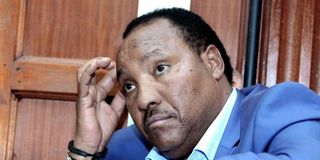
Former Kiambu governor Ferdinand Waititu.

What you need to know:
- Ferdinand Waititu and the other petitioners sought the court’s intervention to quash the law, which is anchored in the national values and principles of governance.
- The provision disqualifies a person convicted of corruption or an economic crime from being elected or appointed to public office for 10 years after conviction.
Former Kiambu Governor Ferdinand Waititu, who is serving a 12-year jail term over corruption, has suffered yet another blow after the High Court declined to declare unconstitutional the law barring people convicted of corruption or economic crimes from holding public office for 10 years.
In a landmark judgment, Justice Enock Chacha Mwita said Waititu and other petitioners “failed to demonstrate why that law should be declared unconstitutional.”
Justice Mwita, who has since been elevated to the Court of Appeal, said the petitioners did not meet the legal threshold to warrant Section 64 of the Anti-Corruption and Economic Crimes Act being “declared unconstitutional.”


In the petition, Waititu and the other petitioners sought the court’s intervention to quash the law, which is anchored in the national values and principles of governance.
The judge ruled that Section 64 of the Anti-Corruption and Economic Crimes Act was enacted to enforce Chapter Six of the Constitution.
The provision disqualifies a person convicted of corruption or an economic crime from being elected or appointed to public office for 10 years after conviction.
The judge found that the petitioners had failed to demonstrate why the court should exercise its unfettered jurisdiction in their favour.
“The petitioners did not demonstrate why the section is unlawful,” the judge observed.

Former Kiambu County Governor Ferdinand Waititu at Milimani Law Court on February 13, 2025
Waititu, the second petitioner, joined the others in challenging the legality of the sentences imposed on them following their convictions in the Sh588 million corruption case at Milimani in 2019.
The petition also challenged the alternative prison terms imposed alongside the fines, with the petitioners arguing that the sentences exceeded the limits prescribed under Section 28(2) of the Penal Code.
The case stems from a Sh588 million corruption conviction involving the irregular award of a tender to Testimony Enterprises Limited for the construction of roads in Kiambu County during Waititu’s tenure.
Waititu was fined Sh53.5 million or sentenced to 12 years in prison.
Former Kiambu roads chief officer Luka Mwangi Wahinya, the third petitioner, was fined Sh21 million or sentenced to seven years in prison, while businessman Charles Chege Mbuthia, a director of Testimony Enterprises Limited, was fined Sh295 million or sentenced to nine years in prison.
The petitioners argued that the alternative prison terms exceeded the statutory limits and resulted in unlawful imprisonment, raising constitutional concerns beyond their individual cases.
However, Justice Mwita found that the petitioners had not demonstrated that Section 28(2) of the Penal Code applied to their circumstances, noting that they had been prosecuted and convicted under the Anti-Corruption and Economic Crimes Act.
Section 28(2) of the Penal Code limits the prison term for failure to pay a fine to a maximum of 12 months for fines exceeding Sh50, 000, unless another law provides otherwise.
The judge also noted that appeals against the convictions and sentences had been filed at the time and had since been dismissed, with the sentences upheld.
The judge further observed that the constitutionality of Section 64 of the Anti-Corruption and Economic Crimes Act could best be addressed by the appellate court when handling appeals arising from the convictions.
“The appellate court was well placed to address the issues, including whether Section 28(2) of the Penal Code was applicable but was overlooked during sentencing,” the judge stated.
“The jurisdiction of this court is not a substitute for the appellate jurisdiction,” he added.
The court also found that the petitioners had not established a specific constitutional violation attributable to the Director of Public Prosecutions (DPP), who was named as the respondent.

Former Kiambu County Governor Ferdinand Waititu is being escorted to a Milimani Law Court on February 13, 2025.
The judge observed that the petition had failed to demonstrate that the DPP was responsible for the alleged violations of the Constitution, the law or the petitioners’ fundamental rights and freedoms.
Their appeals against the convictions and sentences have also since been dismissed in the anti-corruption court.
In dismissing their appeals, Anti-Corruption High Court Judge Rose Ougo said the magistrate’s court had properly applied the law when it sentenced Waititu, his wife, Susan Wangari, Chege and Mwangi.
Justice Ougo also reinstated the charges and convicted the accused of money laundering and receiving proceeds of crime.
Waititu and the three others will appear before an anti-corruption court magistrate on October 27, 2026, for mitigation and sentencing on the counts of money laundering and receiving proceeds of crime.
Waititu was convicted of corruptly receiving a Sh25 million bribe from Testimony Enterprises Limited while knowing that it was proceeds of crime.
Follow our WhatsApp channel for breaking news updates and more stories like this.