Waititu's sentencing for money laundering pushed to Thursday
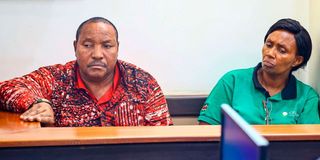
Former Kiambu County Governor Ferdinand Waititu (left) and wife Susan Wangari Ndung’u at the Milimani Law Court on February 13, 2025, before they were sentenced in a Sh588 million corruption case.

What you need to know:
- On Monday, the court decline a request by Susan Wangari to be released on cash bail pending mitigation and sentencing.
- Last week, High Court judge Rose Ougo overturned the acquittals of Wangari and two co-accused on money laundering charges.
The sentencing of former Kiambu Governor Ferdinand Waititu, his wife Susan Wangari and two co-accused over money laundering has been postponed to Thursday after one of the convicts was not produced in court as ordered.
Waititu, Wangari, former Kiambu County chief officer for roads, transport, public works and utilities Luka Mwangi Wahinya, and businessman Charles Mbuthia Chege were directed by the High Court last week to appear before the Milimani Anti-Corruption Court for mitigation and sentencing after their acquittals on money laundering charges were overturned.
However, Chege, the proprietor of Testimony Enterprises Ltd, whose company received road tenders and allegedly paid kickbacks to Waititu, was not brought to court, forcing the proceedings to be postponed.


Anti-Corruption Chief Magistrate Harrison Barasa ordered that the former governor, who is serving a 12-year prison term for corruption, be produced in court on October 21, 2026, alongside his co-convicts for mitigation and sentencing.
“Your honour, one of the serving prisoners, Charles Chege Mbuthia, has not been produced from Kamiti Maximum Prison and, therefore, it is not possible for today’s proceedings to continue,” the prosecution told the court.
During Monday’s proceedings, Wangari applied to be released on cash bail pending mitigation and sentencing. The court declined the request and ordered that she remain at Lang’ata Women’s Prison pending further proceedings.
Last week, High Court judge Rose Ougo overturned the acquittals of Wangari and two co-accused on money laundering charges, ruling that the trial court had misapprehended both the facts and the law.
“Accordingly, the Court sets aside the acquittals on Counts 10, 11, and 12 and convicts the Appellants and the 2nd Respondent on all money laundering counts as charged,” Justice Ougo ruled.
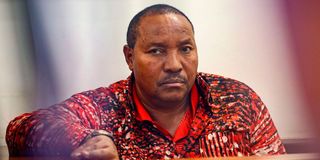
Former Kiambu County Governor Ferdinand Waititu at the Milimani Law Court on February 13, 2025, before he was jailed for 12 years in a Sh588 million corruption case.
The judge dismissed appeals by Waititu, Chege and Wahinya, upholding their convictions over the irregular procurement of road works in Kiambu County.
The court found that the prosecution had proved the convicts’ involvement in the fraudulent award of a multi-million-shilling road contract.
Waititu was convicted of corruptly receiving Sh25 million from Testimony Enterprises Ltd, which had been awarded a Sh588 million contract by the county government.
In allowing the State’s cross-appeal, Justice Ougo ruled that the prosecution had traced funds from the irregular tender through entities associated with the accused, while the defence had failed to provide credible documentation to rebut the evidence.
“The evidence demonstrates a classic pattern of placing, layering, and integrating illicit funds through corporate entities and asset acquisitions,” the judge said.
The judge also upheld the fines and custodial sentences imposed by the trial court, ruling that the mandatory fines under the Anti-Corruption and Economic Crimes Act were lawful and could not be reduced by reference to the general sentencing provisions of the Penal Code.
“The fines imposed by the court under the Anti-Corruption and Economic Crimes Act, being mandatory fines, were properly imposed,” she ruled.
Waititu had challenged the fines and prison terms, arguing that the default imprisonment terms were unlawful. His co-convicts also contested the computation and legality of their penalties.
However, Justice Ougo said an appellate court could interfere with a sentence only in specific circumstances, including where it was illegal, based on erroneous legal principles or manifestly excessive or inadequate.
Follow our WhatsApp channel for breaking news updates and more stories like this.