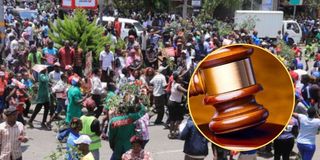
The government has been given 90 days to develop regulations governing public demonstrations, picketing and the use of force, in line with the Constitution.
The High Court in Kisumu ruled that regulations on public order management would provide certainty on how citizens exercise their rights under Article 37 and offer clear guidelines to the National Police Service (NPS) under Article 244 of the Constitution.
“A structural interdict to issue in respect thereof to confirm compliance. The Bill of Rights are not an inspiration; they are a vested right that is to be exercised and enjoyed by the citizens of this Country within the parameters of the law,” said the court.
The directive arose from a petition filed by 28 relatives and victims of police brutality during demonstrations by Azimio supporters in Kisumu and surrounding areas between March and July 2023.
The High Court has given the government 90 days to develop regulations governing public demonstrations, picketing and the use of force, in line with the Constitution.
Photo credit: File | Nation
The court ruled that there was sufficient evidence that the petitioners were victims of police brutality. Nine victims were shot dead or succumbed to their injuries days later. Evidence presented in court showed that some were dragged from their homes and beaten to death by police officers.
Other victims were carrying out their daily activities and were not part of the demonstrations when police officers allegedly accosted, assaulted and left them for dead.
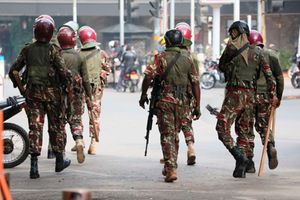
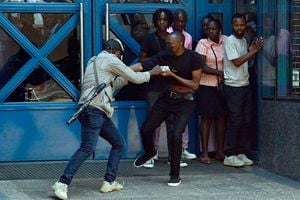
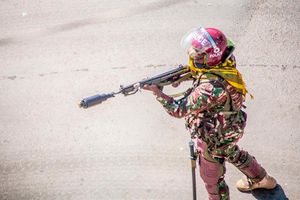
The victims told the court that police used lethal force, including firearms and batons, against them. They further submitted that during operations in Nyalenda, Obunga, Manyatta, Kondele, Ahero, Migori and other parts of Kisumu, police used excessive force against both protesters and non-protesters, despite neither group posing a threat to officers.
They also alleged that police illegally broke into homes in Nyalenda, Obunga and Manyatta, dragged men outside and brutalised them in violation of Articles 31 and 50 of the Constitution.
Further, the petitioners said victims were shot and maimed, while children were killed in violation of their constitutional rights.
The court awarded compensation ranging from Sh300,000 to Sh4.8 million, totalling Sh38 million, for deaths and injuries suffered.
It also directed the Independent Policing Oversight Authority (IPOA) to conduct prompt, thorough and impartial investigations into the circumstances under which the victims or their relatives died or were injured at the hands of police officers, within 90 days.
“It is not lost on this Court that most of our public institutions were of colonial heritage. That those institutions were modelled against public interest. In the post 2010 Constitution, the curriculum, policies and spirit of those institutions that were created immediately after 1963 would run afoul of the Constitution,” the court noted.
The court also questioned the National Police Service training curriculum and its approach to maintaining public order in relation to Article 37 of the Constitution.
“The level of violence meted out to the petitioners in this case gives credence to doubts as to the existence of a set of rules and regulations to govern public order in light of Article 37 of the Constitution,” said the court.
The judge concluded that police used excessive force against demonstrators in Kisumu and Migori, including the use of lethal weapons that violated the petitioners' rights.
The court further noted that overall operational command of the NPS rests with Inspector-General of Police Douglas Kanja.
“His total hold and control of the service is reinforced by the provisions of section 10 of the National Police Service Act, which sets out a plethora of the functions and powers of that office. They are so detailed as to leave no room whatsoever for speculation as to who is in charge and control of the Service,” said the court.
The court also said that IPOA could not escape accountability for taking ages to conclude the investigations.
“While it is not liable for the brutal acts of the NPS officers, it delayed investigations and its recalcitrant behaviour cannot be left to go unchecked. It must be made to account for its existence,” said the court.