A proposal by the Independent Policing Oversight Authority (IPOA) to deploy drones, body-worn cameras and other digital surveillance tools to monitor police conduct during public protests has ignited a heated national debate, exposing deep anxieties over police brutality, public accountability, privacy rights and the State’s preparedness ahead of the 2027 General Election.
The proposal emerges at a time when the National Police Service is facing sustained criticism over allegations of excessive force, delayed emergency response, enforced disappearances and weak evidence collection during demonstrations and security operations.
Police officers have in recent years repeatedly been accused by human rights groups and the public of using brutal force during youth-led anti-government protests that shook the country, particularly the Gen Z-led anti-finance bill demonstrations in 2024.
IPOA believes technology could become one of the strongest tools in restoring accountability within law enforcement while independently documenting what happens during volatile public protests.
According to IPOA Director of Inspections, Monitoring and Preventive Services Munene Mugambi, the authority is exploring the use of drones, body cameras and digital monitoring systems to track police conduct during demonstrations and public order operations as the country inches closer to another highly charged election cycle.
“We want to deploy technology in monitoring police officers. However, it is not just about fault finding,” Mr Mugambi said. “We will use the devices in also recognising officers who conduct themselves professionally during operations, based on clear evidence. Devices like drones can not only help detect misconduct, but also document and commend good policing practices.”
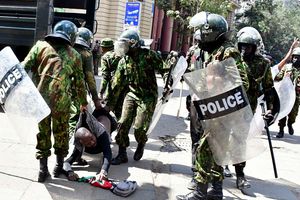
Police officers arrest a protester on Kenyatta Avenue in Nairobi during anti-Finance Bill protests on June 27, 2024.
Photo credit: Bonface Bogita | Nation Media Group
The proposal has quickly gained traction within Parliament, with a section of lawmakers backing the move and urging IPOA to strengthen its oversight mechanisms before the 2027 elections.
During a recent meeting with IPOA officials, members of the National Assembly Departmental Committee on Administration and National Security, chaired by Narok West MP Gabriel Tongoyo, supported the use of technology in policing oversight, arguing that modern tools could provide an independent record of police actions during demonstrations.
“We support the use of technology including body cameras to monitor police conduct during public demonstrations. However, we need to know how you intend to deploy the technologies,” Mr Tongoyo said.
The committee nevertheless warned that Kenya’s political history suggests the next election period could once again trigger heightened tensions, public unrest and confrontations between demonstrators and security officers.
Nakuru Woman Representative Liza Chelule urged IPOA to carry out a comprehensive risk assessment before the polls, saying oversight systems must be prepared for both pre-election and post-election volatility.
“We support the use of technology in oversight, but IPOA must conduct a proper assessment and understand the risks involved, before and after the 2027 polls, to inform preparations,” she said. “This is the best way IPOA can prepare itself.”
But while the proposal has been welcomed by some policymakers and accountability advocates, it has also triggered wider questions over surveillance, operational feasibility and whether technology alone can solve the country’s policing crisis.
IPOA Commissioner Annette Mudola Mbogo said drones would likely be deployed selectively, particularly during planned demonstrations and organised public order situations where aerial surveillance can help preserve evidence and reconstruct events.
“In cases where events are planned, drones can provide effective monitoring,” Ms Mbogo said. “However, we must develop a clear framework that addresses data protection and surveillance concerns.”
She said the authority is also considering the use of body-worn cameras, CCTV systems and digital recording tools within police stations as part of wider reforms aimed at strengthening transparency and protecting evidence from manipulation.
“These technologies will make it more difficult to manipulate evidence and improve the integrity of investigations,” she explained.
The proposal comes as IPOA itself faces mounting pressure over its capacity to investigate police misconduct efficiently amid a growing backlog of complaints and increasing public demand for accountability.
In February this year, the authority disclosed that 3,988 police officers are currently under investigation for alleged misconduct, yet only 47 officers have so far been convicted.
Face mask vendor Boniface Kariuki is rushed to hospital by protesters after he was shot by a police officer in Nairobi on June 17, 2025.
Photo credit: Billy Ogada | Nation Media Group
Those cases involve deaths, serious injuries, sexual offences and other alleged human rights violations. Two of the convictions were linked to the June 2024 Gen Z-led anti-finance bill protests.
“We have 3,988 officers under investigations for police excesses,” Mr Mugambi revealed at the time. “Out of these, we have secured convictions against 47 officers across thirty-three case files involving deaths, serious injuries, sexual offences, and other human rights violations.”
He said many of the accused officers had once operated with near-total impunity under the protection of institutional power.
“Some of those involved were once untouchable police officers who wore a badge of authority, promising to uphold the law and protect citizens, but now some have been convicted and others face the consequences of unlawful force,” he said.
The figures paint a stark picture of the scale of complaints facing the country’s police service, particularly after years of accusations involving extrajudicial killings, enforced disappearances and brutality in informal settlements and during anti-government demonstrations.
Mr Mugambi acknowledged that investigations often take months because they involve witness interviews, forensic analysis, internal reviews and coordination with the Office of the Director of Public Prosecutions.
“The investigations cover a wide range of offences, including deaths, serious injuries, sexual offences, and other human rights violations,” he said. “The investigations are time-consuming, involving the collection of statements, internal review, and referral to the Office of the Director of Public Prosecutions.”
However, IPOA says its work continues to be constrained by funding shortages, staffing gaps and rising public complaints.
The authority has now requested Parliament to allocate it a Sh100 million confidential budget to support sensitive investigations involving rogue officers.
Appearing before the National Assembly Departmental Committee on Administration and Internal Security during discussions on the 2026/27 budget, IPOA Vice-Chairperson Anne Wanjiku said the funds would support covert operations, surveillance and investigations into complex cases such as enforced disappearances, torture allegations and extrajudicial killings.
“It is against this background that IPOA seeks consideration by the National Assembly for enhanced budgetary allocation toward confidential funds to strengthen the Authority’s operational effectiveness and responsiveness,” Ms Wanjiku told MPs.
According to IPOA, the authority had requested Sh238 million in the Budget Policy Statement for its operations but received only Sh136 million in the printed estimates, leaving a deficit of Sh102 million.
Officials warned that the funding shortfall threatens efforts to clear nearly 1,000 backlog investigations and prosecute hundreds of pending court cases involving police misconduct.
The authority’s Deputy Director of Legal Services, Festus Kinoti, told lawmakers that IPOA is currently managing more than 3,600 investigation files while simultaneously handling 314 active court cases across the country.
“We have a backlog of 3,600 cases for investigation. We hope to finalize 971 cases and also undertake another 1,450 investigations,” Mr Kinoti said.
Some lawmakers questioned whether increased allocations alone would improve accountability outcomes.
Mandera East MP Hussein Weytan challenged IPOA officials to explain what measurable impact additional funding would have on backlog reduction, prosecutions and public confidence in police oversight.
IPOA officials attributed the delays to growing complaints, limited personnel and years of underfunding.
Ms Wanjiku said the authority has since introduced reforms aimed at reducing case congestion, including an Alternative Dispute Resolution policy to handle minor complaints such as police inaction.
“We were treating all cases equally, but with the new Standard Operating Procedures, we can now prioritise public interest matters and fast-track urgent complaints,” she said.
The debate surrounding IPOA’s proposed use of drones and surveillance equipment has divided security experts and political leaders.
Security expert David Ngugi argued that while the idea is sound in principle, the cost of acquiring advanced technology may become a major obstacle.
“It is a good idea, but technology is expensive,” he said. “For instance, a drone costs between Sh3 million to Sh4 million. Acquiring the devices may be very expensive.”
Security analyst John Opondo said the country risks overemphasising technology while ignoring deeper structural problems within the police service.
“More focus should be turned to quality of policing, for instance the change of police attitude and behaviour,” Mr Opondo said. “Police should be trained on how to better manage protests.”
Teso North MP Oku Kaunya also questioned whether drones would be effective in spontaneous incidents such as violent attacks by criminal gangs or chaotic street confrontations.
“In cases of organised criminal activity drones can be deployed effectively to identify what is happening,” he said. “But in isolated incidents, such as goon attacks, by the time you deploy a drone, the damage has already been done.”
He warned that deployment of surveillance technology must remain intelligence-led and based on credible risk assessments.
Homa Bay Town MP Peter Kaluma, meanwhile, raised concerns that constant monitoring of police officers during operations could unintentionally create hesitation in situations requiring decisive action.
“We must balance human rights with necessary police intervention to save the State,” Mr Kaluma said. “If officers feel constantly watched, we risk creating police lethargy in situations where action is required.”
The push for technology reflects growing frustration with repeated allegations of abuse by security officers and the slow pace of justice for victims.
Since its establishment in 2011, IPOA has investigated complaints involving unlawful killings, torture, sexual misconduct and abuse of power by police officers. Some of its investigations have led to landmark convictions.
In February this year, the High Court sitting in Mombasa sentenced former Likoni OCS Yunus Athman to life imprisonment for the 2018 murder of 20-year-old Mbaraka Maitha Omar in Likoni.
Justice Wendy Kagendo Micheni found that the officer fatally shot the victim while attempting to arrest him over allegations of goat theft.
In another case, two officers from Mbururu Police Station in Kakamega were jailed for 35 years after they were found guilty of torturing and killing Dennis Lusava during the enforcement of COVID-19 regulations in 2020.
Witnesses told the court that Lusava was brutally assaulted while in custody after being arrested for allegedly failing to wear a face mask. IPOA investigations helped secure the convictions.
Other cases include the conviction of former Ruaraka OCS Nahashon Mutua for the murder of Martin Koome in police custody, and the conviction of police constable Titus Ngamau Musila, alias “Katitu”, over the killing of Kenneth Kimani in Githurai.