When Nigerian billionaire Aliko Dangote sought to establish a cement factory in Kitui, the investment promised to transform the county’s limestone-rich hills into an industrial powerhouse. But the project never materialised, leaving residents waiting for jobs and economic opportunities from their mineral wealth.
More than a decade later, another industrial giant is making progress in the same area. Devki Group, owned by billionaire Narendra Raval, is investing billions of shillings in a clinker plant in Ngaaie, Mwingi North, even as unresolved questions over land and compensation continue to shape the project’s history.
The industrial group, led by billionaire Narendra Raval, is developing a clinker plant through its National Cement Company subsidiary near the county’s limestone deposits.
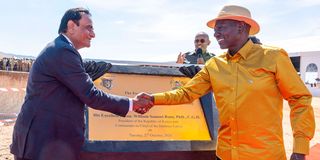
President William Ruto presided over a groundbreaking ceremony for the project on Tuesday, October 27, 2026, marking a major step towards establishing Kitui as a centre for cement production.
The investment is about more than cement. It is a test of whether Kenya can turn its mineral wealth into jobs while creating conditions that allow large investors to establish industries without being frustrated by bureaucratic hurdles, land disputes or demands for improper payments.
The project is already changing life in Kanana, near Ngaaie Hills, where construction has attracted workers and traders to an area previously characterised by limited commercial activity.
President William Ruto (left) and Dr Narendra Raval during the groundbreaking ceremony for the Sh70 billion Devki Group cement and clinker manufacturing plant in Ngaaie, Mwingi North Constituency, Kitui County, on Tuesday, October 27, 2026. Looking on is Blue Economy CS Ali Hassan Joho (Centre).
President William Ruto has seized on the investment to make a wider case for industrialisation, arguing that Kenya must protect investors from bureaucratic hurdles, brokers and demands for bribes or shares if it is to create jobs.
The developments have renewed hopes that Kitui’s limestone deposits can finally support large-scale manufacturing. But the history of earlier proposals shows that securing investment is only part of the challenge: land arrangements, community interests and compensation must also be addressed.
In September, Raval said about 2,600 people were working at the site, with the number expected to exceed 4,000 at the peak of construction. Once the plant is operational, it is expected to employ between 3,000 and 3,200 people permanently, with most of the jobs going to local residents.
For the surrounding communities, the economic benefits are already visible in the demand for food, transport, housing and other services. The longer-term promise lies in permanent jobs and the wider commercial activity that a major factory could support.
Raval has presented industrialisation as one way of addressing unemployment among young people graduating from colleges and universities.
“We talk about GenZ but this is the only way for them to work. We have to put them in the job. They are graduating, there are no jobs and jobs will not come if we don’t do industrialization in the country,” he said in an earlier interview with Kenya Broadcasting Corporation.
The Devki project comes as Ruto seeks to show that his administration can create a more predictable environment for major investors.
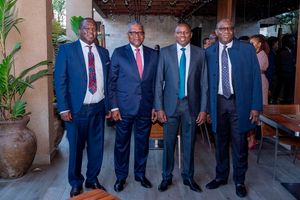
From left CEO Mamlaka Foods Kiprop Chirchir, Nigerian billionaire Aliko Dangote, Kimani Ichungwa and Nigeria Ekiti State Governor Kayode Fayemi at a Nairobi hotel on September 13, 2022, before they left for Kasarani stadium for President William Ruto’s inauguration ceremony.
Photo credit: Vincent Chepkwony
During a media engagement in Mombasa on October 1, the President revisited Dangote’s failed attempt to establish a cement factory in Kitui, alleging that the businessman had been subjected to demands for shares and other conditions under the previous administration.
“Aliko Dangote angefanya hii kazi miaka sita iliyopita lakini akapewa masharti ya kutoa shares,” Ruto said.
Ruto subsequently announced that another investor was ready to establish a cement factory worth Sh33 billion in Kitui. He said he planned to visit the county in November to launch construction, although he did not disclose the investor’s identity or the proposed plant’s production capacity.
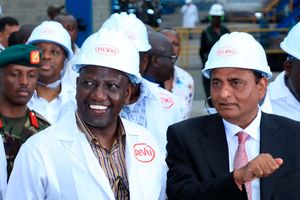
President William Ruto with Devki Group boss Narendra Raval.
Photo credit: File | Nation Media Group
Ruto’s broader argument is that investors should not be left to navigate complicated land arrangements and other requirements without government support.
“If you tell an investor to go and look for land, and he does not know the owners of the land, we will lose him,” he said.
On October 26, the President renewed his warning against brokers, cartels and people accused of demanding bribes or shares from investors. His position is that Kenya must offer businesses a predictable environment if it wants to attract capital and expand manufacturing.
Dangote’s failed bid has become a central part of that argument. However, the allegations about demands made of the Nigerian businessman should be distinguished from the financial and land-related difficulties that affected other cement proposals in Kitui.
The history of the Ngaaie project shows why land acquisition and compensation have been as important as the availability of limestone.
In 2014, Athi River Mining (ARM) announced plans to invest in a cement factory and limestone mining operation in the area. The project was initially valued at about Sh25 billion, with reports indicating that roughly 250 households would have to relocate. Later reports put the proposed investment at about $400 million, then estimated at Sh34.4 billion.
The plans triggered opposition from some residents, who questioned how the land had been identified and whether the community had been adequately consulted.
In October 2014, residents organised under Ngaaie Focus Community Based Organisation threatened legal action and demanded disclosure of transactions and minutes of meetings between ARM and the county government. They also raised concerns about the relocation of families and compensation.
The dispute reflected a fundamental problem: while investors needed land for large-scale mining and manufacturing, residents wanted transparency over agreements affecting their homes, property and livelihoods.
Compensation later became a major point of contention. A Kenya Human Rights Commission report documented a dispute between ARM and communities in Ngaaie and Twi Muma over land and graves. The company required ownership documents to assess land claims, while residents said much of the land was communally occupied and lacked individual title deeds. The resulting disagreements centred on land valuation, compensation and the treatment of affected households.
President William Ruto (right) and Narendra Raval, Executive Chairman of the Devki Group of Companies, during the commissioning of the Sh11 billion Devki Iron Ore Pelletisation Plant at Manga in Taita-Taveta County on December 3, 2024.
Photo credit: PCS
Devki’s entry did not immediately resolve the compensation question. On May 2024 reports suggested that plans for Devki to establish a cement factory in Mwingi were threatened by protests from residents who said they had not been compensated for land and related claims.
The dispute involved 19 claims concerning compensation for graves and other developments on acquired land. Residents threatened demonstrations and legal action unless the outstanding issues were addressed. Devki had acquired ARM in 2020, inheriting a project whose land arrangements had already generated controversy.
This is a critical part of the story. Devki’s progress has followed an earlier investment’s failure to take off, but the transfer of the business did not automatically settle all questions raised by affected residents.
The land issue is not simply about whether an investor can obtain a site. It is also about establishing who has legitimate interests in the land, how those interests are assessed and whether people affected by the project receive fair compensation.
These concerns should not be taken as evidence that Devki has faced the same allegations Ruto has made about Dangote’s proposed investment. The cases involve different circumstances. But together, they illustrate the need for clear land arrangements and transparent engagement between investors, government and local communities.
After years of stalled proposals, Ngaaie is showing signs of an industrial future. The challenge now is to ensure that the factory is completed, the promised jobs are delivered and the land disputes of the past do not overshadow the benefits of the investment.