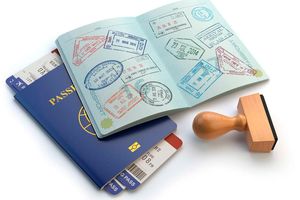
Starting October 12, 2025, travellers to the European Union (EU) will have their travel document data and personal information registered electronically, instead of manual passport stamps.
Under the new EU travel rules, non-EU travellers will be required to provide fingerprints and a facial image at the border point under the Entry/Exit System (EES), replacing manual stamping, starting in October 2025 with full implementation by April 2026. The European Commission has stressed that data collection will include personal information, passport details, entry and exit locations, and stay durations.
So how will it affect you? Kenyans, or Africans, will continue applying for the Schengen Visa, applicable to most EU countries who have agreed on a common external border.
As usual, you must submit a completed application form, a valid passport issued within the last 10 years and with at least two blank pages, and two recent passport-sized photos.
Applicants are also required to provide proof of sufficient financial means, such as bank statements, a travel medical insurance policy with coverage of at least approximately Sh4.5 million (€30,000, $35,000), a round-trip flight itinerary, proof of accommodation, and a cover letter explaining the purpose of travel.
Additionally, depending on individual circumstances, extra documents may be needed, such as an employment contract, proof of enrollment, or a letter of invitation.
Before you travel, ensure your passport is biometric – EES requires chip-enabled passports that can store digital fingerprints and facial data.
Upon arrival, you will have to provide your personal data. Passport control officers will scan your fingerprints or take a photo of your face. This information will be recorded in a digital file.
3. Longer wait times at entry point
This implies that travellers could wait for longer hours at the port of entry while this is being processed. However, this process could be quicker if you register some of your data in advance, preferably making an application via your mobile, if made available by the country of arrival or departure.
Travellers from some non-EU countries, starting 2026, will need an ETIAS visa waiver, which requires a separate application.
ETIAS, or the European Travel Information and Authorisation System, is a new digital travel authorisation for visa-exempt nationals who intend to travel to European Union countries for short-term stays.
These include Austria, Belgium, Bulgaria, Croatia, Cyprus, and Czechia, as well as Denmark, Estonia, Finland, France, Germany, and Greece. Others are Hungary, Iceland, Italy, Latvia, Liechtenstein, Lithuania, and Luxembourg. The requirement also applies to Malta, the Netherlands, Norway, Poland, Portugal, and Romania, along with Slovakia, Slovenia, Spain, Sweden, and Switzerland.
It functions similarly to a visa waiver system, with applications submitted online and linked to your passport.
ETIAS requires an online application, has a fee for most applicants, though some are exempt, and is valid for three years or until the passport expires.
It will cost $25, though some exemptions apply. Applicants who are under 18 or above 70 years of age are exempt from this payment.
As is tradition, airlines will refuse passengers without valid visas or valid ETIAS. This means the airlines will demand this information before check-in.
When the ETIAS starts in late 2026, Kenyans will need to apply for a travel authorisation online before travelling to the Schengen Area.
By digitally tracking entries and exits, authorities can quickly identify overstays and individuals using fraudulent documents. And so it will be important to track your stay duration carefully. Overstaying beyond the 90-day Schengen limit could lead to deportation and re-entry bans or fines.
It is also important that as a traveler, you familiarise yourself with self-service kiosks, as many airports and major entry points will rely on automated stations for biometric scanning.
As the EU moves forward with its digital transformation of travel, one thing is clear: the era of paper passports and manual stamping is rapidly coming to an end.