Two companies linked to the late businessman Francis Mburu have moved to court seeking to stop the Ethics and Anti-Corruption Commission (EACC) from recovering Sh1.5 billion paid to them as compensation for land occupied by two public schools in Ruaraka.
Afrison Export Import Limited and Huelands Limited want the High Court to bar the anti-graft agency from commencing recovery proceedings until an appeal they have filed at the Supreme Court is determined.
The EACC is demanding nearly Sh2.5 billion from 25 individuals and companies, including former CS Fred Matiang’i, Immigration PS Belio Kipsang and companies linked to Mr Mburu’s family.
The EACC wants to recover payments to private firms for 13.77 acres in Ruaraka that the government already owned.
The Ethics and Anti-Corruption Commission (EACC) has written demand letters to the 25, seeking restitution totaling Sh1.5 billion with annual interest of 12 per cent from January, 2018 when the monies were paid to Whispering Palms Estate Ltd.
Former National Land Commission (NLC) chairperson Muhammad Swazuri and other commissioners at the time, Tom Konyimbih and Emma Muthoni Njogu have also been served with similar demands for restitution of the funds.
Whispering Palms Estate Ltd, Afrison Import Ltd and Huelands Ltd and their directors Mark Mungai Mburu, Justin Sam Mburu have also been served.
Champion Kenya Ltd, Meshack Onyango Dihay, Hezekiah Wilfred Muchae Kabue (Lands ministry), Charles Kagema (NLC), Zacharia Ndege (NLC), Josiah Oindo (NLC), Salome Ludenyi Munubi (NLC), John Mwangi Mwaniki (Lands ministry), Geoffrey Kingora Mwangi (NLC) and Francis Karimi Mugo (NLC) have also been served with restitution letters.
Other State employees at the time also served with restitution demands are Rose Muema (Acting County Secretary, Nairobi), Patrick Thoithi Kanyuira (Attorney-General’s office), Peter Ouma Adipo (Lands ministry), Sospeter Oduor Ohanya (NLC) and Judy Gitau (Nairobi County).
Afrison Export Import Limited and Huelands Limited, through co-director Mark Mburu, say in their High Court case that the EACC acted prematurely by demanding a refund of the Sh1.5 billion, together with interest, before the Supreme Court has concluded the matter.
Mr Mburu said in court papers that the EACC, in a letter dated July 6, demanded repayment of the money, warning that it would institute recovery proceedings if the companies failed to comply.
He said the Supreme Court matter is scheduled for mention on August 14 and argued that the EACC's move risks prejudicing the pending appeal.
“The respondent’s decision is premature, unreasonable, irrational and contrary to the principles of fair administrative action, as it seeks to enforce legal consequences arising from a judgment that remains the subject of active appellate proceedings,” he said.
The companies lodged an appeal at the Supreme Court challenging the Court of Appeal decision, which upheld the compensation is irregular, arguing that the judges failed to properly consider their evidence on ownership of the land and the historical circumstances surrounding the dispute.
They contend that the appellate court erred by failing to distinguish between lawful planning controls and compulsory acquisition of private property.
According to the companies, the court effectively treated planning approval as a mechanism through which private property could be transferred for public use without following the constitutional safeguards governing compulsory acquisition.
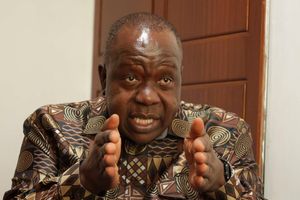
Businessman Francis Mburu. Mr Mburu was paid Sh1.5 billion for the contested Ruaraka land on which two schools stand.
Photo credit: File | Nation
They further argue that the Court of Appeal failed to uphold constitutional protections on private property and security of title.
The companies maintain that there was no loss of public funds and want the National Land Commission (NLC) to pay them the balance of Sh1.769 billion that had been approved as compensation.
The dispute centres on about 13.5 acres occupied by Drive-In Primary School and Ruaraka High School.
In a judgment last month, the Court of Appeal upheld an earlier decision finding that the compulsory acquisition of the land and payment of Sh1.5 billion to Mburu in 2017 were unlawful.
A three-judge bench found that the purported acquisition had no legal basis and declared the payment illegal, null and void.
“Consequently, the payment of Sh1.5 billion to the appellants was illegal, null, and void. It was money paid under a mistake both in law and fact,” the judges ruled.
The court found that the land had been surrendered for public use in 1984 and that the companies could not return more than three decades later to demand compensation.
The judges noted that the two schools had been established on the land in 1984 and 1987 and that the companies had stood by while the institutions operated for decades.
“The establishment of the schools in 1984 and 1987, the allotment letter of 28th June 1999, and the acceptance of that allotment by one of the schools, all point to the appellants' ease with the surrender,” the court said.
Evidence before the court showed that the land was registered in the names of Afrison Export Import Ltd and Huelands Ltd, which said they had purchased it from Joreth Limited in December 1981.
Mr Mburu had told the court that he later borrowed Sh21 million from Continental Credit Finance Limited to finance the construction of 500 maisonettes for the then Kenya Posts and Telecommunications Corporation.
Drive-Inn Primary School in Ruaraka, Nairobi. The land on which the school sits is a subject of controversy.
Photo credit: File | Nation
The property was used as security for the loan, but KPTC later took over the construction project.
In 1988, after KPTC failed to complete the project, the corporation entered into an agreement allowing the Office of the President to purchase 196 completed maisonettes. The houses were subsequently occupied by General Service Unit officers.
Mburu claimed that although the housing units occupied a separately surveyed 7.5-acre parcel, the GSU fenced off about 37.5 acres.
He also claimed that Drive-In Primary School and Ruaraka High School were relocated to their current site in 1989 while he was negotiating with the GSU over its occupation of the land.
The NLC on its part maintained that it lawfully commenced the compulsory acquisition process after Mburu sought compensation and it established that the schools stood on privately owned land.
The commission said it completed the required legal procedures before the Ministry of Education wrote to the National Treasury on July 18, 2017, seeking funds to compensate the owners.
The NLC subsequently approved payment of Sh1.5 billion to Mburu, who appointed Whispering Palms Estate Limited as his agent to receive the first tranche.
Former Education Principal Secretary Belio Kipsang, now Immigration PS, told the court that the ministry first became aware of the compensation claim through a September 13, 2016 letter from the NLC.
The letter stated that Mburu's companies, the registered owners of LR No. 7869/4, had complained that the two schools had occupied part of their land for more than 30 years without compensation.
Then-Education CS Fred Matiang’i (left) and Principal Secretary Belio Kipsang at a media briefing.
Photo credit: File | Nation Media Group
Dr Kipsang said the ministry relied on the NLC's advice in processing the acquisition and maintained that the companies had valid ownership documents and that due diligence had been conducted.
The EACC disputed this position, presenting evidence that the land had been voluntarily surrendered for public use.
The commission said that after approval of a subdivision scheme, the Director of City Planning wrote to the Commissioner of Lands on February 20, 1984, asking that portions reserved for public purposes be transferred to the then Nairobi City Commission for development.
Four days later, Mburu, then managing director of Drive-In Estate Developers Limited, confirmed that he had no objection to surrendering the land, provided the Nairobi City Commission guaranteed that the schools would be developed without delay.
The Director of City Planning gave the guarantee on February 29, 1984.
The Court of Appeal found the correspondence supported the conclusion that the land had been voluntarily surrendered and that the subsequent compensation claim had no legal foundation.
The EACC has opposed the companies' latest case before the High Court, arguing that the issues raised in the Supreme Court appeal seek to have the apex court re-evaluate evidence on whether the land was surrendered as a condition for approval of the subdivision scheme in 1982.
“Having made concurrent findings of fact on that issue, the petition of appeal seeks to invite this court to re-evaluate the evidence and interfere with those findings, contrary to its appellate jurisdiction,” the EACC said.
The commission also argued that the companies' appeal is based on the erroneous assumption that a finding of surrender amounts to a finding of compulsory acquisition without compensation.
According to the EACC, surrender and compulsory acquisition are distinct legal concepts recognised under the Constitution and the law.
The companies, however, maintain that allowing the EACC to recover the money before the Supreme Court determines their appeal would effectively enforce the Court of Appeal judgment and could render their appeal nugatory.